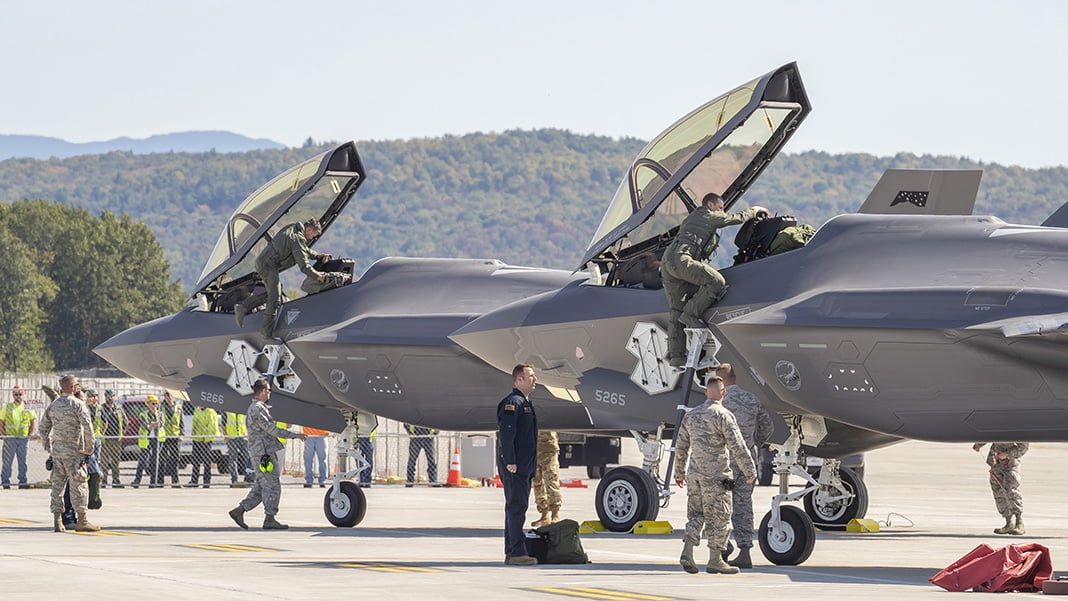
Romania has taken a bold step in enhancing its national defense by approving the acquisition of 32 F-35A Lightning II stealth fighter jets from the United States. The draft law, which is seen as the most substantial investment in the history of the Romanian Armed Forces, marks a pivotal moment for the nation’s military capabilities. This deal not only signifies a substantial financial commitment, estimated at $7.2 billion, but also strategically positions Romania as a critical player on NATO's eastern flank.
The F-35A jets are renowned for their cutting-edge stealth technology, making them one of the most advanced fighter aircraft in the world. Equipped with an advanced stealth design that minimizes radar cross-section, these planes can operate undetected in hostile environments. The F-35A also boasts state-of-the-art avionics and a sensor fusion system that provides pilots with an unprecedented situational awareness, integrating data from multiple sources to ensure superiority in complex combat scenarios. Powered by the F135 engine from Pratt & Whitney, the jets deliver unmatched performance in terms of speed and agility, making them a formidable asset for any air force.
The Romanian government has outlined a phased plan for the procurement, with the initial batch of jets expected to be delivered by 2030. This first phase will eventually lead to the purchase of 16 additional aircraft, raising Romania's total F-35 fleet to 48. By doing so, Romania aims to replace its current fleet of F-16 fighter jets gradually, many of which were acquired secondhand from Portugal and more recently from Norway. These F-16s are expected to remain operational until at least 2040 as Romania transitions to a fully F-35-equipped air force.
The geopolitical backdrop of this deal cannot be overlooked. With tensions still simmering following Russia’s invasion of Ukraine, Romania’s investment in the F-35 is not just about acquiring superior military technology but also strengthening its strategic posture. The acquisition will significantly boost Romania's air defense and improve interoperability with other NATO forces, a critical aspect as the alliance fortifies its eastern borders against potential threats from Russia.
Funding for this ambitious purchase will come through a combination of state budget allocations, loans, and loan guarantees from the U.S. government, reflecting the close military ties between Bucharest and Washington. As part of the deal, Romania will also benefit from related support systems, including secure communications, navigation equipment, training simulators, and advanced electronic warfare capabilities. Additionally, Romanian military personnel will receive comprehensive training on the operation and maintenance of the aircraft.
The broader implications of this acquisition extend to Romania’s role in regional security and its commitment to NATO's collective defense. Once fully operational, Romania's F-35s will join a growing fleet of these fifth-generation jets across Europe, with countries like Poland and the Czech Republic also investing heavily in similar aircraft. This shared investment in advanced airpower underscores the importance of unity among NATO members in facing common threats.
By choosing the F-35, Romania is not just buying a new aircraft; it is investing in a defense ecosystem that includes high-tech weaponry and secure network-centric warfare capabilities, poised to keep pace with the evolving nature of global conflict. This strategic upgrade comes at a time when the need for advanced defense systems has never been more apparent. Romania’s commitment to bolstering its military infrastructure with state-of-the-art technology sends a strong message to both its allies and adversaries in a rapidly shifting geopolitical landscape.
As a result, Romania's move could serve as a blueprint for other NATO members aiming to modernize their defense forces, ensuring a collective approach to security in a region that remains under the shadow of conflict and unpredictability.
——— End of Article ———