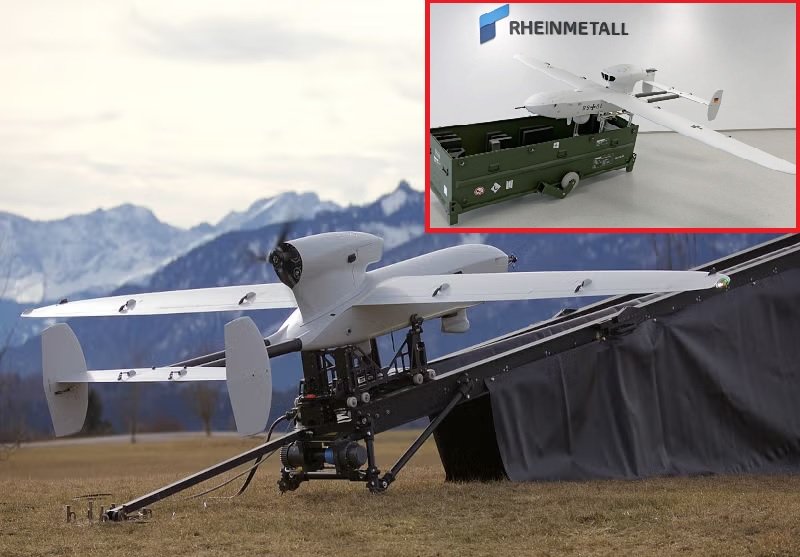
DUSSELDORF, — Rheinmetall’s LUNA NG unmanned reconnaissance system has received provisional airworthiness certification from the Bundeswehr Aviation Authority (LufABw), moving the system closer to full type certification.
Provisional Airworthiness Certification
The provisional certificate allows the LUNA NG to operate in regular restricted airspace under aviation test procedures. This removes the previous limitation of operating only in dedicated military areas and supports flight operations over densely populated European territory while meeting civil aviation safety standards.
Mike Schmidt, CEO of Rheinmetall’s Air Unmanned Space business unit, said the certification process follows the same standards used for large aircraft such as the A320. He said critical systems, including the autopilot and safety-critical navigation systems, had to be developed and certified in-house because certified systems for tactical unmanned aircraft are not available on the market.
Flight Testing and Pilot Training
The LUNA NG has completed around 150 flights, accumulating approximately 200 flight hours under civil operating licences.
The first Bundeswehr pilots and verifiers have also completed training on the system. The provisional certification allows these qualified personnel to conduct independent flights for training and testing.
LUNA NG Specifications
The Bundeswehr is introducing the system under the designation HUSAR (Highly Efficient Unmanned System for Medium-Range Reconnaissance). It is designed for sustained airborne reconnaissance, object classification and real-time detection.
Key specifications include:
- Endurance: More than 12 hours
- Data-link range: More than 100 km
- Coverage: More than 30,000 km²
- Maximum operating altitude: Above 5,000 m
- Maximum take-off weight: 110 kg
- Reconnaissance speed: 90 km/h
- Maximum speed: 130 km/h
- Wingspan: 5.34 m
- Length: 3.17 m
- Height: 0.73 m
- Payload: Up to around 30 kg
- Engine: Heavy-fuel Wankel rotary engine
The aircraft uses a carbon-fibre-reinforced plastic (CFRP) structure and has low acoustic, thermal and radar signatures.
Sensors and Runway-Independent Operation
The LUNA NG has a modular payload architecture supporting electro-optical, infrared, acoustic and spectrum-analysis sensors. Rheinmetall also lists options for communications relay, tactical satellite communications and AI-supported data evaluation.
The aircraft can be launched by catapult without a runway and recovered autonomously using differential GPS with either a net or parachute.
Bundeswehr HUSAR Order
The current Bundeswehr order covers 12 standard systems plus one pilot/training system, including spare parts and training support. The contract was valued at around €200 million net.
Each complete system typically consists of:
- Five air vehicles
- Two ground control stations
- Two launcher vehicles
- Two antenna masts
- Workshop equipment
- Transport platforms
Deliveries were planned to begin in 2025, with the complete order scheduled through 2028. The systems are intended for the German Army’s reconnaissance and artillery units.
Integration into Military Networks
Earlier in 2026, the LUNA NG participated in Bundeswehr tests of reconnaissance and strike networks at the Army Combat Training Centre. The system was integrated with the Command & Control Unmanned Management System (C2-UMS Bw) and operated alongside other unmanned systems.
Rheinmetall said the LUNA NG has demonstrated its ability to operate within the Bundeswehr’s reconnaissance and operational network, including real-time interaction with other unmanned systems.
The company said the majority of the required certification criteria have already been met. Rheinmetall is continuing work with the aviation authorities toward full type certification and broader operational use of the LUNA NG.
——— End of Article ———