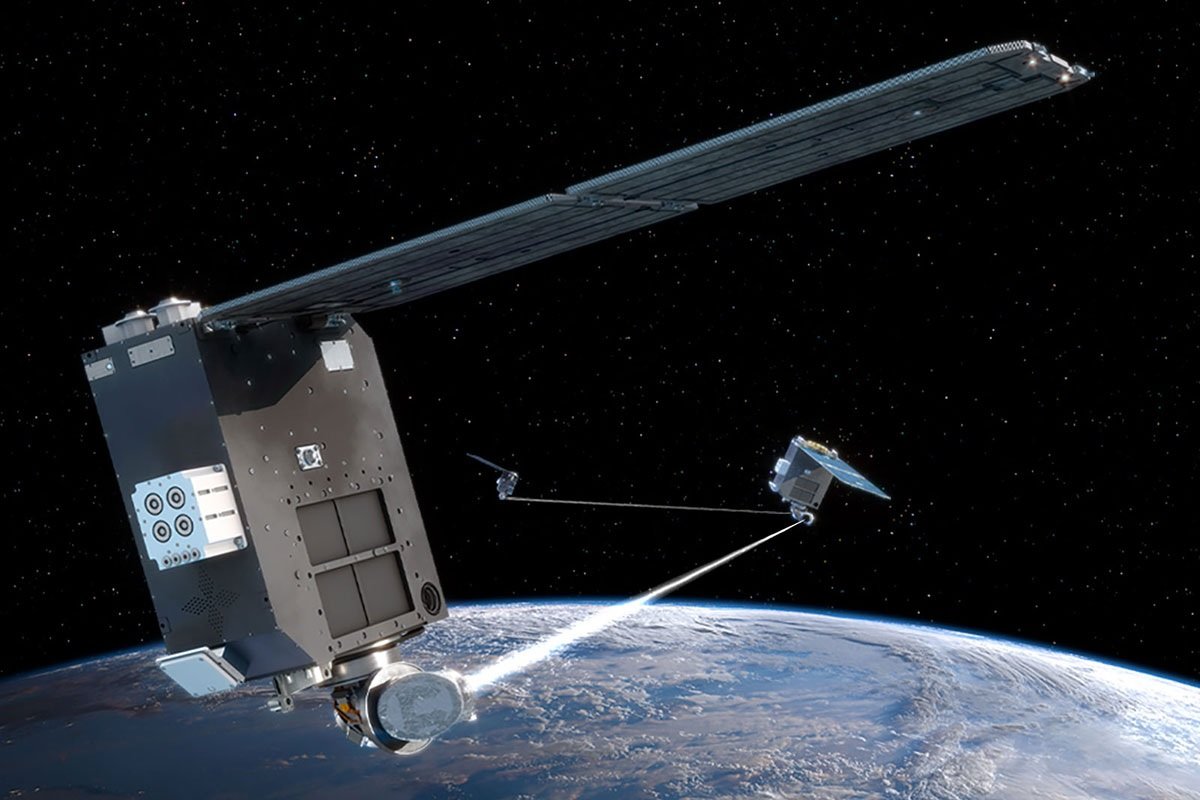
Defense News ,U.S :- The anticipated launch of a national security space mission, USSF-124, slated for December 2023, has encountered a setback, pushing the timeline to the second quarter of 2024. The Missile Defense Agency (MDA) confirmed the delay, attributing it to technical challenges faced by one of the spacecraft vendors during final integration testing.
Mark Wright, spokesperson for MDA, revealed that despite one vendor readiness for a December launch, complications arose, necessitating a postponement until no earlier than the second quarter of fiscal year 2024. USSF-124 comprises six satellites dedicated to tracking hypersonic missiles. Among them, four are missile-tracking sensors by L3Harris for the Space Development Agency Tracking Layer constellation, while the remaining two, one from L3Harris and the other from Northrop Grumman, are part of MDA Hypersonic and Ballistic Tracking Space Sensor (HBTSS) program.
The Tracking Layer, designed as a global sensor network, aims to establish a defense shield against Russian and Chinese ballistic and hypersonic missiles. The Space Development Agency satellites focus on tracking hypersonic threats, while HBTSS employs sensors to maintain accurate threat tracks. It transfers this data to interceptor missiles, attempting to neutralize the threats, forming part of a comprehensive, multi-layered missile defense architecture.
Notably, both the Tracking Layer and HBTSS are integral to demonstrating the fire control technology necessary for intercepting hypersonic weapons. In a strategic move for efficiency, SDA and MDA opted to combine their payloads. Originally scheduled for a September launch with other SDA satellites, the four L3Harris Transport Layer satellites were removed from the manifest due to production delays.
The specific HBTSS payload encountering technical issues remains undisclosed by MDA. However, sources close to SDA suggest that any delay is unrelated to the L3Harris Tracking Layer satellites. The planned launch of USSF-124 involves deploying the satellites into low orbit using a SpaceX Falcon 9 rocket from Cape Canaveral Space Force Base, Fla.
Against the backdrop of these developments, congressional defense committees are pressing the Pentagon for clarity on the roles of MDA and SDA in missile tracking. Representative Doug Lamborn, chairman of the House Armed Services strategic forces subcommittee, emphasizes the critical importance of hypersonic defense to national security. Some lawmakers advocate for SDA taking over the mission entirely, citing its rapid development capabilities, while others argue for MDA retaining authority due to its extensive experience in tracking ballistic missiles.
The reporting structure, with MDA under the undersecretary of defense for research and engineering and SDA reporting to the U.S. Space Force chief of space operations, raises questions about their collaboration. Congressional monitoring may focus on the implications of this structure for efficiency and efficacy, as highlighted by defense analyst Kelley Sayler in a Congressional Research Service report earlier in the year.
——— End of Article ———