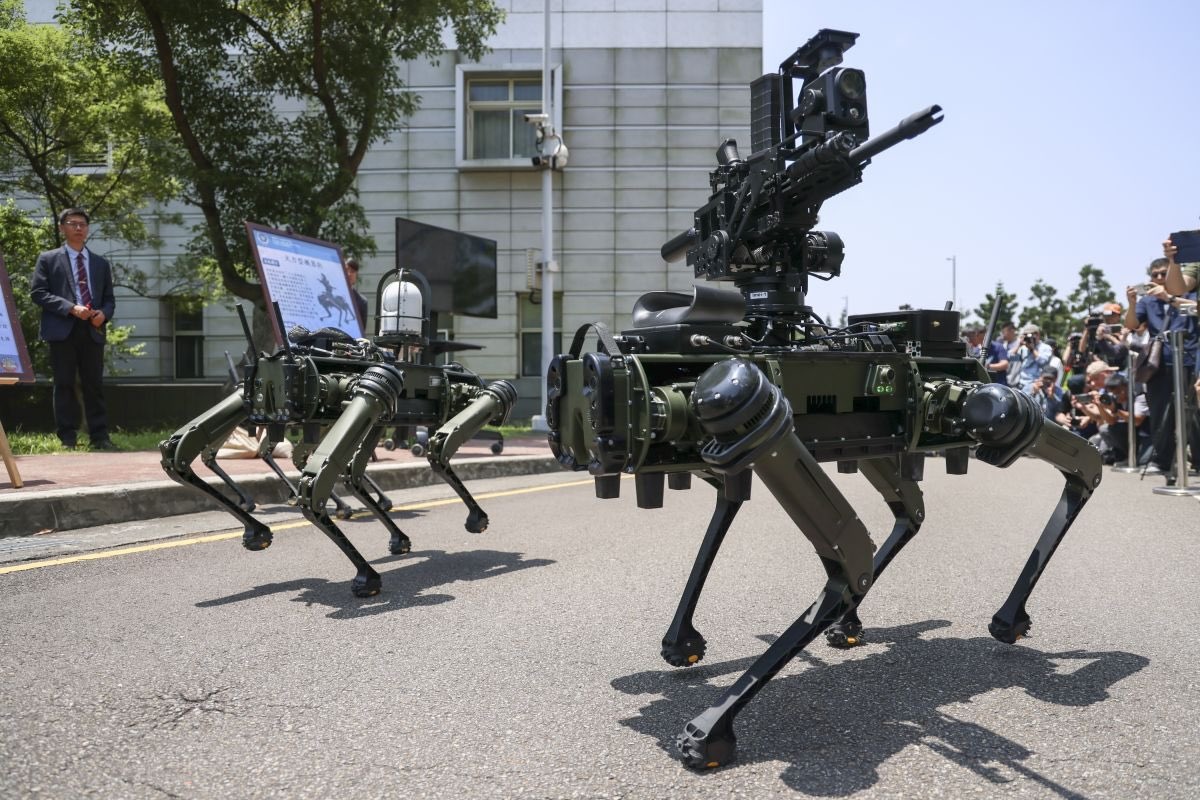
TAIPEI — June 03, 2026 : Taiwan’s National Chung-Shan Institute of Science and Technology (NCSIST) has publicly unveiled three military robotic dog variants designed for reconnaissance, patrol, surveillance, and combat-support missions, as part of the island’s broader effort to expand autonomous defense capabilities amid growing regional security concerns.
The systems, unveiled on June 2, 2026, are intended to operate in high-risk environments while reducing the exposure of military personnel to frontline threats. Developed using the Vision 60 quadruped platform manufactured by US-based Ghost Robotics, the robotic dogs have been modified by NCSIST with domestically developed reconnaissance sensors, surveillance systems, and weapon integration technologies tailored to Taiwan’s operational requirements.
According to NCSIST, the decision to build the systems on an established US-developed platform is intended to accelerate deployment and maintain a reliable non-Chinese supply chain for autonomous military technologies.
Platform Specifications and Operational Design
The robotic dogs are based on the Vision 60 quadruped system, which is engineered to operate in austere and physically demanding environments. The platform includes self-righting capabilities and three degrees of freedom in each leg, allowing it to move across uneven terrain, stairways, steep slopes, muddy areas, and wet conditions, including heavy rain.
The platform weighs 52.4 kilograms and can carry payloads of up to 10 kilograms. It is capable of reaching speeds of 2.5 meters per second, or approximately 9 kilometers per hour, and can operate continuously for between eight and ten hours on a single charge. NCSIST stated that the system is designed to function in extreme environmental conditions, with an operational temperature range between minus 40 degrees Celsius and 55 degrees Celsius.
Three Military Variants Developed by NCSIST
To support different mission requirements, NCSIST has integrated proprietary Taiwanese-developed systems into the base platform to produce three operational variants for military use.
Autonomous Patrol and Security Variant
The first configuration is designed for autonomous patrol, facility security, and surveillance missions. Equipped with a 32-line three-dimensional LiDAR system and thermal imaging sensors, the robotic dog is capable of autonomous navigation, obstacle avoidance, heat-source detection, and real-time environmental mapping.
Officials stated that the system is intended to support base security operations and nighttime monitoring of sensitive military facilities and critical infrastructure. The LiDAR system enables the platform to generate detailed three-dimensional spatial maps while moving independently through complex environments.
Intelligence, Surveillance, and Reconnaissance (ISR) Variant
The second configuration focuses on intelligence gathering and battlefield reconnaissance. Equipped with an in-house electro-optical reconnaissance payload, the ISR variant is designed to search for, identify, and track targets while transmitting real-time information to military operators and command centers.
The robotic platform can zoom in on suspected targets and relay operational data to a smart command-and-control system, allowing commanders to maintain battlefield awareness without deploying personnel into potentially dangerous operational zones. Taiwanese defense planners view such systems as useful tools for reducing risks during surveillance and reconnaissance missions.
Armed Combat and Fire Support Variant
The third variant combines reconnaissance capabilities with offensive functions and represents the most combat-oriented version of the robotic dog platform.
The system incorporates a domestically developed remote-controlled weapon station mounted on its back and was demonstrated carrying a riot gun intended for crowd-dispersal and defensive operations. The platform uses artificial intelligence-enabled multi-target recognition technology capable of identifying, tracking, and locking onto moving threats.
According to NCSIST, the combat version is intended to support military fire-support missions, urban defense operations, and the protection of critical facilities where unmanned systems can supplement frontline personnel.
Focus on Remote Offshore Defense
A major operational driver behind the robotic dog program is Taiwan’s requirement to strengthen monitoring and security capabilities across remote offshore territories in the South China Sea.
Jen Kuo-kuang, deputy director of NCSIST’s Missile and Rocket Systems Research Division, stated that Taiwan’s Coast Guard and Marine Corps have identified a requirement to monitor coastlines on the Pratas (Dongsha) Islands and Spratly (Nansha) Islands, including the strategically significant outpost of Itu Aba.
Taiwanese authorities have observed increasing Chinese coast guard patrols and drone activity near these sensitive outposts. Officials believe robotic systems could provide persistent surveillance and monitoring while reducing the need for personnel to remain stationed in exposed coastal positions for extended periods.
The robotic dogs could also support deterrence and security operations in sparsely populated areas where maintaining permanent human patrols is operationally challenging.
Future Integration into Multi-Domain Networks
NCSIST stated that the robotic systems are designed to communicate with one another and exchange targeting and operational data in real time. Future development efforts will focus on integrating the robotic dogs with uncrewed aerial vehicles (UAVs) and unmanned surface vessels (USVs) to establish a coordinated multi-domain combat network.
The institute said the objective is to create a three-dimensional operational system capable of sharing intelligence and battlefield information across land, maritime, and aerial domains to improve situational awareness and operational coordination.
Although the robotic dog systems remain in the demonstration and prototyping phase, the unveiling marks an important step in Taiwan’s effort to expand unmanned military capabilities and strengthen defense resilience through automation and advanced battlefield technologies.
Taiwan has increasingly invested in unmanned systems, including drones, autonomous maritime platforms, and artificial intelligence-enabled technologies, as part of its wider defense modernization strategy. Defense analysts note that quadruped robotic systems are increasingly being tested globally for reconnaissance, security patrols, logistics support, and combat-assistance missions in complex operational environments.
——— End of Article ———