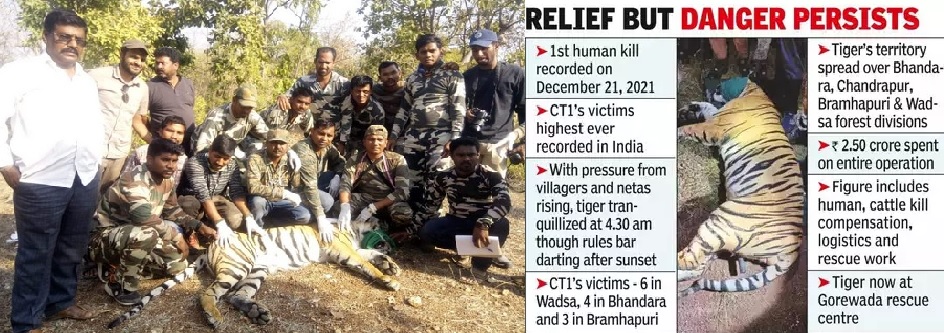
Defense News ,India :- In the Chandrapur and Gadchiroli districts of Maharashtra, there's growing worry about clashes between people and tigers. Forest officials have taken action, claiming to have caught 62 troublesome tigers in the past ten years.
As more land disappears and humans move into tiger territory, it's becoming urgent to protect these big cats. The Tadoba Andhari Tiger Reserve's quick-response team, made up of 15 members, has a tough job: catching tigers that pose a threat to humans.
Over the last decade, they've used tranquilizers to capture 62 'conflict' tigers, including 35 males and 27 females. In 2023 alone, they caught 4 tigers in Gadchiroli and 8 in Chandrapur, along with 8 leopards. Currently, they're searching for the G-18 Tiger in Gadchiroli, using 70 camera traps to help.
Fatal tiger attacks have terrified local villagers. A recent incident in Gadchiroli saw a tiger kill a 55-year-old woman, Mangalabai Vitthal Bole, and another attack on January 7 claimed the life of Sushma Devidas Mandal in Aheri tehsil.
Speaking to ANI, Dr. Ravikant Khobragade, a vet at Tadoba-Andhari Tiger Reserve, revealed their efforts in capturing 'man-eater' tigers and leopards. Despite orders to shoot some animals, they safely caught and sent them to the zoo.
The team is also involved in radio collaring elephants and microchipping tigers, leopards, and wild dogs. Dr. Khobragade stressed the importance of understanding tiger behavior before capturing them. Equipped with modern technology and specialized vehicles, the team uses drones, night vision binoculars, ambulances, and hydraulic cages.
Capturing tigers is a patient process. Dr. Khobragade highlighted the challenges, including the lack of vehicle access in forests and the difficulty of reaching targets. Ajay Marathe, a shooter in the team, mentioned the pressure from the public during rescues and the importance of maintaining the team's morale.
The team believes that incidents of human-wildlife conflict are rising and calls for a strategic approach to increase the tiger population. Their goal is to protect both the forest ecosystem and local communities, emphasizing the need to address these issues simultaneously.
——— End of Article ———