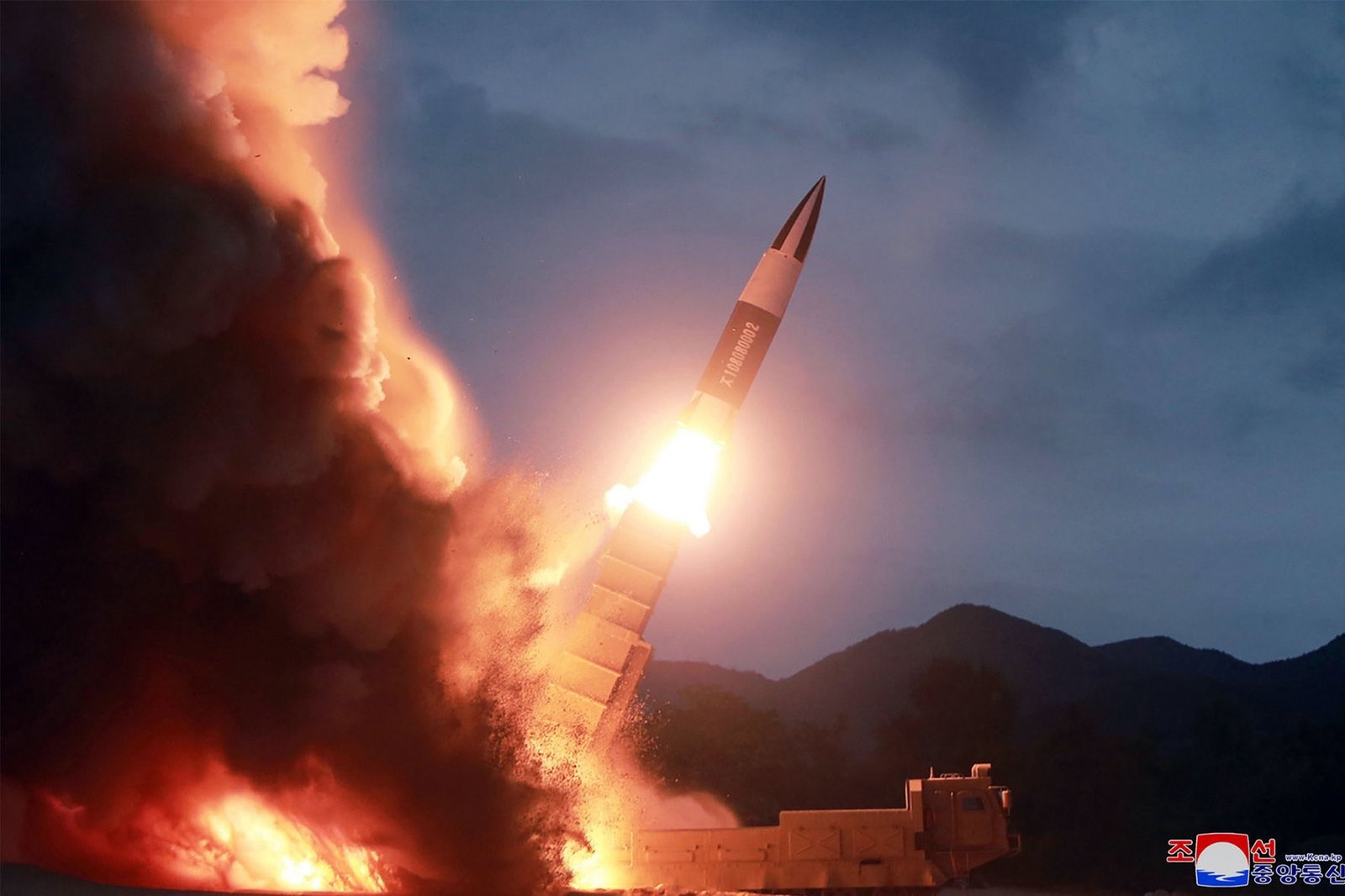
SEOUL — North Korea launched a ballistic missile from the Wonsan area toward the East Sea, also known as the Sea of Japan, early Wednesday, according to South Korea and Japan. The launch came less than a week before the start of the annual Ulchi Freedom Shield military exercises between South Korea and the United States.
South Korea’s Joint Chiefs of Staff said the missile was launched at around 6 a.m. local time from the Wonsan area on North Korea’s eastern coast. South Korean authorities said it traveled more than 700 kilometers, while Japan’s Defense Ministry estimated the distance at about 690 kilometers and the maximum altitude at around 90 kilometers.
Japanese authorities said the missile landed outside Japan’s exclusive economic zone, and there were no reports of damage to aircraft or ships.
Missile Type Still Under Analysis
South Korea’s Joint Chiefs of Staff has not yet identified the exact type of missile. Officials said a detailed analysis is being carried out by South Korean and U.S. authorities.
The reported flight distance falls within the range generally associated with short-range ballistic missiles, but Seoul has not officially classified Wednesday’s weapon as an SRBM. Analysts have therefore left open several possibilities regarding the missile’s identity.
Hong Min, a senior researcher at the Korea Institute for National Unification in Seoul, said the missile’s range, trajectory and launch location could indicate a hypersonic-type weapon, while a submarine-launched missile was also considered a possibility. These remain assessments rather than an official identification of the weapon.
Second Launch From Wonsan in Less Than a Week
Wednesday’s launch was the second ballistic missile firing from the Wonsan area in less than a week.
South Korean authorities said North Korea launched another ballistic missile from the same area on August 6. That missile reportedly traveled about 300 kilometers. North Korean state media did not report the August 6 launch. Hong Min said the earlier test may not have achieved its intended objective, although North Korea has not publicly confirmed the reason for not reporting it.
South Korean assessments indicate that Wednesday’s launch was North Korea’s 11th suspected ballistic missile test of 2026. The country’s missile testing this year has included short-range ballistic missiles, artillery rockets and other tactical weapons.
Launch Comes Before Ulchi Freedom Shield
The missile launch took place five days before the scheduled start of the Ulchi Freedom Shield exercise. The annual South Korean-U.S. military drills are scheduled for August 17 to August 27 and are intended to improve the allies’ ability to respond to North Korea’s nuclear and weapons capabilities.
North Korea has repeatedly criticised U.S.-South Korean military exercises, describing them as preparations for an invasion. Hong Min said Wednesday’s missile test could be part of North Korea’s existing weapons development program, while the timing may also have been selected to send a political message ahead of the exercises.
“Even if it was a test of a weapon under development, choosing when to conduct it requires a political decision,” Hong said.
South Korea, Japan and U.S. Respond
South Korea’s Office of National Security held an emergency meeting following the launch and called on North Korea to stop actions that violate United Nations Security Council resolutions.
The South Korean military said it was maintaining readiness under its combined defence posture with the United States and was prepared to respond to further provocations.
The U.S. Indo-Pacific Command said it was consulting with allies and partners. Its initial assessment was that the launch did not pose an immediate threat to U.S. personnel or territory, or to U.S. allies.
Japan also condemned the launch. Defense Minister Shinjiro Koizumi said Tokyo had lodged a strong protest with North Korea through diplomatic channels at the Japanese Embassy in Beijing. He said the launch threatened peace and security in Japan, the region and the wider international community.
North Korea Criticizes South Korea and Japan
North Korea did not immediately issue a statement specifically addressing the Wonsan missile launch. However, its officials and state media issued separate criticism of South Korea and Japan on Wednesday.
A North Korean Foreign Ministry official responsible for South Korean affairs criticised Seoul’s plans related to nuclear-powered submarines, describing them as a serious security challenge for North Korea. The official said Pyongyang needed retaliatory capabilities against military moves by its opponents.
In separate commentary, North Korea’s state news agency KCNA accused Japan of seeking nuclear weapons under the cover of peaceful nuclear energy. The commentary referred to Japan’s nuclear power program and domestic political debate over nuclear armament.
The latest missile launch adds to tensions on the Korean Peninsula ahead of the U.S.-South Korean military exercises. South Korean, Japanese and U.S. authorities are continuing to assess the missile’s exact type and technical characteristics.
——— End of Article ———