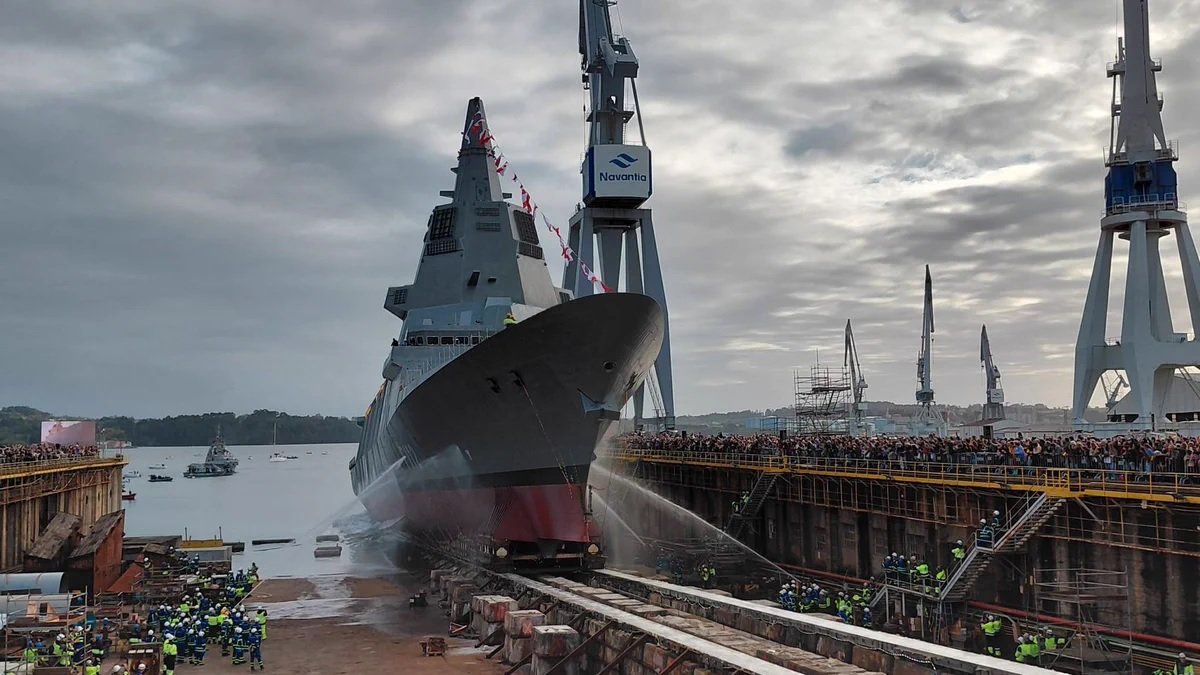
Ferrol, Spain, — Spanish shipbuilder Navantia has launched the Roger de Lauria (F112), the second of five F110-class frigates being built for the Spanish Navy. The vessel entered the water at Navantia's Ferrol shipyard in A Coruña, four months ahead of the schedule agreed with the Ministry of Defence.
The F110 program, with a budget of more than €4.9 billion, is designed to replace the Spanish Navy's aging Santa María-class frigates. The Roger de Lauria is scheduled for delivery in 2029, while all five frigates are expected to be delivered by 2032.
Launch Ceremony at Ferrol Shipyard
The launch ceremony at Slipway 3 was attended by Secretary of State for Defence María Amparo Valcarce, Spanish Navy Chief of Staff Admiral Antonio Piñeiro, Navantia Chairman Ricardo Domínguez, Ferrol Mayor José Manuel Rey, and other government and naval officials.
Navantia employees, their families, and representatives of partner companies also attended the event.
Military chaplain Vicente Hernández Chumillas blessed the frigate before it entered the water at high tide. The Northern Marine Regiment Band performed the Spanish national anthem during the launch.
The ship is named after Roger de Lauria, a historic admiral of the fleets of the Crown of Aragon and Sicily. Writer Almudena de Arteaga, a descendant of the admiral, served as the vessel's sponsor.
Navantia said the frigate reached the launch stage with a higher level of installation and assembly completed than is typical for this phase. Final outfitting will continue alongside the shipyard quay.
F110 Program Progress
The F110 program covers the construction of five multi-purpose escort vessels. Work is progressing on the remaining frigates:
-
F111 Bonifaz: The lead ship, launched in September 2025, is undergoing systems installation and start-up. Sea trials are scheduled to begin in 2027.
-
F113 Menéndez de Avilés: Five hull blocks have been positioned on the slipway following its keel-laying in July 2026.
-
F114 Luis de Córdova: Initial construction has started at Navantia's new Digital Block Factory.
-
F115 Barceló: The fifth and final frigate in the series.
Technical and Digital Capabilities
The F110-class frigates measure 145 meters in length and 18 meters in width, with a displacement of approximately 6,100 tonnes. They use a CODLAG (Combined Diesel-Electric and Gas) propulsion system and are designed to counter air, surface, and submarine threats while supporting maritime security missions for civilian authorities.
The vessels incorporate Navantia's SCOMBA combat system and the AN/SPY-7 radar system from Lockheed Martin. Their integrated mast is designed to optimize electromagnetic spectrum management and reduce radar signature.
The program also introduces a digital twin, a virtual replica of the physical ship developed in collaboration with the Spanish Navy and the Directorate-General for Armament and Materiel (DIGAM). Using cloud computing, machine learning, and the Internet of Things (IoT), the technology supports data-driven management of ship operations and maintenance.
Another feature is the Integrated Services System (SSI), a neural network connected to sensors within the ship's lighting infrastructure. The system was developed jointly with the University of Vigo.
Industrial and Economic Impact
The F110 program is a major contributor to Spain's defense and manufacturing industries. According to Navantia, approximately 65% of the program's components come from Spanish suppliers.
The project is expected to support around 9,000 jobs over more than ten years, involving approximately 500 companies across Spain. It also supports industrial modernization at the Ferrol shipyard through new production methods and the Digital Block Factory.
During the ceremony, Secretary of State for Defence María Amparo Valcarce highlighted the contribution of Ferrol's naval and industrial community. Admiral Antonio Piñeiro emphasized Spain's commitment to innovation and technological sovereignty.
Navantia Chairman Ricardo Domínguez also highlighted the role of digital twin technology and advanced sensors in the program, noting its potential for international opportunities following the success of the F100 frigate class.
The launch of Roger de Lauria marks another milestone in the F110 program, which is intended to strengthen the Spanish Navy's operational capabilities while supporting domestic industrial development and skilled employment.
——— End of Article ———