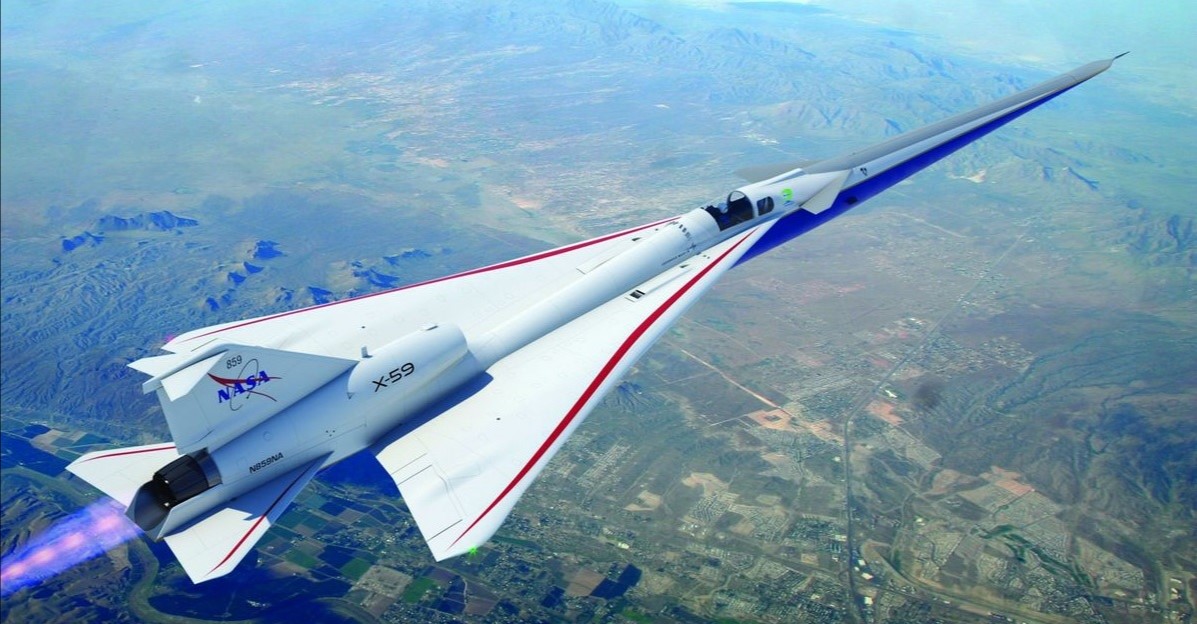
Defense News ,U.S :- In an exciting development, NASA and Lockheed Martin are set to reveal the groundbreaking X-59 Quesst, a supersonic jet engineered to transcend the sound barrier without generating the typical thunderous sonic boom.
Since 2019, Lockheed Martin "Skunk Works" facility in Palmdale, California, has been crafting the experimental X-59 Quesst, designed to soar at supersonic speeds while significantly reducing the disruptive noise associated with sonic booms. Instead of the traditional explosive sound, the X-59 aims to create a more subtle "thump," akin to the closing of a car door. NASA envisions this innovation playing a crucial role in reshaping regulations that currently prohibit supersonic flight over populated areas due to the disturbances caused by sonic booms.
A milestone event is scheduled for Friday, January 12, at 4 p.m. EST (2100 GMT), where NASA will host a free livestream unveiling of the X-59. The painted aircraft will make its debut, showcasing its final red, white, and blue paint job. The public is invited to join the celebration, with NASA providing printable invites and free STEM toolkits for educators to enhance the experience.
The X-59, previously displayed in August 2023, exhibited its distinctive design, featuring a sharp, elongated nose measuring 38 feet (11.5 meters). This nose, instrumental in shaping shock waves during flight, highlights the aircraft unique geometry. Pilots of the X-59 rely on the External Vision System (XVS) as the aircraft lacks a traditional forward windscreen. The XVS utilizes a forward-facing camera, a cockpit-mounted display screen, and custom image processing software to provide an augmented reality view of the pilot forward line-of-sight along with graphical flight data overlays.
Measuring at 99.7 feet long and 29.5 feet wide, the X-59 is engineered to achieve a speed of Mach 1.4, equivalent to 925 mph (1489 kph), at an altitude of 55,000 feet. The aircraft is powered by a single engine developed by General Electric Aviation.
Upon completion, the X-59 will embark on a research campaign flying over selected residential areas to gather data on how individuals below experience and react to the quieter sonic booms it produces. NASA intends to employ this valuable data to seek approval for commercial supersonic flights from regulatory agencies, including the Federal Aviation Administration. The X-59 Quesst represents a significant leap forward in supersonic travel technology, promising a quieter and more sustainable future for high-speed air travel.
——— End of Article ———