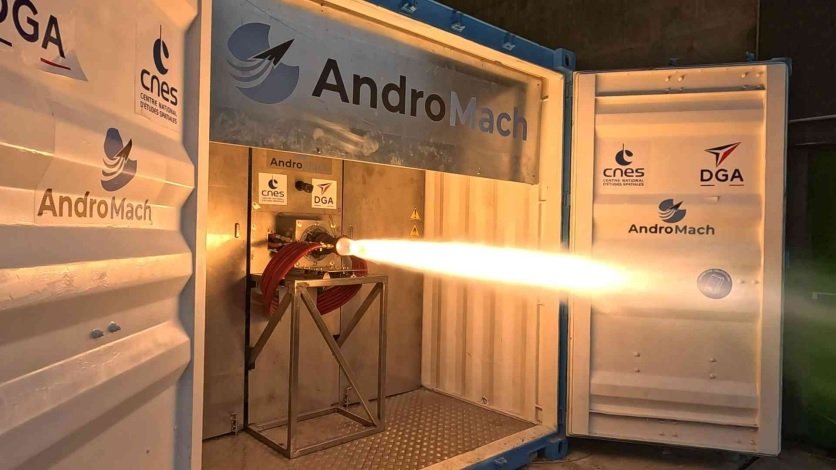
GIRONDE, France — French aerospace startup AndroMach has successfully completed the qualification test campaign for its reusable cryogenic rocket engine, Banger, after conducting 21 consecutive hot-fire ignitions without a single failure. The milestone validates the engine's repeated ignition capability and reusability, paving the way for flight testing of the company's Envol suborbital hypersonic drone.
The successful qualification campaign was confirmed by France's Direction Générale de l'Armement (DGA) on 22 July 2026.
Engine Qualification Campaign
The qualification tests were carried out in December 2025 at the DGA Essais de Missiles (DGAEM) test center in Saint-Médard-en-Jalles, Gironde, in southwestern France. The campaign received technical support from the Centre National d'Études Spatiales (CNES), France's national space agency.
During the campaign, the Banger engine accumulated approximately seven minutes of total burn time across 21 successful ignitions, demonstrating reliable restart capability and hardware reusability after repeated firings.
According to the DGA, the main objective of the tests was to study the engine's behavior during startup under demanding thermal and mechanical conditions while identifying the most suitable operating parameters. Engineers, technical experts, and technicians from DGAEM provided test engineering, operational support, and safety management throughout the campaign.
Banger Rocket Engine
Developed entirely in-house by AndroMach, the Banger engine is a reusable cryogenic rocket engine that uses liquid oxygen (LOX) and propane as propellants. The engine is designed to be fully reusable and re-ignitable, allowing multiple ignition cycles without replacing major hardware.
The company also states that several engine components are manufactured using metal 3D-printing technology.
Envol Hypersonic Drone
The Banger engine will power Envol, a four-meter-long unmanned suborbital hypersonic drone designed for scientific, industrial, and defense missions.
Envol features a dual-propulsion configuration. It takes off from a conventional runway using two jet engines before igniting the Banger rocket engine during flight.
According to AndroMach, the vehicle is designed to reach speeds of Mach 5 and an altitude of approximately 200 kilometers before gliding back to a runway landing. As a suborbital vehicle, Envol is intended to complete missions without entering orbit, with a planned turnaround time of less than six hours between flights.
The drone is designed to carry payloads of up to approximately 30 kilograms.
Planned Applications
According to the DGA, Envol is being developed for a range of civilian and defense-related missions.
Its planned applications include:
- Conducting microgravity and atmospheric research during suborbital flights.
- Performing in-flight qualification of aerospace technologies, materials, and hardware in hypersonic and near-space conditions.
- Serving as a high-speed target vehicle with complex flight profiles for evaluating civilian and military detection, tracking, and interception systems.
Company Background
AndroMach was founded in September 2023 by engineers from the Institut Polytechnique des Sciences Avancées (IPSA). The company focuses on reusable propulsion systems and hypersonic flight technologies as part of France's growing New Space sector.
Development Roadmap
With the qualification of the Banger engine completed, AndroMach will move to the next stage of the Envol program.
According to the company's development roadmap:
- Envol XP1, the commercial prototype, is scheduled for its first flights during 2026–2027.
- Envol XP2, the industrial version, is planned for 2027–2028.
- First commercial operations are targeted for 2028.
The company is also preparing a crowdfunding campaign through the Souvtech Invest platform to support the next phase of development.
DGA Support
The DGA described the successful engine qualification campaign as an important milestone for the Envol program. It also highlighted the contribution of its ALIENOR innovation cluster, which supports New Space companies and technology development in France's Nouvelle-Aquitaine region.
Source : techtimes
——— End of Article ———