JAMMU, INDIA : A gas leak from an abandoned cylinder at a scrap dealer’s shop triggered panic and a coordinated emergency response in a residential locality near Jammu airport on Saturday, February 7, 2026, prompting the deployment of national and state disaster-response units and the launch of a scientific investigation to determine the nature and origin of the substance involved.
Incident and Emergency Response
The incident occurred in the Rani Bagh area, a mixed residential and commercial neighbourhood located close to the airport perimeter. Residents reported a sudden onset of breathlessness and respiratory discomfort, leading to immediate alerts to local authorities. Joint teams from the National Disaster Response Force and the State Disaster Response Force, along with police and fire and emergency services, were dispatched to the site.
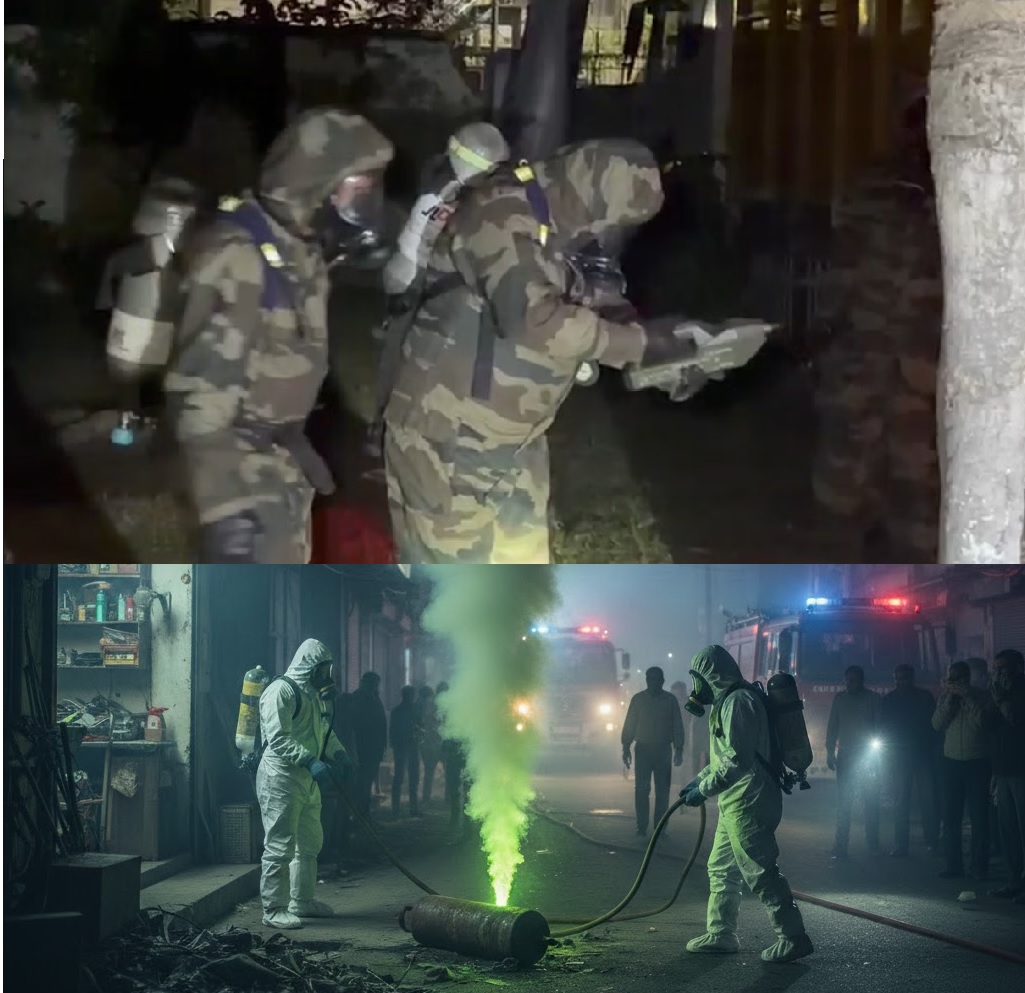
Responders wearing specialised protective equipment isolated the affected premises, contained the leak, and secured the cylinder. Authorities confirmed that the situation was stabilised and that there was no ongoing release after containment measures were completed. Residents in the immediate vicinity were advised to remain cautious while monitoring continued.
Investigation and Chemical Analysis
Officials stated that a formal investigation has been initiated to identify the gas and establish how the cylinder came to be stored at a scrap dealer’s shop. Samples have been collected for laboratory analysis to determine the chemical composition and assess potential health and environmental risks.
While no official identification has yet been made public, authorities have not ruled out the possibility that the cylinder may have contained a hazardous chemical, including sulfur mustard. The findings of the scientific analysis will guide subsequent legal, environmental, and security actions.
Regulatory and Security Context
Sulfur mustard is classified as a Schedule 1 chemical weapon under the Chemical Weapons Convention, an international treaty that prohibits the development, production, acquisition, stockpiling, and use of chemical weapons. Schedule 1 substances are defined as having no legitimate industrial or commercial applications, and their presence outside tightly controlled research or defence settings raises serious regulatory and security concerns.
India is a signatory to the convention, which mandates strict controls and reporting requirements for any handling of such substances, even in minute quantities for permitted laboratory purposes.
Technical Characteristics of Sulfur Mustard
Sulfur mustard, commonly referred to as mustard gas, is a vesicant agent that causes blistering of the skin, damage to the eyes, and injury to the respiratory tract when inhaled. It is heavier than air and can accumulate in low-lying or enclosed areas. Depending on environmental conditions such as temperature and humidity, it can persist for extended periods, increasing exposure risks.
Medical effects may not be immediately apparent, with symptoms often developing hours after exposure. This delayed onset complicates early diagnosis and response in civilian settings.
Historical Use and Documented Fatalities
Mustard gas was first deployed on a large scale during World War I, notably by German forces in July 1917 near Ypres, Belgium. During the conflict, chemical weapons caused an estimated 1.3 million casualties and nearly 90,000 deaths. Mustard gas accounted for a significant share of these casualties, primarily through incapacitating injuries rather than immediate fatalities.
Its most extensive modern use occurred during the Iran–Iraq War (1980–1988), when Iraqi forces employed sulfur mustard against Iranian troops and Kurdish civilians. The 1988 attack on Halabja involved a combination of chemical agents and resulted in an estimated 3,200 to 5,000 deaths, with thousands more injured.
Latest Documented Attacks
In more recent conflicts, sulfur mustard has been documented in attacks by non-state actors. The Organisation for the Prohibition of Chemical Weapons confirmed its use by ISIS in Marea, Syria (August 2015), and in Taza, Iraq (March 2016). These incidents involved improvised or laboratory-grade forms of the agent rather than military-standard munitions.
Industrial Status and Controlled Precursors
Sulfur mustard itself has no lawful industrial application. International regulations permit only extremely limited use for medical research or for testing protective equipment in authorised defence laboratories. Certain related chemicals, such as thiodiglycol, are used in civilian industries including ink and textile manufacturing, but these substances are strictly monitored because they can be converted into sulfur mustard.
Ongoing Probe and Next Steps
Authorities in Jammu are examining whether the cylinder recovered from the scrap shop could be a legacy military munition, an improperly disposed industrial container, or material originating from an illicit source. The outcome of the chemical analysis will determine the scope of any criminal investigation and the involvement of specialised national or international agencies.
Officials have stated that public updates will be issued once laboratory results confirm the identity of the gas. At present, authorities maintain that the immediate threat has been neutralised, while emphasising that the investigation remains ongoing.
——— End of Article ———