Several weapons and unmanned systems being developed or used today have design concepts that can be traced back to military research conducted during the final years of the Cold War, according to an analysis by firearms and military analyst Gatnerd on X.
The analysis points to systems involving uncrewed ground vehicles, loitering munitions, ground-launched cruise missiles, fiber-optic weapons, stealth bombers and unmanned surface vessels. Gatnerd's broader point is that several ideas now receiving renewed attention were already being explored in the 1980s and 1990s.
The comparison does not mean that modern systems are unchanged versions of older weapons. Current systems use newer electronics, software, sensors, materials, communications and manufacturing methods. In several cases, the relationship is better described as a revival of an earlier concept rather than a direct technical continuation.
FireAnt and Sandia's 1980s Fire Ant
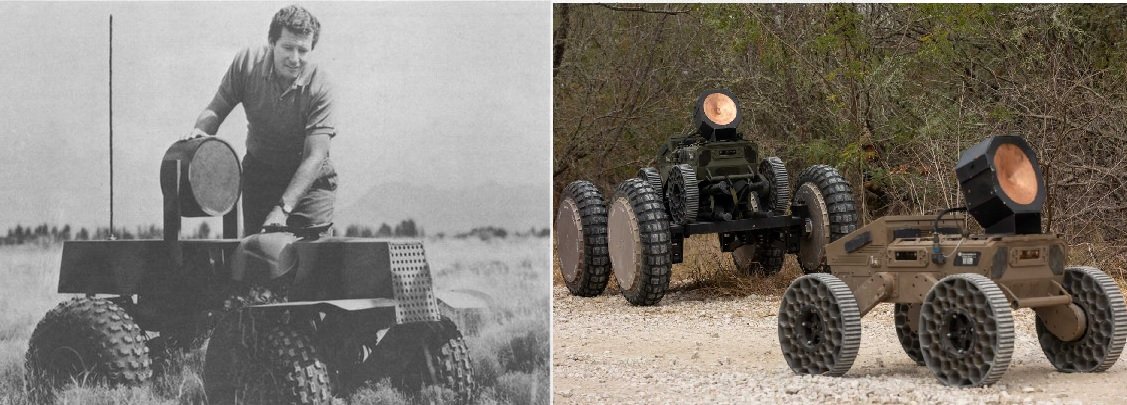
One of the examples highlighted by Gatnerd is the FireAnt uncrewed ground vehicle developed by Swarmbotics AI.
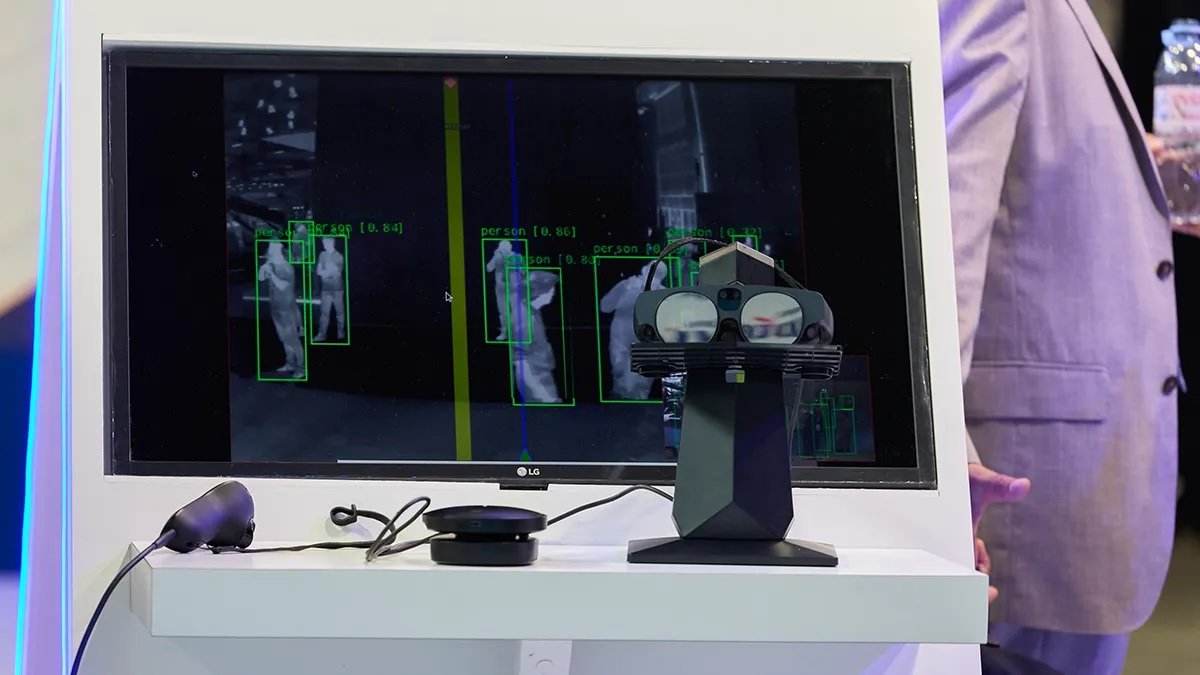
Swarmbotics describes FireAnt as an attritable, swarming, man-portable UGV that can support missions including counter-drone operations, intelligence, surveillance and reconnaissance, electronic warfare and other modular payload applications. The company's ANTS, or Attritable Networked Tactical Swarm, family combines the robotic platforms with software for coordinated swarm operations.
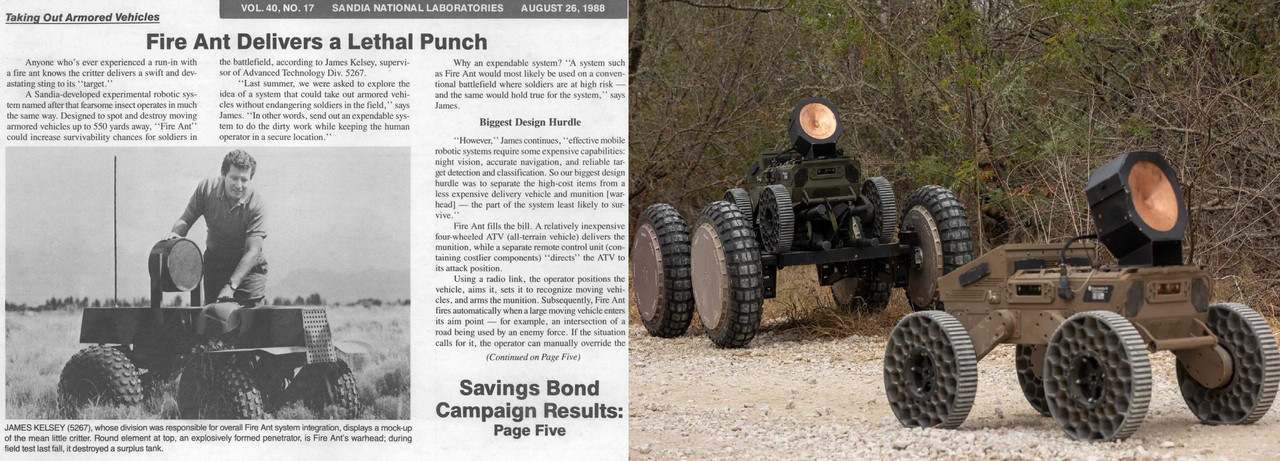
The U.S. Army has also been testing FireAnt systems. Recent footage showed an M2A4 Bradley infantry fighting vehicle carrying five FireAnt UGVs during the Pegasus Charge 3 test exercise. The testing is examining how small robotic systems can be carried and employed with conventional Army formations.
Gatnerd noted that the name and basic concept recall a different Fire Ant system tested by Sandia National Laboratories in 1987 and 1988.
The Sandia Fire Ant was a small remotely operated ground vehicle based on a Honda 125 four-wheeled all-terrain vehicle. It carried a shaped-charge-type warhead and an onboard video camera, allowing an operator to control the vehicle toward a target. Later versions were also described with automatic target-recognition capabilities.
The earlier project illustrates that the idea of using small unmanned ground vehicles to approach armored targets was being explored decades before today's autonomous and swarm-enabled UGV programs.
Shahed-136 and the Dornier DAR Comparison
Gatnerd also pointed to similarities between the Iranian Shahed-136 one-way attack drone and the West German Dornier Drohne Anti-Radar, or DAR, project from the 1980s.
Dornier developed DAR as an unmanned system intended to locate and attack enemy radar installations. The aircraft used a delta-wing configuration and was designed for launch from a ground vehicle. The project was developed during the Cold War and was eventually terminated; it did not enter German service.
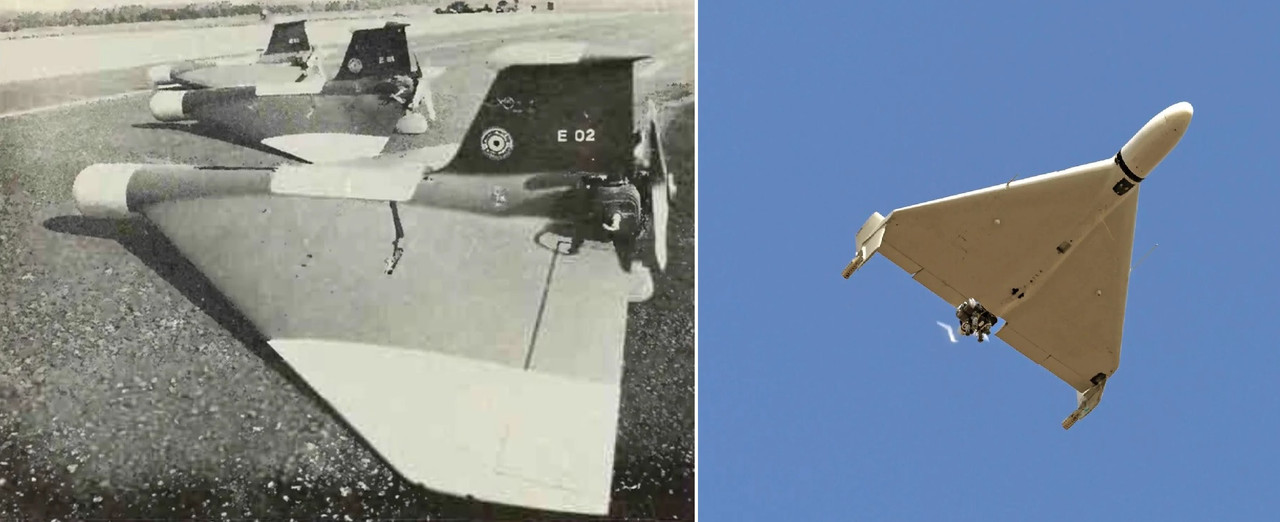
The Shahed-136 has a broadly similar cropped-delta configuration, which has led to repeated comparisons with DAR. However, the available evidence does not establish a confirmed direct technical lineage between the two systems. Some accounts have proposed a connection through Israel's Harpy loitering munition, while other assessments treat the similarity as primarily visual and conceptual.
Therefore, the DAR example is better described as a case of similar design and mission concepts rather than a confirmed direct development line from the 1980s German project to the Shahed-136.
B-21 Raider and the B-2 Spirit
The B-21 Raider provides a clearer example of design continuity within the U.S. bomber program.
The B-2 Spirit first flew in 1989 and established the flying-wing configuration that remains associated with Northrop Grumman's low-observable bomber designs. The U.S. Air Force says the B-2's low observability comes from a combination of its flying-wing design, composite materials, coatings and other technologies.
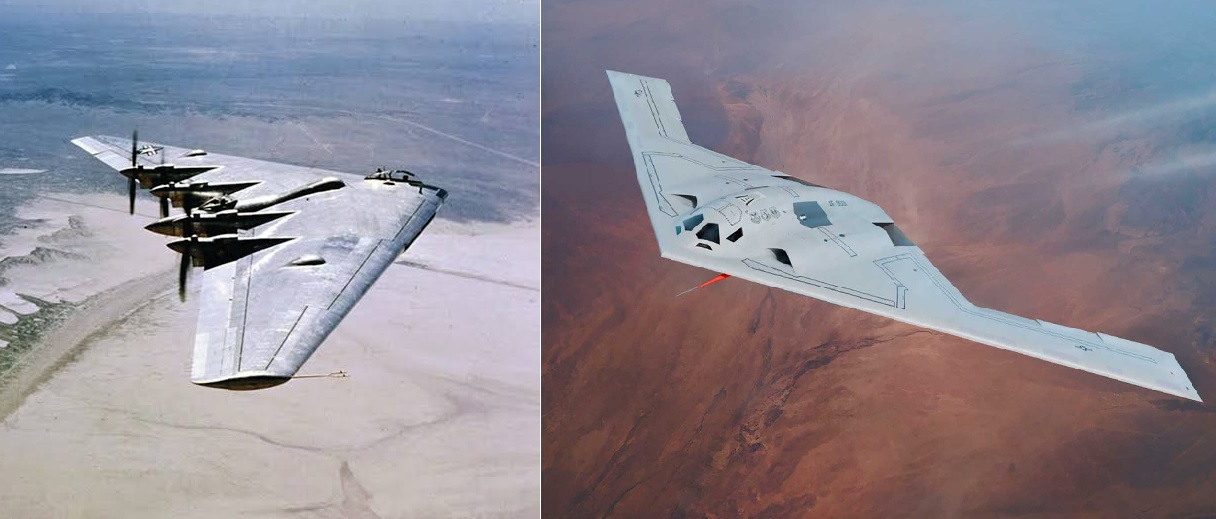
The B-21 uses the same broad flying-wing approach but incorporates substantially newer technologies and systems. Its development therefore illustrates how an aerodynamic and stealth concept originating during the Cold War can continue into a new generation of aircraft.
Typhon Brings Ground-Launched Tomahawk Capability Back
Another example is the U.S. Army's Mid-Range Capability, commonly known as Typhon.
The Army's system uses a ground-based launcher capable of firing the Navy's Standard Missile-6 and Tomahawk Land Attack Missile. The U.S. Army successfully demonstrated a Tomahawk launch from the prototype system in June 2023, and the MRC subsequently became an operational Army capability.
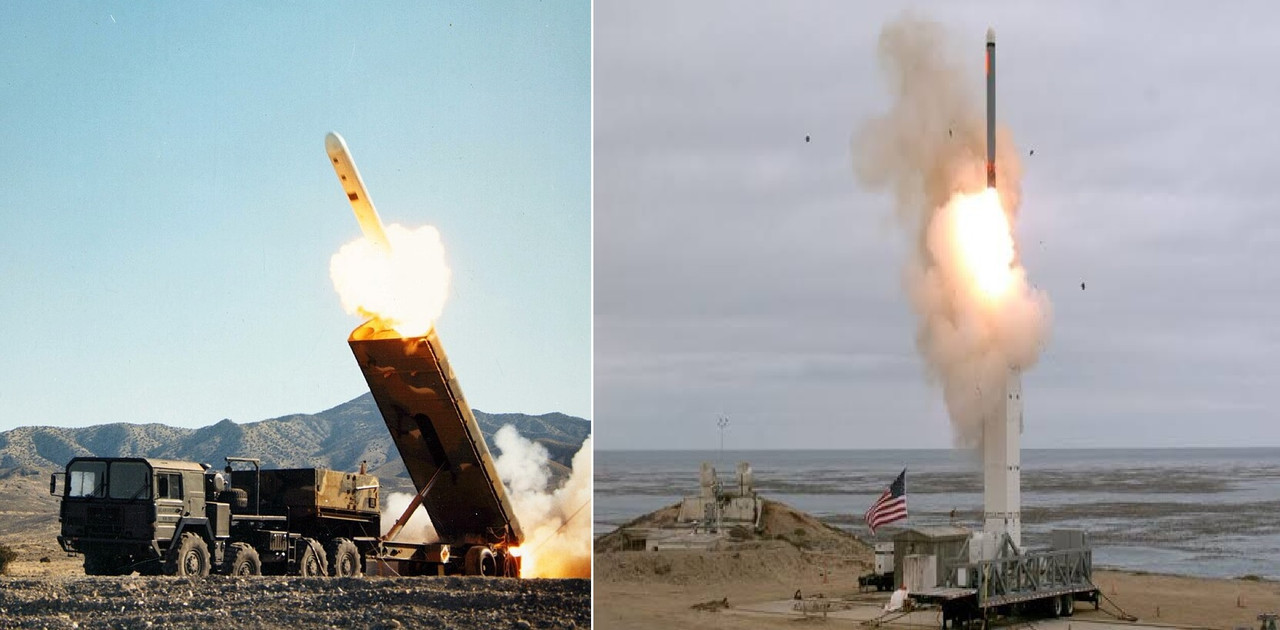
The concept has a Cold War predecessor in the BGM-109G Gryphon ground-launched cruise missile. The Gryphon was a ground-launched version of the Tomahawk family that entered service in Europe during the 1980s before being eliminated under the 1987 Intermediate-Range Nuclear Forces Treaty.
Typhon is not a reintroduction of the Gryphon itself. Instead, it represents the return of a ground-based launch concept using modern launch equipment and existing naval missiles.
Fiber-Optic Weapons Predated Today's FPV Drones
Fiber-optic FPV drones have become increasingly important because their physical communication links are difficult to disrupt through conventional radio-frequency electronic warfare.
The underlying idea is much older. The U.S. Army's Fiber Optic Guided Missile and Enhanced Fiber Optic Guided Missile programs were developed during the 1980s and 1990s.
The EFOG-M used a fiber-optic cable connecting the missile to the launch vehicle. A camera in the missile transmitted imagery to the operator, who could use that information to select and engage targets. U.S. government documentation described a range of up to 15 kilometers.
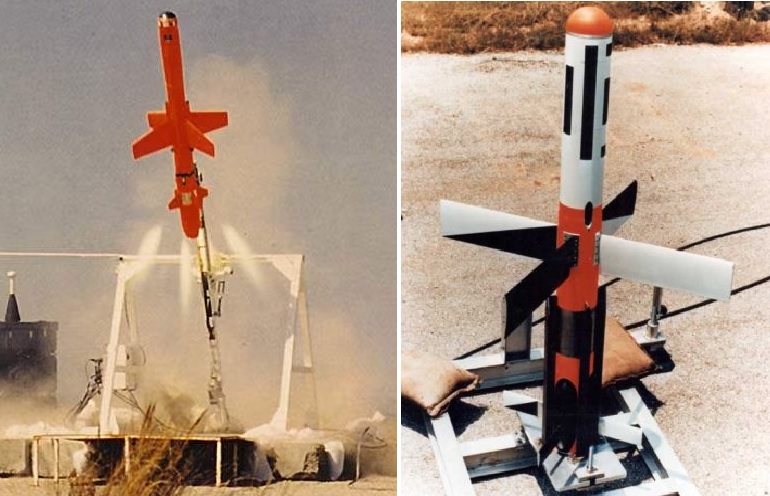
A 1987 U.S. Naval Institute account also described the earlier FOG-M concept, in which video from a missile's nose camera was transmitted to the operator through a fiber-optic cable.
Today's fiber-optic FPV drones apply the same fundamental principle in a much smaller and generally less expensive form. Their use demonstrates how an older military technology can become practical on a much wider scale when combined with modern commercial electronics and unmanned platforms.
OWL MK II and Early Unmanned Surface Vessels
The same pattern can be seen at sea.
Howard Hornsby's OWL MK II was an unmanned surface vessel developed around the late 1980s and tested extensively during the 1990s. A U.S. Marine Corps photograph from 1998 identifies the OWL MK II as a remotely controlled unmanned surface vessel developed by Navtec and Howard Hornsby for the Office of Naval Research.
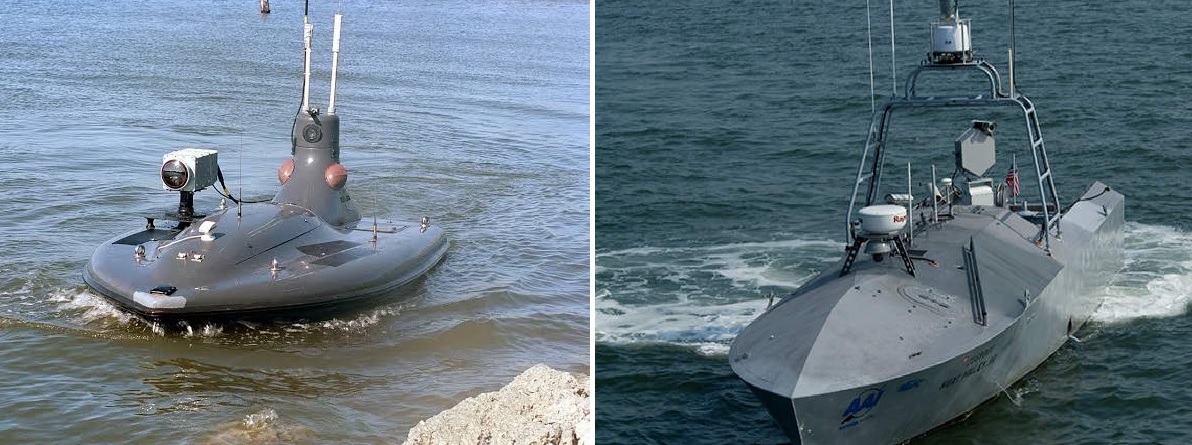
The platform was tested for missions including marine reconnaissance, harbor protection, minehunting and littoral anti-submarine operations. According to accounts of the program, an OWL MK II operated with U.S. Navy Detachment 1 in Bahrain from 1995 to 1997.
The system did not become a major formal Navy program, but its development demonstrated that unmanned surface vessels were being considered for operational naval missions decades before the current expansion of maritime drones.
Cold War Research and the Post-Cold War Period
Gatnerd's comparison focuses on a broader change in military priorities.
During the Cold War, the United States and its allies invested heavily in technologies intended for a potential conflict with a technologically capable peer adversary. These programs included precision weapons, stealth aircraft, unmanned systems, advanced guidance technologies and weapons designed to operate against armored formations and air-defense networks.
After the Cold War ended, many major defense programs were reduced, canceled or delayed. Military operations in the following decades also placed greater emphasis on counterinsurgency and other missions rather than large-scale conventional warfare against a peer military.
The renewed focus on high-intensity conventional warfare has brought some of those earlier concepts back into attention.
The current systems, however, are not simply 1980s weapons reproduced with new names. Modern computing, sensors, communications, autonomy, materials and manufacturing have changed what can be achieved with many of the same basic ideas.
The examples highlighted by Gatnerd therefore show more than simple technological repetition. They demonstrate that several concepts considered advanced during the final years of the Cold War remained relevant, even after the original programs were canceled or left development. As military requirements have changed again, some of those concepts are being developed with technologies that were not available when the original systems were tested.
——— End of Article ———