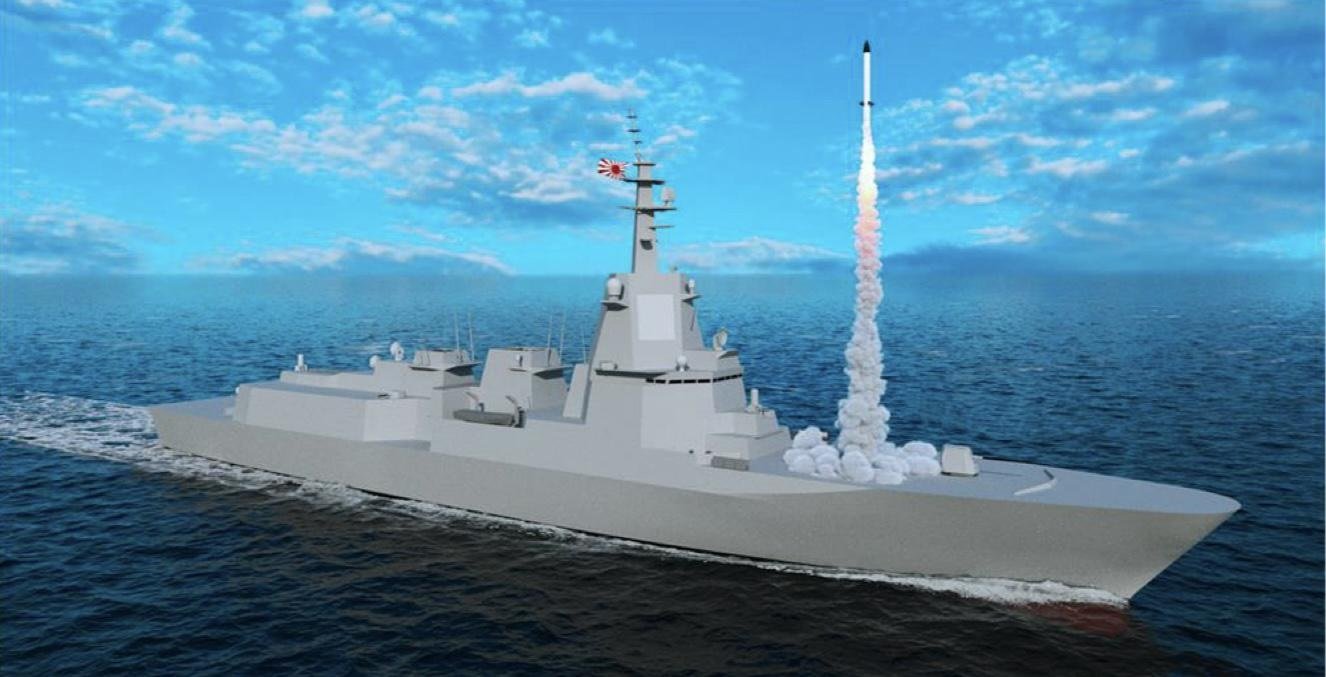
TOKYO — Japan is advancing the construction of two Aegis System Equipped Vessels (ASEV), large surface combatants designed primarily for ballistic missile defense that are expected to become the largest active destroyer-sized warships in the world when they enter service.
The ASEV program was launched as a sea-based alternative to Japan's cancelled Aegis Ashore missile defense system and has become a key part of the country's efforts to strengthen missile defense and maritime security amid the evolving security environment in East Asia.
The first ASEV was laid down on July 18, 2025, at Mitsubishi Heavy Industries' Nagasaki shipyard, while the second began construction on February 5, 2026, at Japan Marine United's Isogo shipyard in Yokohama. According to Japan's Ministry of Defense, the first vessel is scheduled to launch in fiscal year 2026 and enter service in March 2028, with the second expected to launch in fiscal year 2027 and be commissioned in March 2029.
The Ministry of Defense has approved the construction of two vessels under the program. Procurement costs are estimated at approximately 392 billion yen per ship, while the overall two-ship program is estimated at around 1 trillion yen (approximately $7.1 billion).
Largest Surface Combatants in Japan's Fleet
Each ASEV measures approximately 190 meters in length with a 25-meter beam, making the ships significantly larger than Japan's existing Aegis destroyers, including the Maya class.
According to the Ministry of Defense, the vessels have a standard displacement of about 12,000 tons, while full-load displacement estimates range between 14,000 and 16,000 tons. At full load, the ships are expected to be larger than most active destroyers worldwide, including China's Type 055 class.
For comparison, China's Type 055 destroyer has a displacement of about 13,000 tons, is approximately 180 meters long, and carries 112 vertical launch system (VLS) cells.
128 Vertical Launch Cells
The ASEV's primary combat capability is centered on a 128-cell Mk 41 Vertical Launch System, arranged with 64 cells forward and 64 aft. This gives the vessel a larger missile capacity than Japan's Maya-class destroyers, which carry 96 VLS cells, and 16 more cells than the Type 055.
The planned missile inventory includes:
- SM-3 Block IIA interceptors for ballistic missile defense.
- SM-6 missiles for air and missile defense.
- Evolved SeaSparrow Missiles (ESSM).
- Tomahawk cruise missiles for long-range land-attack missions.
- Extended-range Type 12 surface-to-ship missiles, capable of engaging both maritime and land targets.
- The future Glide Phase Interceptor (GPI), being jointly developed by Japan and the United States to intercept hypersonic glide vehicles.
The integration of Tomahawk cruise missiles and the extended-range Type 12 missile will also support Japan's developing counterstrike capability.
Advanced Radar and Combat Systems
The ships will be equipped with Lockheed Martin's AN/SPY-7(V)1 Active Electronically Scanned Array (AESA) radar, derived from technology used in the U.S. Long Range Discrimination Radar.
Japanese defense officials state that the SPY-7 provides approximately five times the tracking capability of the older SPY-1 radar installed on the Japan Maritime Self-Defense Force's current Aegis destroyers.
The radar arrays are mounted above the bridge to improve detection of low-altitude threats, including sea-skimming missiles.
Additional sensors and systems include:
- AN/SPQ-9B horizon-search radar.
- Three AN/SPG-62 fire-control illumination radars.
- AN/SLQ-32(V)6 electronic warfare system.
Additional Armament and Propulsion
Besides its missile systems, the ASEV will be fitted with a Mk 45 Mod 4 5-inch naval gun, Phalanx Close-In Weapon Systems (CIWS), and facilities to operate two SH-60 helicopters.
The ships are planned to use Rolls-Royce MT30 gas turbines for propulsion and are expected to achieve speeds of approximately 30 knots. Crew size is estimated at around 240 personnel.
Strengthening Japan's Missile Defense
The ASEV program originated after Japan cancelled the land-based Aegis Ashore missile defense system in 2020.
The new vessels are designed to provide persistent ballistic missile surveillance, tracking, and interception, allowing the Japan Maritime Self-Defense Force's existing Kongō, Atago, and Maya-class Aegis destroyers to focus more on fleet air defense, anti-submarine warfare, and other multi-mission operations.
Due to their size and capabilities, the vessels are expected to be designated as guided-missile cruisers rather than destroyers. Once commissioned, they will become a central component of Japan's sea-based ballistic missile defense architecture while supporting the country's expanding long-range strike capability.
——— End of Article ———