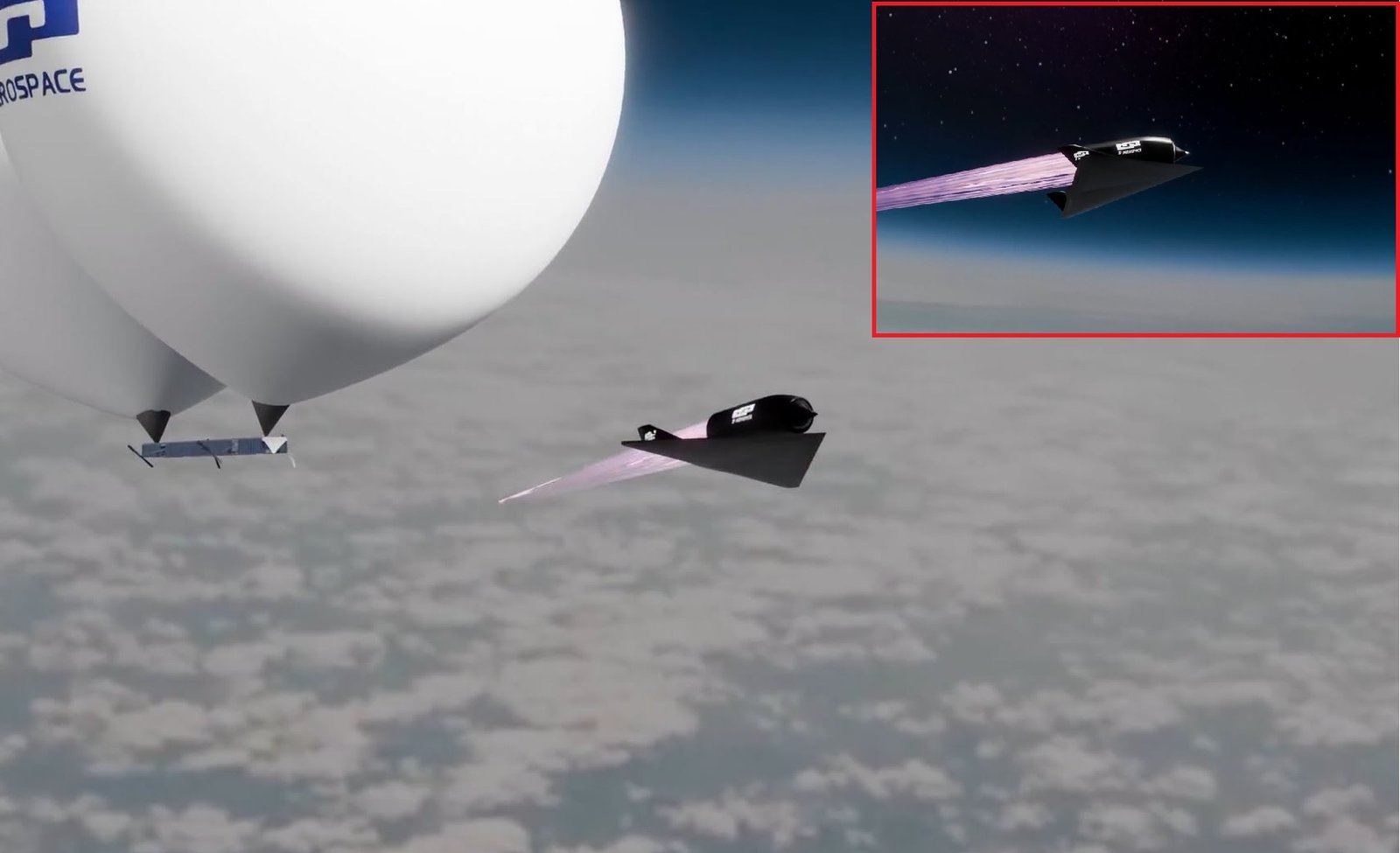
CALIFORNIA — JP Aerospace, an American volunteer-run nonprofit that has spent more than four decades developing an alternative approach to spaceflight, has released new computer-generated images of a proposed vehicle called Hazel.
The images, shared by JP Aerospace president John Powell, show a dark, wing-shaped aircraft being released from a high-altitude airship called SuperTandem. The airship features two balloons connected by a long truss. Powell said the images are stills from an upcoming Hazel concept video and are not footage of an actual flight or test.
No physical hypersonic vehicle matching the current Hazel concept has been publicly reported as built or flown. JP Aerospace has not disclosed technical specifications, funding sources or a target launch date for Hazel.
Airship to Orbit program
JP Aerospace refers to itself as “America’s Other Space Program.” Its long-term Airship to Orbit (ATO) program aims to reach space using lighter-than-air vehicles instead of conventional rockets.
The proposed system has three stages. The Ascender would carry people and cargo from the ground to about 140,000 feet. The Dark Sky Station, positioned at roughly 140,000 feet, would serve as a high-altitude transfer and construction facility.
The final stage is the Orbital Ascender, a proposed airship about one mile long that would be built at the Dark Sky Station. Covered with solar panels, it would gradually accelerate over several days using lightweight, low-power electric ion propulsion, eventually reaching orbital speeds of above Mach 20.
Previous high-altitude testing
JP Aerospace's best-documented flight was the October 2011 mission of its unmanned Tandem airship. The twin-balloon vehicle used a 30-foot carbon-fiber truss, two electric motors and six-foot propellers, reaching 95,085 feet over Nevada's Black Rock Desert. The altitude set an airship record at the time.
Powell said Tandem took about five years to develop and cost roughly $30,000. After the flight, the vehicle was recovered by parachute after one balloon failed and the second was released.
The organization has also conducted roughly 200 smaller research missions using balloons and small rockets. Its PongSat program has carried thousands of student science experiments to high altitudes in ping-pong balls.
Hazel's earlier design
The Hazel name is also linked to a 1959 U.S. concept for an inflatable Mach 3 aircraft called Hazel MC-10. The earlier design was studied extensively and had work conducted on its engines, wings and subsystems, but it never flew after competing programs advanced.
Powell has discussed building engineering models of the 1959 design for low-speed and Mach 4 wind-tunnel testing and explanatory videos. The latest concept presents Hazel as a hypersonic test vehicle that could be air-launched from a high-altitude platform.
JP Aerospace has not publicly confirmed construction or flight testing of the massive orbital-class airships required for its Airship to Orbit vision, nor has it reported a flight of a physical Hazel vehicle matching the current concept.
The organization is also working on projects including the Ellipse airship prototype, hybrid and magnetohydrodynamic propulsion tests, and a crewed submarine used as a systems and life-support testbed.
The new SuperTandem and Hazel images add to JP Aerospace's ongoing concept work, but they remain computer-generated illustrations rather than operational hardware.
——— End of Article ———