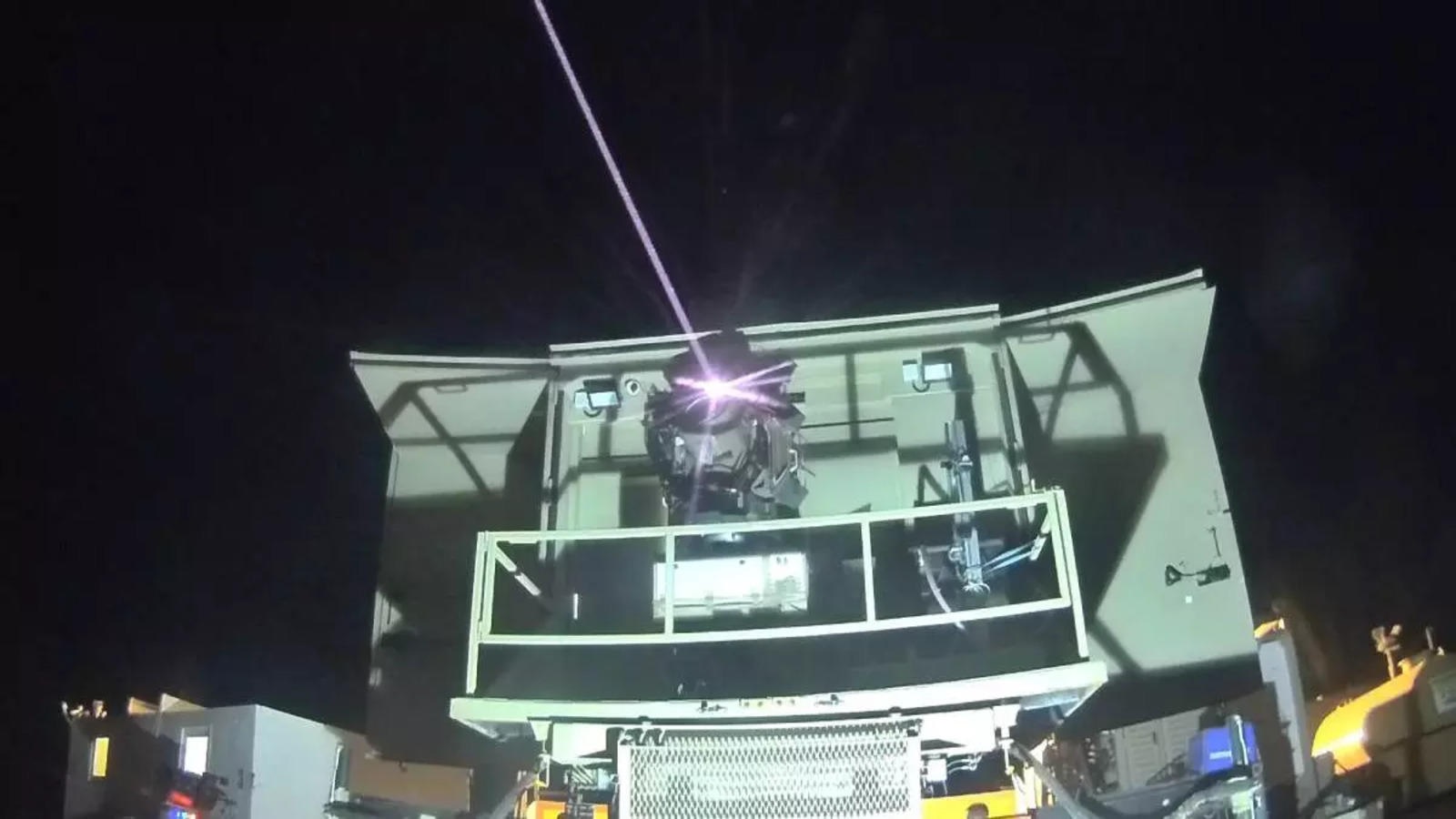
Defense News ,Israel :- The Iron Beam, an innovative Israeli system designed to neutralize airborne threats using a potent laser beam, has entered an advanced testing phase in proximity to the Gaza Strip amid the ongoing conflict. This marks a significant development two years after the official commencement of the program, which had been preceded by a protracted debate between advocates and critics of laser-based defense systems.
Initial reports indicate that the primary objective is to create an electric solid-state laser in the range of 100-150 kW, capable of effectively intercepting rockets and missiles. To achieve the requisite power, the plan involves deploying two laser guns in tandem. A credible source within the defense industry emphasized that, in order to intercept a broader spectrum of threats beyond short-range rockets, Israel aims to develop a laser generator with the capacity to produce a formidable 1 MegaW beam.
In a strategic move, the Israeli Defence Ministry has earmarked substantial funding, totaling hundreds of millions of NIS, for the research and production of the Iron Beam system. The developmental blueprint for Iron Beam is spearheaded by the Directorate of Defence Research and Development (DDR&D) in collaboration with Rafael and Elbit Systems. Following the initial investment, further allocations of hundreds of millions of NIS are anticipated to propel the project towards completion.
Notably, this isn't the first venture into laser-based defense technology for Israel. In the past, collaborative efforts between Israel and the U.S. led to the development of Nautilus, a laser "cannon" designed to eliminate incoming rockets. Also known as the Tactical High-Energy Laser (THEL), the cooperative project saw progress in 2000 when the demonstrator successfully intercepted 28 Katyusha artillery rockets and five artillery shells. Despite these achievements, the program faced challenges due to the substantial size and weight of the prototype, mainly attributed to the specifications of the chemical laser generator. Consequently, THEL was discontinued in 2005.
The historical resistance to laser weaponry within Israel played a role in steering the focus towards alternative defense systems such as Iron Dome and David's Sling. These systems, born out of the opposition to laser-based technology, have proven effective in addressing specific security concerns, showcasing the nation's commitment to exploring diverse solutions for its defense needs. The Iron Beam now stands as the latest manifestation of Israel's ongoing pursuit of cutting-edge defense capabilities in a volatile geopolitical landscape.
——— End of Article ———