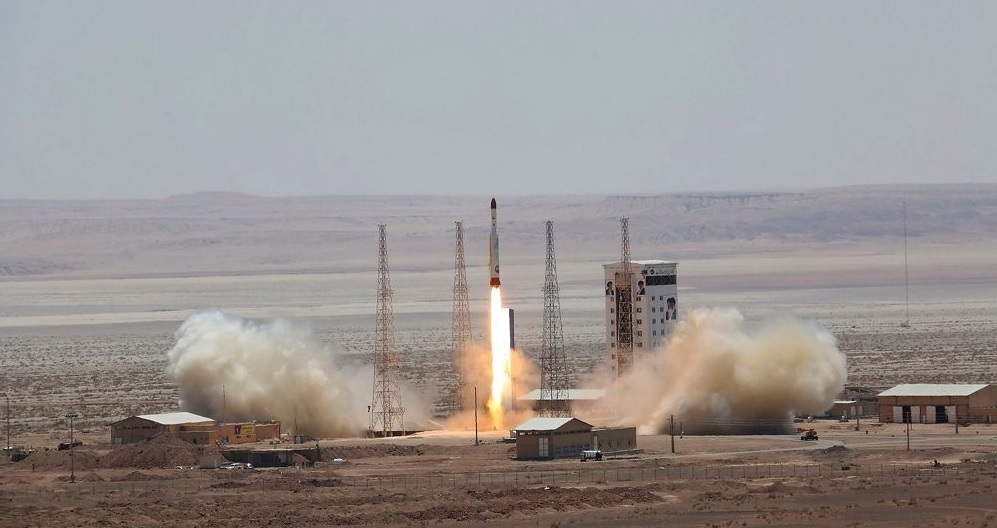
Iran recently launched a satellite into space, a move that has drawn fresh concerns from the West due to its potential ties to Tehran’s missile development program. The launch was conducted by Iran's paramilitary Revolutionary Guard, which used a Qaem-100 rocket to propel the Chamran-1 satellite into orbit, marking another step in Iran’s expanding space and military technology program.
State-run media described the launch as a success, though there has yet to be independent confirmation. The Qaem-100, a solid-fuel, three-stage rocket, successfully placed the 60-kilogram Chamran-1 satellite into an orbit approximately 550 kilometers above Earth. Notably, the rocket bore a Quranic verse, symbolizing the ideological underpinnings of Iran’s space efforts. This marks the second successful satellite deployment using the Qaem-100, after an earlier launch in January.
The satellite launch took place near Shahroud, a city approximately 350 kilometers east of Tehran, from a mobile launcher—a detail that underscores the sophistication of Iran’s space launch technology. This capability is seen as a double-edged sword by international observers. While Iran insists its space program is for civilian purposes, many in the West fear it serves as a cover for developing long-range ballistic missile capabilities, including intercontinental ballistic missiles (ICBMs), which could eventually be fitted with nuclear warheads.
Adding to these concerns is the timing of the launch, which coincided with a period of heightened tension in the Middle East, particularly the ongoing conflict between Israel and Hamas in Gaza. During this time, Iran carried out a direct missile and drone attack on Israel, showcasing its military prowess. Furthermore, Iran’s uranium enrichment has progressed to near-weapons-grade levels, causing alarm among nuclear watchdogs. Although Iran has consistently denied seeking nuclear weapons, its growing enrichment capacity and space technology developments suggest otherwise to many international experts.
Western powers, particularly the U.S., have long voiced concerns over Iran's space program, arguing that the technology used in satellite launches could also be employed to develop ICBMs. These fears have grown after the expiration of U.N. sanctions related to Iran's ballistic missile program in October 2023. The U.S. State Department has condemned Iran’s previous satellite launches, calling them a violation of a U.N. Security Council resolution.
The U.S. intelligence community has echoed this sentiment, stating that Iran's satellite launch vehicle technology could significantly shorten the timeline for developing ICBMs. The connection between satellite launchers and missile development lies in the shared technology used to propel heavy payloads across long distances—both in space and for military purposes.
While Iran's leadership, including the head of the Revolutionary Guard, General Hossein Salami, celebrated the launch as a victory against international sanctions, the launch also raises questions about the nation’s broader intentions under its space program. Iran's current president, Masoud Pezeshkian, has yet to publicly comment on the future of the space program, leaving uncertainty about the direction the country will take in the coming years.
The launch also comes ahead of the second anniversary of the death of Mahsa Amini, which triggered mass protests against Iran’s mandatory hijab laws and its theocratic regime. Amid these domestic challenges, Iran continues to assert its technological ambitions on the world stage, further complicating its relations with the international community.
As Tehran pushes ahead with both its space and missile programs, the potential for a deeper geopolitical conflict looms, particularly as Iran moves closer to achieving the technological capabilities that could extend beyond regional power to global influence. For now, the satellite launch has put Iran back into the international spotlight, with eyes on whether this progress signals a new chapter in its military and technological capabilities—or a further escalation of tensions with the West.
——— End of Article ———