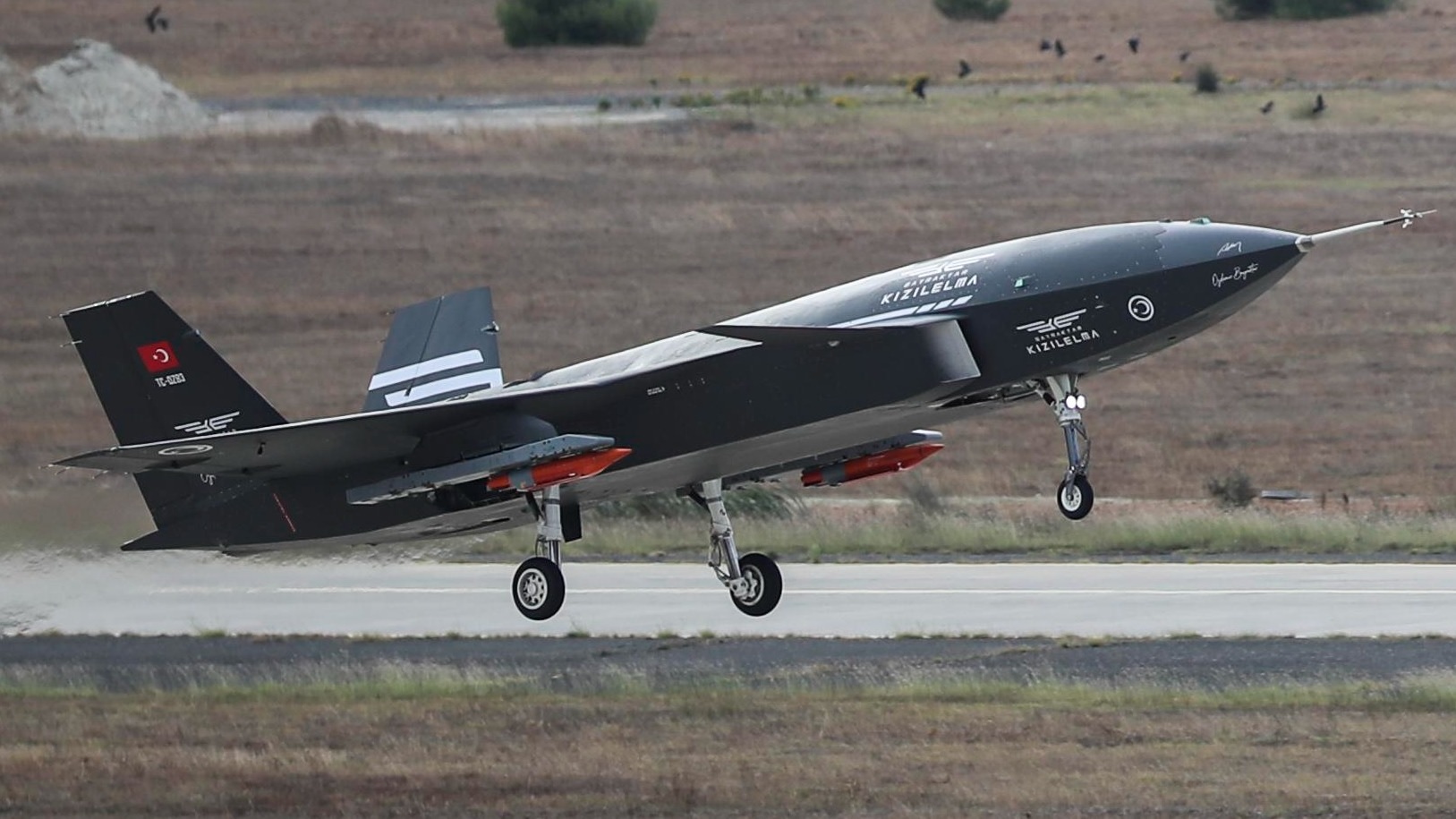
ISTANBUL — May 8, 2026 : Indonesia has officially become the first international customer for Türkiye’s Bayraktar Kızilelma unmanned combat aerial vehicle (UCAV), following the signing of a major framework agreement between Turkish defence company Baykar and Indonesia’s PT Republik Aero Dirgantara during the SAHA 2026 International Defence, Aerospace and Space Industry Fair in Istanbul.
The agreement, signed on May 6, covers the procurement of an initial batch of 12 Bayraktar Kızilelma aircraft, equivalent to one operational squadron, with deliveries scheduled to begin in 2028. The contract also includes options for four additional squadrons, potentially increasing Indonesia’s total acquisition to 60 aircraft.
Baykar Chief Executive Officer Haluk Bayraktar confirmed that Indonesia is the first export customer for the Kızilelma platform since the aircraft completed its maiden flight on December 14, 2022.
The deal represents a significant expansion of defence-industrial cooperation between Ankara and Jakarta, particularly in unmanned systems, aerospace manufacturing, missile technology, and advanced defence electronics.
Comprehensive Industrial Cooperation Package
The agreement extends beyond aircraft procurement and establishes a broad industrial cooperation framework inside Indonesia. Under the arrangement, PT Republik Aero Dirgantara — a subsidiary of Indonesian defence and aerospace company Republikorp — will support local integration, sustainment, and future production activities related to the Kızilelma programme.
The framework includes technology transfer, local production capability, maintenance, repair and overhaul (MRO) infrastructure, technical certification activities, workforce training programmes, and the establishment of integration centres for the aircraft inside Indonesia.
The project further expands an existing defence partnership between Baykar and Republikorp that was formalized in February 2025 for the local production of Bayraktar TB3 and Bayraktar Akıncı unmanned aerial vehicles.
Indonesian facilities are expected to support assembly operations, mission systems integration, sustainment activities, and long-term operational support for Turkish-origin unmanned combat platforms.
Part of Broader Türkiye–Indonesia Defence Expansion
Indonesia’s acquisition of the Kızilelma forms part of a wider defence modernization programme involving multiple Turkish defence companies.
In July 2025, Indonesia finalized an estimated $10 billion agreement with Turkish Aerospace Industries (TUSAŞ) for the procurement of 48 Kaan fifth-generation fighter aircraft. Initial deliveries of the Kaan fighters are expected in the early 2030s.
PT Republik Aero Dirgantara has also been designated to support future Kaan maintenance infrastructure, simulator systems, and associated support facilities inside Indonesia.
At the same time, Republikorp-linked entities expanded cooperation with Turkish missile manufacturer Roketsan through a separate joint venture signed in June 2025. That agreement focuses on the gradual local production of Atmaca anti-ship missiles, the Çakır compact cruise missile, and the Hisar and Sungur air defence systems.
During the SAHA 2026 exhibition, Turkish defence electronics company Aselsan additionally signed contracts related to unmanned naval vehicle payloads, mission systems, and military communication equipment for the Indonesian Armed Forces.
Kızilelma Programme Background
The Bayraktar Kızilelma originated from Baykar’s MIUS (Muharip İnsansız Uçak Sistemi) programme, which was launched in 2013 as part of Türkiye’s effort to develop an indigenous jet-powered unmanned combat aircraft.
Baykar publicly disclosed the programme in July 2021. Development expenditures for the aircraft are estimated at approximately $1 billion.
The first prototype was assembled in March 2022 and completed its maiden flight on December 14, 2022. Since then, the programme has progressed through a series of flight-test campaigns focused on autonomous flight control, high-speed handling, weapons integration, and manned-unmanned operational concepts.
Aircraft Design and Technical Specifications
The Bayraktar Kızilelma is designed as a low-observable unmanned fighter platform capable of conducting strike, interdiction, suppression of enemy air defences (SEAD), reconnaissance, and air-to-air combat missions.
The aircraft features a blended stealth-oriented fuselage, canard-delta aerodynamic configuration, side-mounted engine intakes, and twin outward-canted vertical stabilizers designed to reduce frontal radar signature while maintaining maneuverability at high angles of attack.
The platform measures 14.5 metres in length, has a wingspan of 10 metres, and stands 3.5 metres high.
The aircraft has a maximum takeoff weight of 8,500 kilograms and supports an internal payload capacity of 1,500 kilograms.
To preserve low observability during combat operations, the Kızilelma incorporates internal weapons bays. Additional payload configurations are supported through six external wing hardpoints and two internal weapon stations.
The aircraft is equipped with an Active Electronically Scanned Array (AESA) radar, electro-optical targeting systems, and infrared search and track (IRST) sensors to support target acquisition, tracking, and situational awareness.
Autonomous and Manned-Unmanned Teaming Capabilities
The Kızilelma has been designed around artificial intelligence-supported operational concepts, including “loyal wingman” missions and manned-unmanned teaming operations alongside piloted combat aircraft.
The aircraft supports autonomous takeoff, landing, taxiing, navigation, and coordinated mission execution through integrated onboard control systems.
Communication architecture includes both line-of-sight and beyond-line-of-sight connectivity for networked operations.
Baykar has stated that the platform is intended to support beyond-visual-range combat capability and future distributed autonomous air combat operations.
Performance specifications released by the company indicate a cruise speed of approximately Mach 0.6 and a maximum speed approaching Mach 0.9.
The aircraft has a combat radius of approximately 930 kilometres, or 500 nautical miles, an operational altitude of 25,000 feet, and a service ceiling reaching 45,000 feet. Endurance is reported to exceed three hours depending on mission configuration.
Prototype Development and Flight Testing
The Kızilelma flight test campaign has focused on validating autonomous control systems, aerodynamic performance, and coordinated operations with crewed combat aircraft.
In April 2023, the aircraft conducted a formation flight with a Turkish Air Force F-16 during the Teknofest aerospace event, demonstrating manned-unmanned coordination capability.
By June 2023, the aircraft had reached an altitude of 9.5 kilometres during its twelfth flight test.
The third prototype, designated TC-ÖZB3 (PT3), completed its maiden flight on September 25, 2024. The prototype introduced revised avionics architecture, aerodynamic refinements, structural modifications, and an afterburning engine configuration assessed to be based on the AI-322F turbofan series.
The afterburning configuration enables transonic flight performance and improved maneuver capability during high-stress flight operations.
In December 2025, two Kızilelma aircraft successfully completed an autonomous close-formation flight simultaneously, marking the first documented fighter-class UCAV formation flight conducted without onboard pilots.
Strategic Implications for Indonesia
Indonesia’s acquisition provides the country with early access to a new class of autonomous combat aircraft while the platform continues progressing through operational integration and low-rate production phases.
The procurement is expected to support Indonesia’s long-range deterrence capability, autonomous warfare development, and future manned-unmanned combat operations in the Indo-Pacific region.
The broader framework agreement also includes future autonomous systems research, local aerospace workforce development, technical certification programmes, and integrated support infrastructure tied to Kızilelma operations inside Indonesia.
Further details regarding aircraft variants, production timelines, operational integration, and localized manufacturing activities are expected to be released in the coming months.
——— End of Article ———