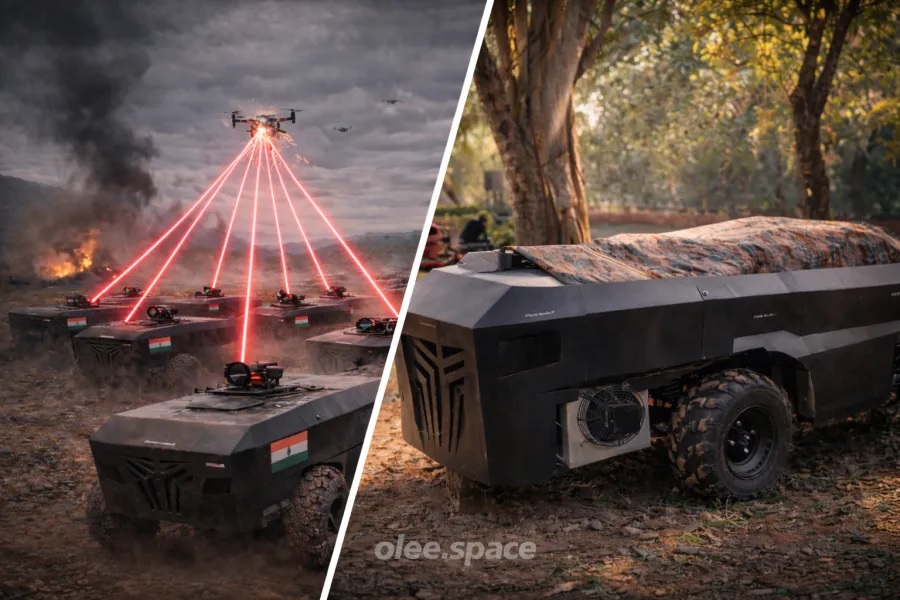
NEW DELHI : Indian defense technology company olee.space has formally unveiled a compact 2-kilowatt (2 kW) artificial-intelligence-enabled laser sniper system integrated onto an Unmanned Ground Vehicle (UGV), marking a new milestone in indigenous directed-energy and autonomous ground warfare capabilities. The company said the system has completed field trials with defense stakeholders and has entered an operationally ready, sale-ready phase.
System Overview and Classification
The newly developed platform is categorized as a ground-based Directed Energy Weapon (DEW) intended for close-combat, perimeter security, and tactical area defense. The laser system is designed to deliver precise, non-kinetic engagements against a range of targets while operating autonomously or as part of a coordinated unit.
According to olee.space, the laser sniper delivers a maximum output of 2 kW and is optimized for rapid engagement scenarios. A key technical parameter is its 30-microsecond (30µs) switching time, enabling near-instant target acquisition and firing once a threat is identified.
Cost and Sustainment Characteristics
One of the defining features of the system is its low operational cost. The company estimates the cost per engagement at under $3 per shot, significantly lower than conventional kinetic munitions. This cost profile is intended to support sustained defensive operations without the logistical burden of ammunition resupply.
UGV Platform and Mobility
The laser module is mounted on a compact, ruggedized UGV platform measuring approximately five feet by three feet. The vehicle’s total weight is under 250 kilograms, allowing it to operate in environments where heavier armored systems face mobility constraints.
The UGV is powered by a diesel engine and offers a base operational range of approximately 130 kilometers, with the option to extend range through additional fuel capacity. The system supports one-touch autonomous deployment, enabling rapid activation in response to emerging threats. The platform is designed for use across urban areas, forests, deserts, and border regions with limited infrastructure.
Artificial Intelligence and Autonomous Functions
The platform integrates proprietary AI and machine-learning algorithms for navigation, surveillance, and target recognition. These systems allow the UGV to operate with minimal human intervention, identifying predefined threats and responding in dynamic operational environments.
A central capability of the system is swarm operation. Multiple UGVs can be networked to function collaboratively, forming coordinated defensive formations around sensitive installations or operational zones. This machine-to-machine coordination enables distributed coverage and faster response times compared with centrally controlled platforms.
Intended Operational Roles
The laser sniper system is designed to perform a range of defensive functions, including neutralization, dazzling, and functional disabling of hostile personnel, vehicles, and equipment. As a non-kinetic option, it is suited for perimeter defense of strategic assets, critical infrastructure, and inland security locations where controlled escalation and precision engagement are required.
The system is also positioned for use in infantry support and special operations, providing mobile, autonomous fire support while reducing direct exposure of personnel to hostile threats.
Company Statement and Development Status
James Solomon, Founder and Chief Executive Officer of olee.space, said the platform combines directed-energy technology, artificial intelligence, and autonomous mobility into a single deployable system. He stated that the design focuses on engaging known targets in rapidly changing environments, while reducing operational risk to human operators.
olee.space confirmed that the system has progressed from prototype development and field-testing phases to full operational readiness. The company is currently engaged in discussions with defense and security clients, including international partners aligned with India.
Strategic Context
The introduction of the AI-enabled laser sniper UGV aligns with India’s broader push to develop indigenous advanced defense technologies and reduce dependence on imported optical, autonomous, and weapon subsystems. Defense analysts note that the move into ground-based directed-energy platforms places India among a small but growing group of countries actively fielding such systems.
With the platform now available for deployment and commercial sale, the development represents a step toward the operational use of autonomous, non-kinetic ground combat systems within India’s evolving defense ecosystem.
——— End of Article ———