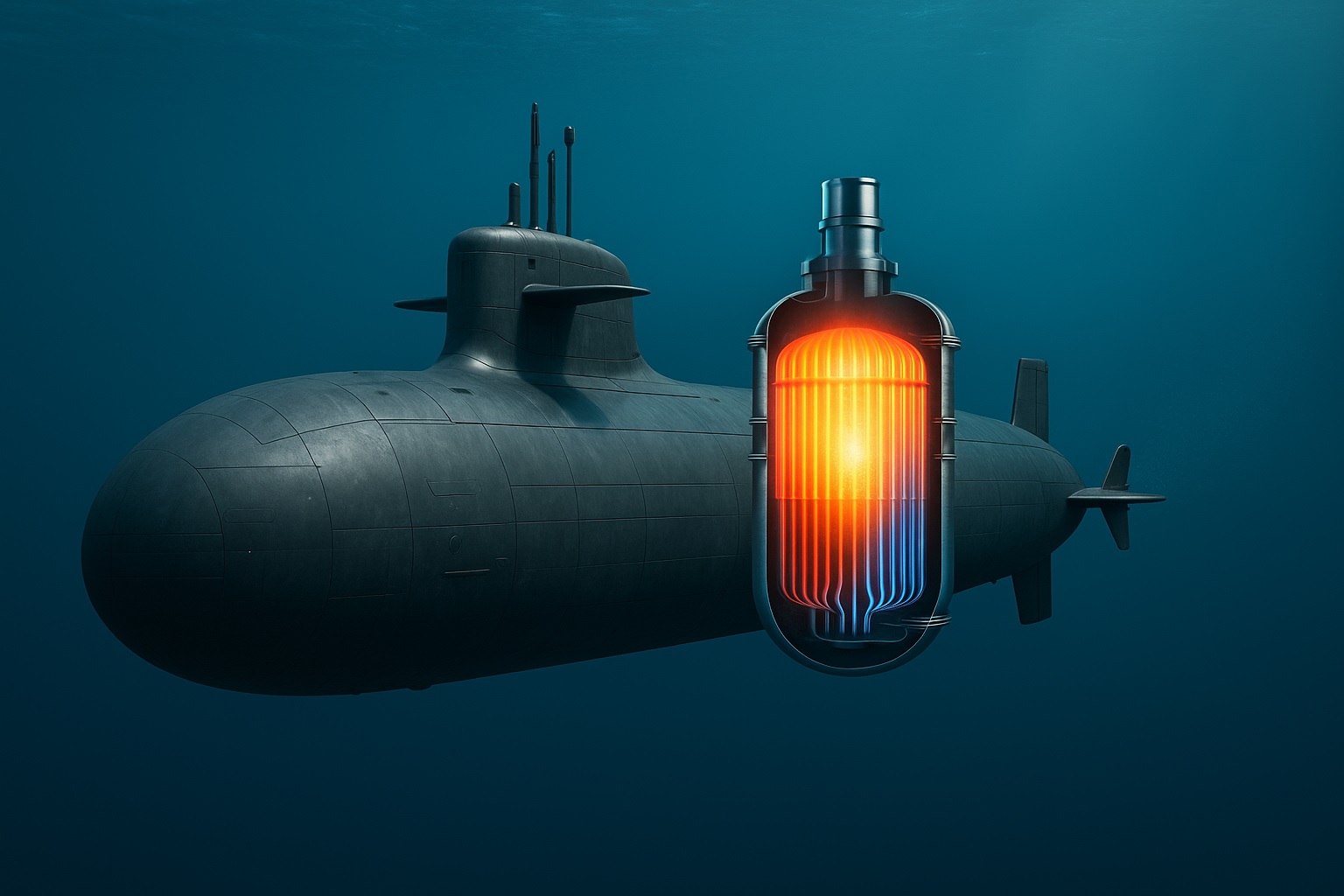
In a significant leap towards strengthening India’s underwater deterrence capabilities, the Indian Navy's upcoming class of nuclear-powered attack submarines under Project-77 could be equipped with the CLWR-B2 reactor—a compact yet powerful pressurized water nuclear reactor engineered specifically for military maritime use. Sources close to the Indian defense establishment indicate that the reactor will provide around 190 megawatts (MW) of thermal output and approximately 65 MW of electrical power, placing India in a select league of nations capable of developing indigenous nuclear propulsion systems for attack submarines.
The CLWR-B2 Reactor: India's Maritime Powerhouse
The CLWR-B2, short for Compact Light Water Reactor – B2, is a refined version of the reactor technology used in India’s Arihant-class SSBNs but significantly more powerful and compact. It is being developed by the Bhabha Atomic Research Centre (BARC) in collaboration with the Indian Navy and Larsen & Toubro (L&T), the latter being the main industrial partner for submarine hull construction. The CLWR-B2 represents the next generation of India’s naval nuclear reactors, benefiting from advancements in metallurgy, miniaturization, and thermal management.
Key specifications of the CLWR-B2 reactor include:
-
190 MW of thermal output, used primarily for propulsion via steam turbines.
-
65 MW of electrical output, to power onboard systems such as sonar, navigation, communications, cooling systems, and electronic warfare suites.
-
High efficiency heat exchangers and turbine generators designed for silent operation—a vital asset for stealth in underwater warfare.
-
Enhanced safety systems and passive cooling technologies to meet military resilience standards.
What Does 190 MW Thermal and 65 MW Electric Power Mean for a Submarine?
In nuclear submarines, the thermal output from the reactor is used to produce steam, which turns turbines connected to the submarine’s propulsion system, allowing it to cruise underwater at sustained speeds for extended durations. The 190 MW of thermal power enables sustained high-speed operations and greater endurance, potentially surpassing 90 days submerged without surfacing.
The 65 MW electrical power is diverted to auxiliary systems onboard. This includes:
-
High-capacity sonar suites and sensor arrays for long-range detection.
-
Electronic warfare systems and decoys for survivability.
-
Life-support systems (air filtration, oxygen generation, fresh water production).
-
Weapon systems, including the powering of vertical launch systems for cruise missiles like the BrahMos and potentially the Nirbhay SLCM.
-
Combat Management System (CMS), navigation, and secure communication arrays.
This power profile puts India's SSNs close to US Virginia-class submarines and Russian Yasen-class SSNs in terms of energy capabilities, albeit with room for growth in stealth and automation.
Project-77: India’s SSN Leap
Project-77, also known informally as the Indian SSN program, aims to build six nuclear-powered attack submarines (SSNs) indigenously. Approved in 2015 with a sanctioned budget of ₹96,000 crore (approx. $12 billion), the submarines will be constructed at the Shipbuilding Centre (SBC), Visakhapatnam, with modular components being fabricated by L&T and other private-sector defense partners.
These SSNs are different from India’s Arihant-class SSBNs, which are meant for nuclear deterrence. SSNs are designed for hunting enemy submarines, escorting carrier battle groups, intelligence gathering, and sea denial missions.
According to defense officials, the first steel for Project-77 was cut in 2021, and the lead boat is expected to undergo harbor trials by 2028, with induction targeted for 2030.
Indigenous Push and Strategic Autonomy
One of the core goals of Project-77 is to achieve full indigenous development of nuclear propulsion and submarine design, which would relieve India from dependence on Russian Akula-class leased submarines (like the now-returned INS Chakra) and reduce exposure to geopolitical constraints.
Additionally, this project enhances India’s second-strike capability and blue-water dominance, especially in the Indian Ocean Region (IOR), where competition with China is intensifying. The integration of CLWR-B2 ensures that India’s SSNs are not only homegrown but optimized for long deployments, rapid strike roles, and future upgrades.
With the inclusion of the CLWR-B2 reactor, India’s Project-77 SSNs represent a landmark stride toward fielding a nuclear-powered submarine fleet that can operate without tether to shore for months, rivaling some of the best in the world. The dual-output (thermal and electric) configuration of the reactor provides ample propulsion and onboard power for sophisticated combat and surveillance operations.
While the program remains under tight secrecy, its implications for India’s naval doctrine, indigenous defense manufacturing, and regional deterrence posture are profound. As the world watches, India steadily sails toward a future where it can project underwater power on its own terms.
——— End of Article ———