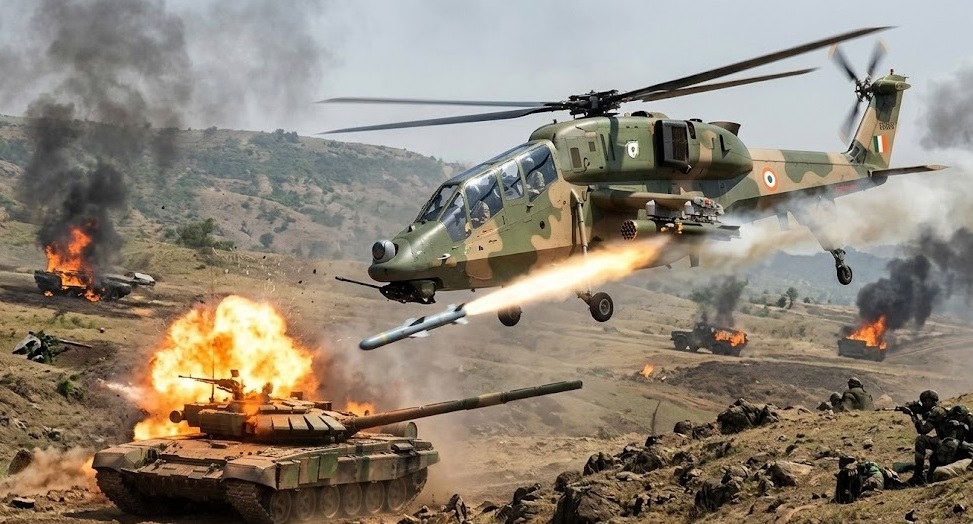
NEW DELHI — March 15, 2026 : India’s indigenous Light Combat Helicopter (LCH) Prachand, developed and manufactured by Hindustan Aeronautics Limited, has entered its full weaponization phase as the Indian armed forces prepare to begin user trials of advanced anti-tank guided missiles. The development marks a key stage in the operational maturation of the helicopter, which is designed primarily for high-altitude combat missions.
The next phase of testing will focus on integrating and validating the HELINA and Dhruvastra anti-tank guided missile (ATGM) systems, both developed by the Defence Research and Development Organisation and produced by Bharat Dynamics Limited. The trials are part of a broader effort to ensure that the Prachand fleet enters service with fully operational precision-guided weapon capabilities.
The progress follows the approval by India’s Ministry of Defence (India) to procure 156 additional LCH Prachand helicopters, which will significantly expand the rotary-wing combat fleet of the Indian armed forces.
HELINA and Dhruvastra ATGM Integration
The initial weaponization focus involves the helicopter-launched variants of the Nag missile family.
HELINA (Helicopter-launched Nag) is designated for the Indian Army Aviation Corps, while Dhruvastra is the variant intended for the Indian Air Force (IAF). Both missiles share the same underlying design and operational characteristics.
The systems are third-generation “fire-and-forget” anti-tank guided missiles equipped with imaging infrared (IIR) seekers that enable lock-on-before-launch capability. Once a target is locked, the helicopter crew can disengage immediately after launch, allowing the aircraft to maneuver or withdraw from the engagement area.
The missiles have an operational engagement range of approximately 7–10 kilometers and are designed to penetrate up to around 800 mm of modern armored protection, enabling them to defeat main battle tanks and heavily armored vehicles. They are capable of day-night and all-weather operations.
Previous validation trials conducted in Ladakh confirmed the missile’s performance in high-altitude and low-temperature environments, demonstrating successful target acquisition and destruction in thin air conditions. Flight trials integrating the missiles with the Prachand helicopter are expected to begin by late 2026 or early 2027.
Planned Integration of Air-Launched Loitering Munitions
In addition to conventional anti-tank missiles, a longer-term modernization roadmap for the Prachand platform includes the integration of air-launched loitering munitions.
These systems are lightweight unmanned aerial vehicles, typically weighing less than 45 kilograms, capable of persistent surveillance, target identification, and precision strike missions. Once launched, the loitering munition can remain airborne over a designated area before diving onto a selected target with an onboard explosive payload.
Integrating such systems would enable the Prachand to deploy drones from the air, significantly extending the operational reach of the munitions compared to ground launches. The concept would allow the helicopter to release loitering drones from outside heavily defended airspace, enabling strikes against targets such as radar installations, armored formations, or logistical infrastructure.
This approach also aligns with the broader concept of manned-unmanned teaming (MUM-T), in which manned aircraft operate in coordination with autonomous or remotely controlled unmanned systems.
Platform Design and Technical Characteristics
The LCH Prachand is a dedicated attack helicopter designed specifically for high-altitude operations, addressing operational requirements along India’s mountainous borders.
Key characteristics include:
-
Maximum takeoff weight: approximately 5.8 tonnes
-
Service ceiling: over 21,000 feet (6,500 meters)
-
High-altitude takeoff and landing capability: around 5,000 meters
-
Twin Shakti engines, co-developed with France’s Safran
-
Armored cockpit and critical system protection
-
Advanced avionics suite, including helmet-mounted sights and electro-optical targeting systems
-
Electronic warfare and self-protection systems
The helicopter’s existing armament configuration includes:
-
20 mm M621 chin-mounted cannon
-
70 mm rocket pods
-
Up to eight Mistral-2 air-to-air missiles for self-defense and counter-drone engagement
-
Hardpoints for anti-tank guided missiles, including HELINA and Dhruvastra
The combination of these systems allows the helicopter to perform a wide range of missions, including anti-armor warfare, close air support, battlefield reconnaissance, and aerial target engagement.
Procurement of 156 Additional Helicopters
In March 2025, the Ministry of Defence signed contracts worth approximately ₹62,700 crore (excluding taxes) for the acquisition of 156 LCH Prachand helicopters.
The planned distribution is:
-
Indian Army: 90 helicopters
-
Indian Air Force: 66 helicopters
Production will be carried out at HAL’s Tumakuru manufacturing facility in Karnataka. Deliveries are expected to begin around three years after contract signing and continue over a five-year production schedule.
This order follows the earlier induction of 15 limited series production helicopters, delivered beginning in 2022, including:
-
10 helicopters for the Indian Air Force
-
5 helicopters for the Indian Army
Operational Role in High-Altitude Environments
The Prachand helicopter was developed to address the operational challenges posed by extreme-altitude combat zones, including regions such as Siachen Glacier and Eastern Ladakh.
Many conventional attack helicopters experience performance limitations in thin air environments. The Prachand’s design enables sustained operations at altitudes exceeding 6,000 meters, providing armed reconnaissance, anti-armor capability, and close air support to ground forces deployed in mountainous terrain.
The integration of long-range anti-tank missiles and loitering munitions will further expand the helicopter’s ability to engage targets from standoff distances, reducing exposure to short-range air defense systems.
Indigenous Defence Production
The Prachand program forms part of India’s broader Atmanirbhar Bharat initiative to expand domestic defence manufacturing.
According to industry data, the platform incorporates more than 65 percent indigenous content and involves over 250 Indian suppliers, including numerous micro, small, and medium enterprises. The program integrates a domestic aerial platform with indigenous weapons systems such as HELINA and Dhruvastra, reducing reliance on imported attack helicopters and foreign munitions.
With the ongoing weapon integration trials and planned procurement of 156 additional units, the LCH Prachand is expected to evolve into a fully combat-ready high-altitude attack helicopter platform capable of precision anti-armor operations and future drone-enabled warfare roles within the Indian armed forces.
——— End of Article ———