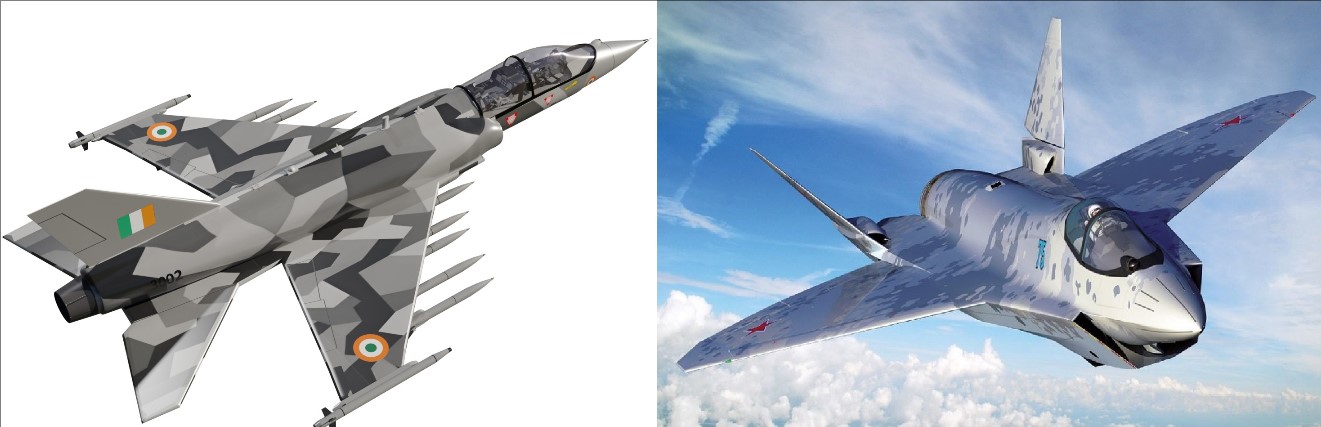
India’s Hindustan Aeronautics Limited (HAL) is making waves with its plans for the Hindustan Aeronautics Limited Fighter Trainer-42 (HLFT-42), a next-generation advanced jet trainer. While the current focus is on developing an AI-driven platform for pilot training, the HLFT-42 could serve as the foundation for a transformative leap in India's defense aviation. If HAL prioritizes a low radar cross-section (RCS) in the early stages of the HLFT-42’s design, the aircraft could evolve into a platform comparable to China's Chengdu J-10 and, eventually, even a low-cost 5th-generation stealth fighter.
Low RCS Design: A Strategic Beginning
A low RCS design for the HLFT-42 from the outset could be a game-changer. By emphasizing stealth elements, such as shaping, internal weapon bays, and composite materials, HAL could position the HLFT-42 as not just a trainer but also as a potential multi-role combat aircraft.
Key elements of a low RCS-focused HLFT-42 might include:
- Stealth-Optimized Airframe: Smooth, angular surfaces to deflect radar waves, minimizing detection.
- Engine Infrared Suppression: Modifications to reduce heat signatures, crucial for stealth operations.
- Internal Weapon Carriage: Retrofitting bays for future upgrades to carry guided weapons without compromising stealth.
- Radar-Absorbent Materials (RAM): Integration of advanced coatings and composite materials to further reduce RCS.
Such a configuration would not only enhance survivability in contested airspaces but also enable seamless transition to a combat-capable platform with minor modifications.
A Transition to a J-10-Class Fighter
The HLFT-42, equipped with the powerful AL-31FP turbofan engine, could evolve into an aircraft with performance metrics akin to the J-10, which serves as the backbone of China's air force. With an initial thrust output of approximately 123 kN, the AL-31 engine offers ample power for both high agility in training scenarios and combat versatility.
HAL’s gradual upgrades to the HLFT-42 could include:
- Advanced Avionics: Integration of Active Electronically Scanned Array (AESA) radars, improved electronic warfare (EW) suites, and enhanced situational awareness systems.
- Expanded Payload Capacity: Compatibility with air-to-air and air-to-ground munitions, transforming the HLFT-42 into a light multi-role fighter.
- In-Flight Refueling: Increasing endurance for longer missions.
This upgraded variant could serve as an affordable yet potent option for countries looking for a light fighter, filling a niche between trainers and full-fledged multirole jets.
The Future: A Single-Engine 5th Generation Variant
Building on the HLFT-42’s airframe and technology, HAL could develop a single-engine, 5th-generation stealth fighter, offering a low-cost alternative to platforms like Russia’s Sukhoi Su-75 Checkmate. Such an aircraft could complement India's Advanced Medium Combat Aircraft (AMCA) by filling the role of a cost-effective, high-volume fighter for frontline operations.
Design Elements for a Future 5th-Gen Variant:
- Stealth Enhancements: Full stealth shaping with internal weapon bays and sensor integration.
- Improved Propulsion: An upgraded version of the AL-31 or indigenous Kaveri-derived engines for enhanced thrust and fuel efficiency.
- Network-Centric Capabilities: Seamless integration with existing platforms like AMCA, Su-30MKI, and UAVs for coordinated operations.
- AI-Driven Systems: Fully autonomous flight capabilities, sensor fusion, and predictive maintenance powered by artificial intelligence.
- Supersonic Cruise: Achieving supercruise capabilities to reduce reliance on afterburners, increasing operational range and survivability.
By incorporating lessons learned from the HLFT-42 program and leveraging stealth expertise from the AMCA, this future fighter could provide India with an edge in low-cost 5th-generation air dominance.
Strategic Advantages
- Affordability and Scalability: The HLFT-42 and its derivatives would serve as cost-effective alternatives to heavy fighters like the Su-30MKI, reducing the operational burden while increasing fleet numbers.
- Export Potential: A 5th-gen light fighter could be an attractive option for countries unable to afford high-end Western fighters.
- Force Multiplication: Working in tandem with AMCA and other platforms, the HLFT-42 derivatives could create a layered defense and offense strategy, ensuring air superiority.
- Indigenous Capability: Developing a light, 5th-generation fighter domestically would further India’s Atmanirbhar Bharat (self-reliance) goals in defense production.
Complementing AMCA in Warfare
While the AMCA is designed as a heavy stealth fighter optimized for advanced missions, a single-engine stealth variant of the HLFT-42 could handle:
- High-tempo missions requiring rapid deployment.
- Operations in secondary theaters, freeing up AMCA for critical engagements.
- Cost-effective patrols and quick-reaction alerts.
Together, the two platforms would create a balanced air force capable of countering threats across the spectrum, from peer adversaries to asymmetric challenges.
Conclusion
The HLFT-42 offers India more than just a trainer—it is a potential springboard to an entire family of future-ready aircraft. By focusing on low RCS from the beginning, HAL can lay the groundwork for a multi-role fighter in the J-10 category and eventually evolve the platform into a low-cost, single-engine 5th-generation stealth aircraft. This strategic move could redefine India’s airpower and enable it to meet the challenges of modern aerial warfare while achieving cost efficiency and technological self-reliance.
As India continues its journey toward becoming a global aviation leader, the HLFT-42 stands as a critical milestone, showcasing the nation's commitment to innovation, adaptability, and operational excellence.
——— End of Article ———