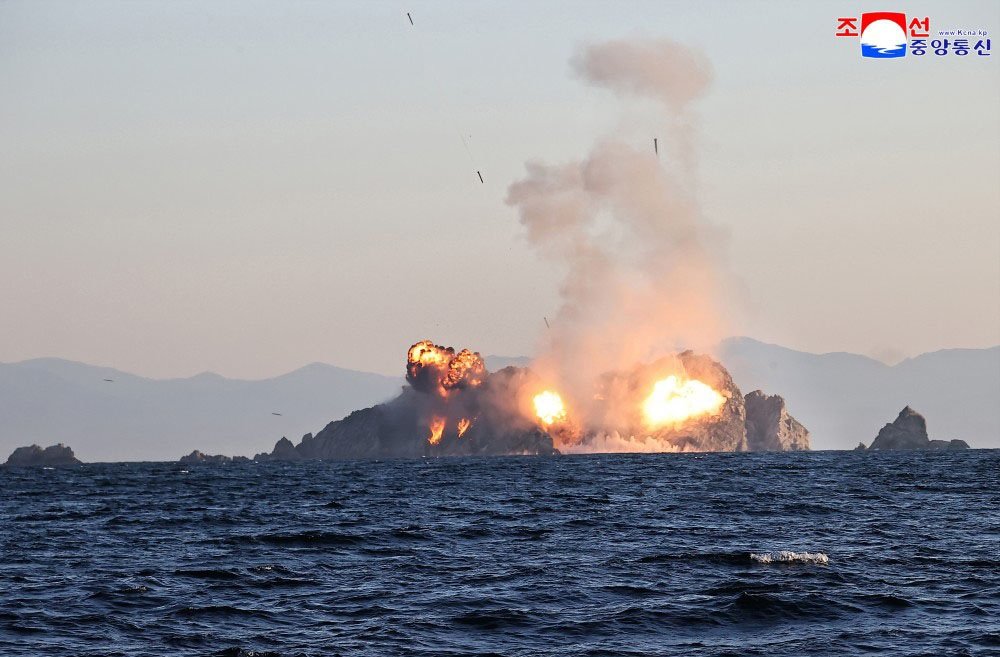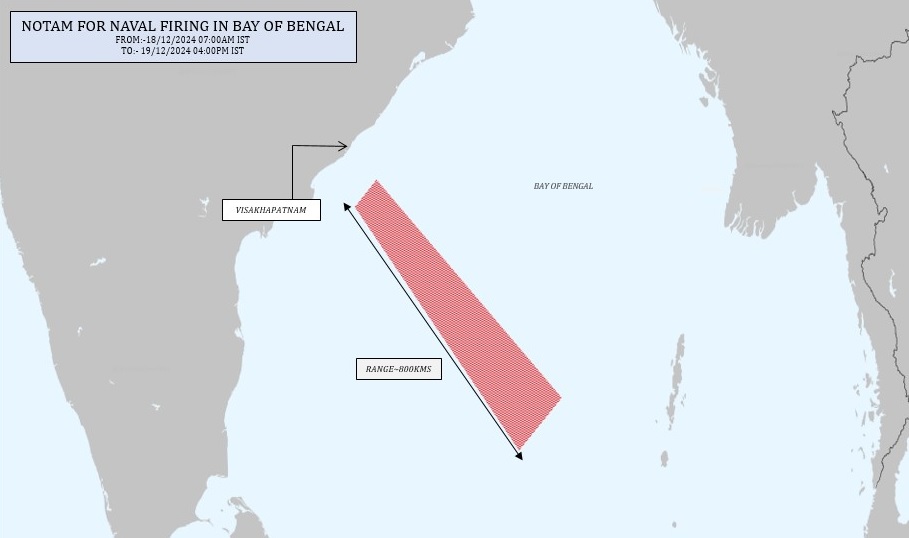
The Indian Navy has issued a Notice to Airmen (NOTAM) for December 18 and 19, 2024, signaling preparations for a potential missile test in the Bay of Bengal. This notification designates an area with a range of up to 800 km, sparking widespread speculation about which advanced missile system might be under trial. Two key contenders dominate discussions: the BrahMos Extended Range (ER) supersonic cruise missile and the Indigenous Technology Cruise Missile (ITCM).
BrahMos-ER: A Leap in Supersonic Capability
The BrahMos-ER represents a significant evolution of the Indo-Russian BrahMos cruise missile. While the original variant had a range of 290 km, the ER version extends this to over 800 km, thanks to advancements in propulsion and design. Its supersonic speed, exceeding Mach 3, ensures rapid delivery of precision strikes, making it a formidable weapon for naval and coastal defense.
A successful test of the BrahMos-ER from a naval platform would mark a milestone in the Navy's ability to project power across vast maritime distances. This capability is particularly vital in the Indian Ocean Region (IOR), where control of sea lanes is essential for both security and economic stability.
ITCM: A Boost for Indigenous Technology
The ITCM is a subsonic cruise missile powered by the domestically developed Manik turbofan engine. Designed to replace foreign engines in India's missile arsenal, the ITCM represents a critical step toward self-reliance in defense technology.
While primarily envisioned for land-based platforms, launching the ITCM from a naval warship would showcase its versatility. Its estimated range—likely comparable to the BrahMos-ER—combined with its precision navigation system, could provide the Navy with an economical yet effective tool for long-range maritime strike operations.
Strategic Implications
Testing either of these missiles would underscore India's commitment to enhancing its indigenous defense capabilities. The BrahMos-ER, with its unmatched speed and range, offers the Navy a cutting-edge tool for rapid response and deep-strike missions. Meanwhile, the ITCM signals India's ability to innovate in-house, reducing dependence on foreign suppliers and potentially lowering costs.
In a broader context, these advancements play into India's strategic posture in the IOR. With increasing activity from rival powers, the Indian Navy’s focus on long-range precision strike capabilities bolsters its ability to deter threats and maintain dominance in this geopolitically critical region.
Context and Future Outlook
The NOTAM hints at a rigorous operational trial, likely simulating real-world conditions to validate the selected missile's performance. This kind of testing ensures reliability, accuracy, and integration with naval systems—crucial factors for deployment readiness.
If successful, the missile test would mark a pivotal moment in India’s maritime modernization drive. The inclusion of systems like the BrahMos-ER and ITCM aligns with India's broader vision of developing a robust, indigenous defense ecosystem while preparing its armed forces for the challenges of modern warfare.
Title for Search Engine Indexing
"Indian Navy's Missile Test in Bay of Bengal: BrahMos-ER or ITCM to Redefine Maritime Strike"
——— End of Article ———