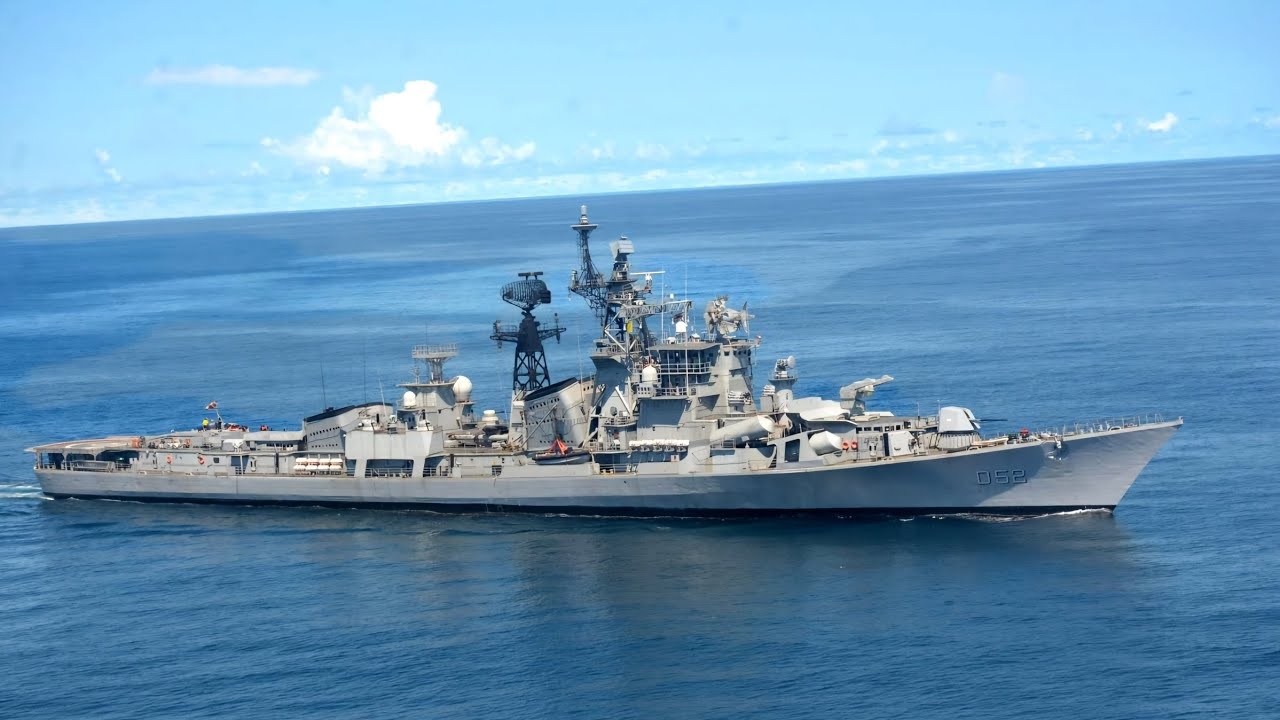
Bengaluru, August 2025 – In a significant boost to the Indian Navy’s surveillance and combat capabilities, the indigenously developed MFR X-Band Radar has been successfully integrated with the frontline warship INS Rana, a Rajput-class destroyer. The radar, jointly developed by the Defence Research and Development Organisation (DRDO) and Bharat Electronics Limited (BEL), was showcased at Aero India and represents a leap forward in naval radar technology for India.
Advanced Features for Maritime Operations
The Multi-Function Radar (MFR) X-Band is built to deliver superior tracking and targeting performance even in rough sea states. Its design includes:
-
Electronic stabilization to compensate for ship roll and pitch during operations.
-
Distributed T/R module design that ensures graceful degradation of system performance in case of localized failures, improving reliability.
-
Automatic acquisition and tracking of both air and surface targets with high update rates.
-
Seamless integration with CMS (Combat Management System) and WCS (Weapon Control System), enabling precise engagement of threats with surface-to-air missiles (SAMs) and naval guns.
Technical Specifications
The radar operates in the X-band frequency and employs four phased-array antennas that provide 360° azimuth coverage. Its elevation coverage extends up to 70°, allowing effective tracking of high-angle aerial threats, including anti-ship missiles and fast maneuvering aircraft.
Key highlights include:
-
Solid-state active array technology with electronic scanning in both azimuth and elevation.
-
Detection range over 200 km in Track While Scan (TAWS) mode.
-
Extended range beyond 300 km in Long Range Surveillance (LRS) mode.
-
Lightweight design with antenna weight around 1.27 tons, making it adaptable for various classes of naval platforms.
-
Fully compliant with MIL-STD and JSS55555:2012 naval qualification standards.
Strategic Importance for INS Rana
INS Rana, a Rajput-class guided missile destroyer, has been in service since 1982 and continues to play a crucial role in the Navy’s Eastern Fleet. The integration of the MFR X-Band radar significantly enhances its air defense and maritime strike capabilities, providing the ship with a modern sensor suite that can effectively counter new-generation threats such as sea-skimming missiles, drones, and stealth aircraft.
This upgrade also reflects India’s focus on indigenous solutions for warship modernisation, reducing dependence on foreign radars and strengthening self-reliance under the Atmanirbhar Bharat initiative.
Part of a Larger Naval Modernisation Drive
The induction of MFR X-Band radars is part of a broader naval plan to equip Indian warships with multi-function active phased array radars capable of long-range surveillance, precision tracking, and fire-control functions. These radars are expected to be standard fits on future destroyers, frigates, and aircraft carriers, ensuring seamless integration across platforms.
The successful integration of the MFR X-Band radar aboard INS Rana represents a vital step in India’s efforts to modernise its naval fleet with indigenous, next-generation electronic systems. With its advanced tracking, targeting, and surveillance capabilities, the radar will significantly improve the Indian Navy’s operational readiness and provide a decisive edge in safeguarding maritime interests in the Indo-Pacific region.
Do you also want me to prepare a comparison box at the end (e.g., MFR X-Band Radar vs existing naval radars like RAWL-02 or EL/M-2248 MF-STAR) so readers can easily see its technological leap?
——— End of Article ———