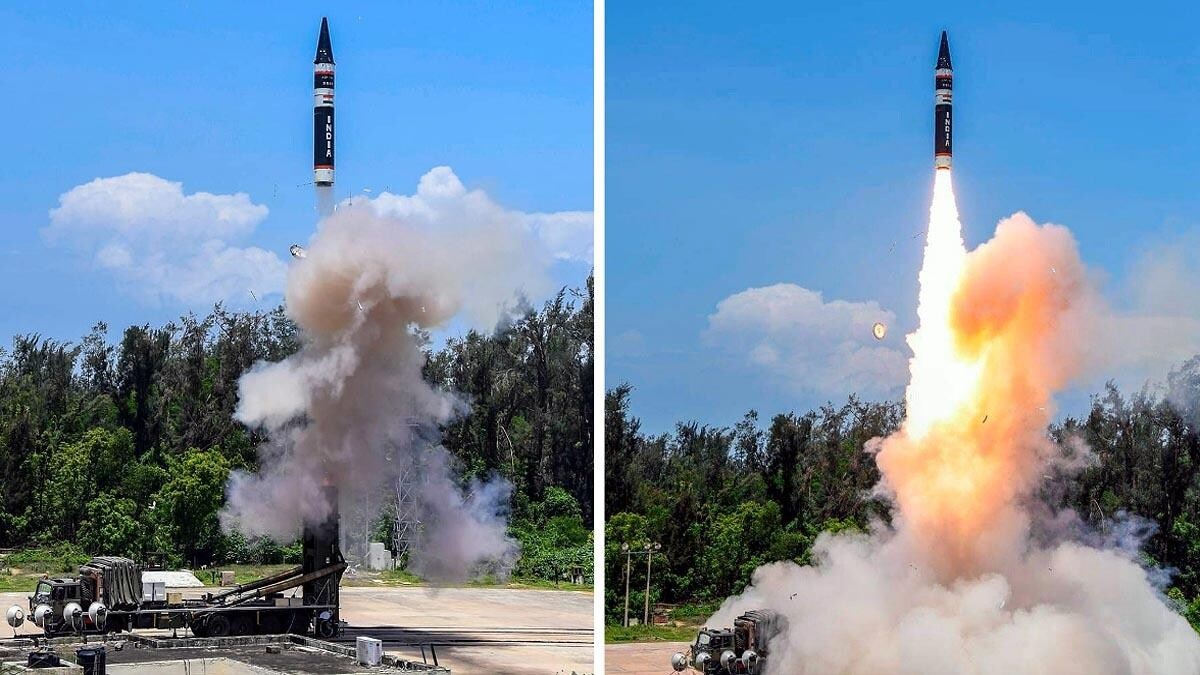
India is advancing its anti-ship missile capabilities with the anticipated test of a Long-Range Anti-Ship Missile (LR-AShM), a move marked by a recent Notice to Airmen (NOTAM) covering a 1,700-kilometer stretch in the Bay of Bengal. Scheduled for November 15 to 17, 2024, this test range hints at a high-stakes launch aimed at bolstering India's maritime deterrence, and it reflects India's aspirations to secure a formidable "carrier-killer" weapon—an asset of strategic depth in modern naval warfare.
A New Leap for India’s Naval Strike Capability
The LR-AShM is expected to bring several high-end capabilities to the Indian arsenal, addressing specific gaps in range and lethality. Unlike conventional anti-ship missiles, India’s LR-AShM, possibly developed by the Defense Research and Development Organisation (DRDO), aims to target large surface vessels like aircraft carriers, posing a significant deterrence factor in a region marked by growing naval competition.
This advanced missile is expected to carry sophisticated guidance systems, possibly leveraging satellite navigation, infrared, and radar homing to ensure precision at long ranges. Furthermore, it may employ cutting-edge countermeasures to evade enemy defenses, increasing its survivability against modern shipborne anti-missile systems. Given the 1,700-kilometer test area, the LR-AShM likely has a range capable of projecting India’s influence deep into contested waters.
The Strategic Significance of the Bay of Bengal Testing Zone
Choosing the Bay of Bengal as a testing ground is both strategic and pragmatic. The vast waters here offer India an ideal area to evaluate missile characteristics, such as speed, flight stability, and maneuverability in a controlled environment. With growing concerns over naval encroachment in the Indian Ocean Region (IOR), the Bay of Bengal provides a geographically advantageous spot for India to test systems that can secure this space. The designated area for the missile test indicates India's commitment to refining and validating its long-range strike capability, especially in maritime contexts.
Technical Advancements: What Makes the LR-AShM Unique?
While much about the LR-AShM remains undisclosed, several features are likely given India’s prior experience with missiles like the BrahMos, Nirbhay, and Agni series. The LR-AShM may adopt a dual-mode seeker technology, allowing it to identify targets accurately even under challenging conditions. It could also boast low-altitude "sea-skimming" flight to evade radar detection until it reaches close proximity to its target. The missile’s propulsion system, possibly based on a solid-fuel rocket or air-breathing ramjet engine, would enable it to achieve supersonic or even hypersonic speeds, making interception by adversarial systems extremely difficult.
A Boost for India's Defense Doctrine
The LR-AShM test exemplifies India’s focused shift towards anti-access/area-denial (A2/AD) capabilities, a military doctrine aimed at deterring enemy forces from accessing or operating in particular areas. As India diversifies its missile programs, such carrier-killer technology is becoming an essential part of its defensive posture. The integration of the LR-AShM into India’s naval forces, especially on platforms like the Su-30MKI or surface ships, would substantially enhance India’s deterrence profile, especially given the presence of powerful foreign navies in nearby waters.
The NOTAM and Test Protocols: Standard Procedure and Strategic Messaging
Issuing a NOTAM is customary for tests of this nature, alerting regional air and maritime traffic of a restricted area. Beyond protocol, though, the notification indirectly signals India’s strengthening of its missile arsenal and conveys to both allies and adversaries that the country is capable of defending its maritime boundaries with advanced technology. These tests underscore India’s progress in indigenous missile development, driven by agencies like DRDO, which has accelerated research on next-gen missiles with improved range, accuracy, and survivability.
In summary, this missile test represents India’s unwavering commitment to safeguarding its maritime interests and maintaining its defense independence. As the country edges closer to operationalizing the LR-AShM, it sends a clear signal: India is not only prepared to defend its shores but also equipped to project strength across its maritime sphere. This potential "carrier-killer" could change the calculus of naval engagements in the Indian Ocean, reinforcing India's strategic autonomy and regional security footprint.
——— End of Article ———