NEW DELHI/ISLAMABAD, — April 15, 2026 : Pakistan conducted a scheduled missile test in the North Arabian Sea on April 14 and April 15, 2026, within a designated exclusion zone announced through a Notice to Airmen (NOTAM), while India deployed its ocean surveillance vessel INS Dhruv to monitor the activity from international waters.
Test Zone and Airspace Restrictions
Pakistan Navy authorities established a restricted zone covering an area of approximately 415 by 450 kilometers in the northern Arabian Sea. The designated region lies off the country’s coastline near Karachi, Ormara, Gwadar, and Sonmiani. The NOTAM imposed temporary restrictions on air traffic routes over the area, extending from sea level to unlimited altitude, to ensure safety during the live-fire exercise.
The exclusion zone was active across April 14 and April 15, with maritime and aviation advisories issued in advance. Pakistani officials did not disclose the specific missile system involved in the tests, and no official confirmation has been released regarding the type, range, or configuration of the missile tested.
Possible System Characteristics
While no formal identification has been provided, defence assessments indicate the test may involve a surface-to-surface ballistic missile, a sea-launched system, or a long-range cruise missile. Analysts note that several of Pakistan’s missile platforms incorporate design elements and technical inputs derived from cooperation with China in both ballistic and cruise missile development programs.
Pakistan has previously conducted missile trials in the Arabian Sea region as part of routine validation of its strategic and naval strike capabilities, including systems launched from both land-based and maritime platforms.
Indian Navy Deployment
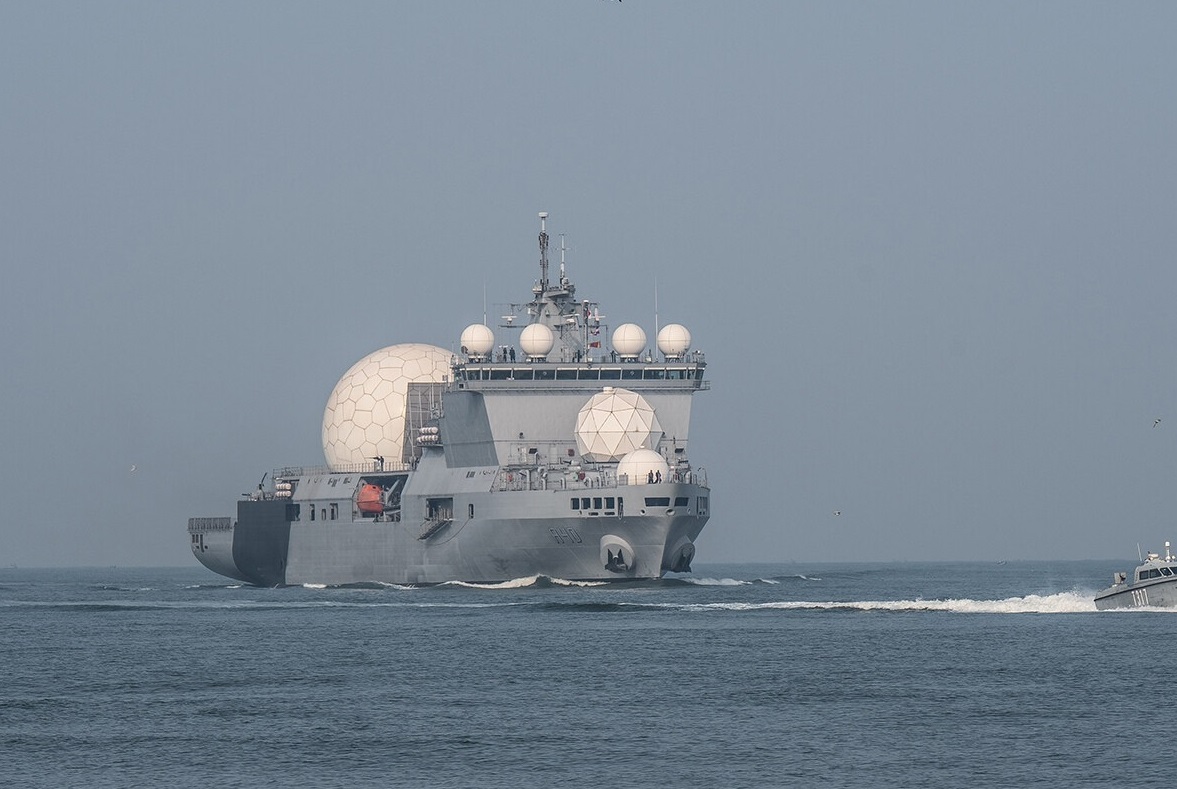
In response to the announced test window, the Indian Navy deployed INS Dhruv into the Arabian Sea on April 13, 2026, positioning the vessel in international waters outside the declared exclusion zone approximately 24 hours before the scheduled launch period.
INS Dhruv (A40) is a specialized ocean surveillance and missile-tracking ship with a displacement estimated between 15,000 and 17,000 tons. The vessel was built by Hindustan Shipyard Limited with technical contributions from the Defence Research and Development Organisation (DRDO) and the National Technical Research Organisation (NTRO).
The ship measures approximately 175 meters in length with a beam of 22 meters and is powered by a combined diesel and diesel (CODAD) propulsion system using twin diesel engines.
Tracking and Sensor Capabilities
INS Dhruv is equipped with a suite of advanced sensors designed for long-range tracking and telemetry interception. Its primary systems include an X-band active electronically scanned array (AESA) radar and a secondary S-band AESA radar, both housed within large radomes. These systems enable detection, tracking, and analysis of ballistic missile trajectories and satellite movements over extended distances.
In addition to radar tracking, the vessel is fitted with telemetry receivers and electronic intelligence systems capable of capturing data related to missile flight characteristics, including velocity, trajectory, staging events, maneuver profiles, and terminal phase behavior.
Intelligence Collection Role
Operating from international waters allows INS Dhruv to monitor the missile test without entering Pakistan’s restricted zone or violating maritime regulations. From this position, the vessel can collect real-time technical data generated during the launch, including radar signatures and electronic emissions.
The deployment enables the Indian Navy to gather direct observational data on the performance parameters of the tested system. Such information is used for analysis, system modeling, and calibration of India’s ballistic missile defence architecture, including early-warning systems and interceptor guidance algorithms.
Strategic Context
India is among a limited group of countries—including the United States, Russia, China, and France—that operate dedicated missile-tracking ships designed for strategic intelligence collection.
The ongoing test by Pakistan forms part of its broader program to validate operational readiness and performance of its strategic missile inventory. The use of the Arabian Sea as a testing range allows for extended flight paths and controlled monitoring conditions.
As of April 15, 2026, neither Pakistan’s military authorities nor India’s Ministry of Defence have issued official public statements detailing the outcome of the test or additional operational specifics regarding the deployment of INS Dhruv.
——— End of Article ———