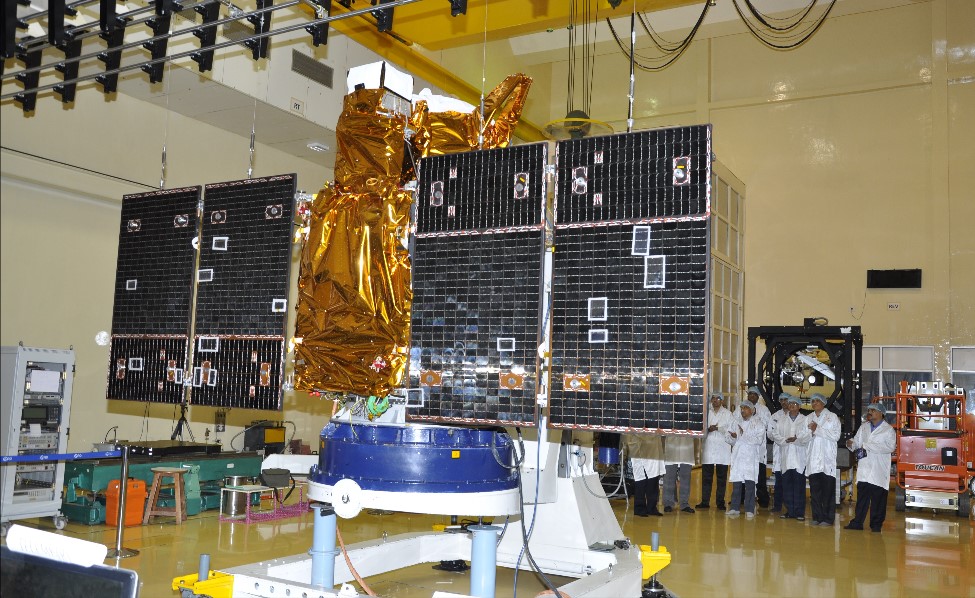
Space News ,India :- The Indian Space Research Organisation (ISRO) has concluded all essential tests on the INSAT-3DS satellite, marking a crucial milestone before the final review process. Following this, the satellite will be transported to the spaceport in Sriharikota, Andhra Pradesh, for its upcoming launch onboard ISRO's GSLV launch vehicle. According to the latest Notice to Air Missions (NOTAM) issued by ISRO, the launch window is set between February 17 and March 17, as reported by TOI.
Part of a series of climate observatory satellites initiated by India, INSAT-3DS follows the launch of INSAT-3DR in 2016. ISRO Chairman S Somanath stated on Tuesday, "All the tests are complete. We will take a call on when to take it to the spaceport after the final review." The successful launch of INSAT-3DS not only signifies the deployment of an advanced Indian meteorological satellite but also serves as a qualification for the GSLV for the upcoming NASA-ISRO Synthetic Aperture Radar (NISAR) satellite launch, expected in March.
In its latest update on NISAR, NASA emphasized the satellite's role in measuring critical Earth vital signs, ranging from wetland health to ground deformation caused by volcanoes. The satellite's primary mission is to study changes in ice sheets, glaciers, and sea ice with exceptional detail, providing valuable insights into the impact of climate change on these frozen surfaces. NASA highlighted that NISAR's capabilities will aid researchers in understanding how small-scale processes contribute to significant changes in ice sheets across Antarctica and Greenland, as well as in mountain glaciers and sea ice globally.
NISAR is poised to offer the most comprehensive overview to date of motion and deformation within Earth's ice- and snow-covered environments, collectively known as the cryosphere. According to Alex Gardner, a glaciologist at the Jet Propulsion Laboratory, "Our planet has the thermostat set on high, and Earth’s ice is responding by speeding up its motion and melting faster… We need to better understand the processes at play, and NISAR will provide measurements to do that."
——— End of Article ———