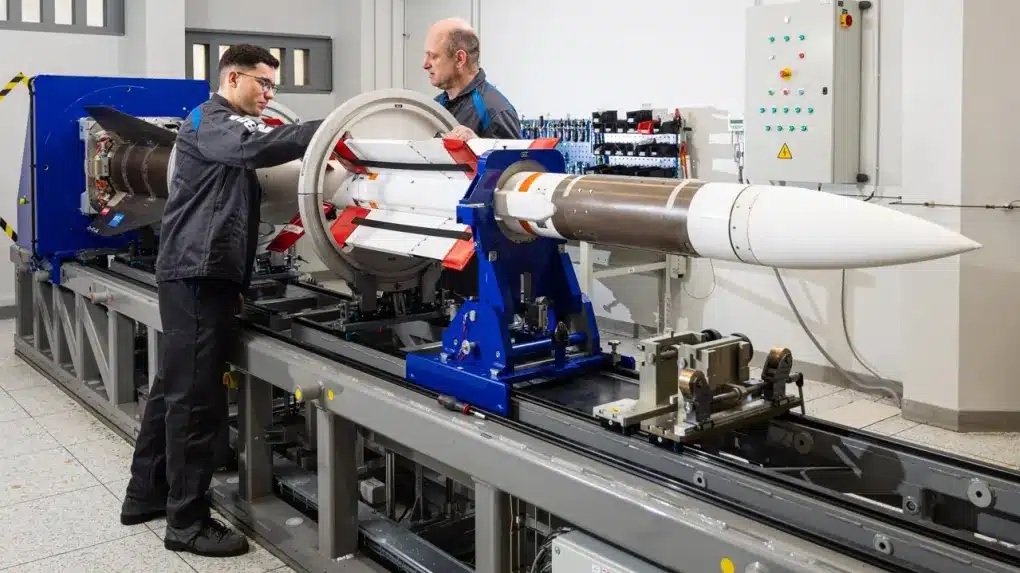
Chennai : Researchers at Indian Institute of Technology Madras (IIT-Madras), working in partnership with Bharat Electronics Limited (BEL), have unveiled an indigenous 80mm precision rocket system intended for deployment from military helicopters. The development represents a new addition to India’s domestically produced air-launched munitions and supports the national objective of defence self-reliance under the Atmanirbhar Bharat initiative.
The rocket has been designed and engineered at the Sudha Murty Centre for Electronic Systems and Instrumentation at IIT-Madras. It is configured to deliver an effective engagement range of approximately 10 to 12 kilometres while remaining compatible with standard helicopter rocket launch pods. According to project officials, the design ensures that multiple-rocket salvo firing can be carried out without adversely affecting aircraft balance or flight stability.
Technically, the munition is powered by a solid-fuel propulsion system that provides sustained thrust, allowing the rocket to achieve velocities in excess of Mach 2. The payload section follows a modular architecture, enabling the same rocket body to be fitted with different warhead options, including high-explosive fragmentation, anti-armor, and airburst variants. This approach allows the weapon to be tailored for a range of mission profiles without structural modification.
Although primarily conceived as a high-accuracy unguided rocket, the system incorporates advanced aerodynamic shaping to improve flight stability and terminal precision. The design also allows for future enhancement with inertial navigation and GPS-based guidance kits, extending its applicability to longer-range and beyond-visual-range engagements if required.
Validation trials were conducted at the Aeronautical Test Range, Chitradurga, where the rocket was tested under simulated operational conditions. During these evaluations, the munition consistently demonstrated impact accuracy within a sub-10-meter circular error margin, meeting the performance thresholds set for helicopter-launched strike weapons.
The rocket is optimized for integration with India’s indigenous rotary-wing platforms, including the HAL Dhruv and the Light Combat Helicopter (LCH) Prachand. BEL has been responsible for production scaling and electronic and systems integration, ensuring compatibility with existing avionics and weapon management systems used by the Indian Armed Forces.
Officials associated with the program stated that the project was initiated to address operational requirements for lightweight, extended-range armaments suited to contemporary asymmetric and high-mobility warfare scenarios. Faculty involved in the development noted that several of the propulsion and aerodynamic technologies demonstrated in the 80mm rocket are also being adapted for other defence applications, including ramjet-assisted artillery concepts, as part of a broader research and development effort.
——— End of Article ———