Technology News ,India :-The Indian government is dedicated to ensuring that clean and safe tap water is available to all rural households in the country. This commitment led to the launch of the Jal Jeevan Mission (JJM) in August 2019. The mission aims to provide a regular and long-term supply of high-quality tap water to rural households, with the government working in partnership with states for its implementation.
Responsibility for planning, approval, implementation, operation, and maintenance of drinking water supply schemes, including those under the Jal Jeevan Mission, rests with State/UT Governments, as drinking water is a state subject. The central government supports states by offering both technical expertise and financial assistance.
Since the initiation of the Jal Jeevan Mission in August 2019, substantial progress has been achieved in improving access to tap water in rural households. Initially, only 16.8% of rural households (3.23 Crore) had tap water connections. According to the latest reports from States/UTs as of December 7, 2023, an additional 10.53 Crore rural households have been provided with tap water connections under JJM. As of this date, approximately 71.51% (13.76 Crore) of the country's 19.24 Crore rural households have tap water supply in their homes.
Given that drinking water is a state subject, the choice of technology to address water quality issues lies with the respective State/UT Governments. The Indian government collaborates with academic institutions like IITs to provide advice on various technologies available to tackle water quality challenges.
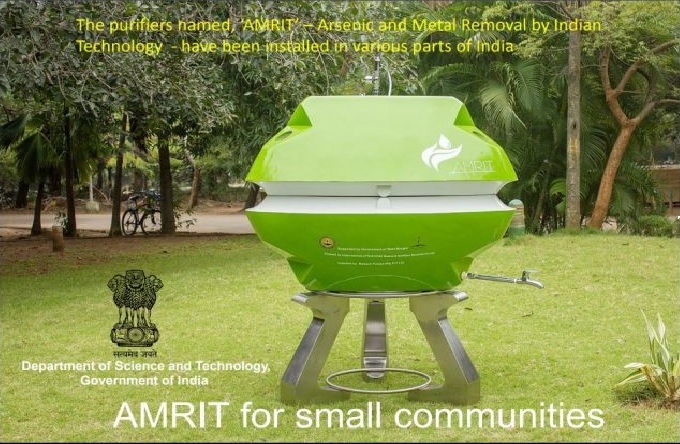
The Indian Institute of Technology (IIT) - Madras, for instance, has developed the 'AMRIT' (Arsenic and Metal Removal by Indian Technology) technology. This innovative solution employs nano-scale iron oxy-hydroxide to selectively remove arsenic from water when passed through it. '
AMRIT' serves both domestic and community levels. This technology, recommended by the Department of Drinking Water and Sanitation's 'Standing Committee,' addresses concerns related to water and sanitation.
In areas affected by water quality issues, including arsenic, short-term measures are taken until long-term piped water supply schemes from safe water sources are implemented. According to reports from States/UTs in the Integrated Management Information System (IMIS) as of December 6, 2023, all 378 arsenic-affected habitations without tap water supply have been provided with safe drinking water through Community Water Purification Plants (CWPPs) for drinking and cooking purposes.
——— End of Article ———