IISc researchers have developed a device that converts infrared light into visible light, potentially transforming applications in defense, medical imaging, and telecommunications.
Researchers at the Indian Institute of Science (IISc) have made a significant breakthrough in the field of light conversion technology. They have developed a device that can convert infrared light, which is invisible to the human eye, into visible light. This advancement has potential applications in defense, communications, and scientific imaging.
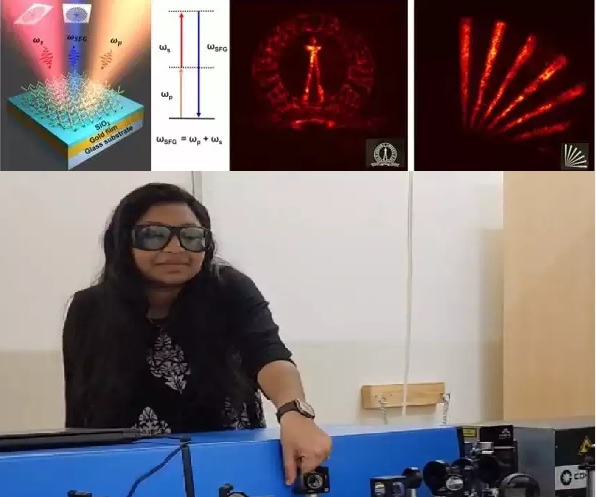
The innovative device uses a new type of non-linear optical mirror stack composed of a 2D material called gallium selenide. This material enables the "up-conversion" of short infrared light frequencies, making them detectable by standard silicon-based cameras.
Infrared light has lower frequencies compared to red light on the visible spectrum. Traditional infrared imaging, which is widely used in defense and research, typically relies on specialized sensors. These sensors are often bulky, inefficient, and restricted for export due to their strategic importance.
The device created by the IISc team overcomes these limitations by offering a more efficient and potentially cost-effective alternative. The device operates by combining an infrared input signal with a pump beam on the mirror stack. The unique non-linear optical properties of gallium selenide in the stack cause the frequencies to mix, resulting in an output beam with increased (up-converted) frequency. Importantly, this process preserves the original properties of the input beam.
In their experiments, the researchers successfully up-converted infrared light with a wavelength of 1550 nm to visible light at 622 nm. This wavelength is easily captured by conventional cameras. The team is now working on extending the device's capabilities to up-convert light of even longer wavelengths and to improve its overall efficiency.
Associate Professor Varun Raghunathan from the Department of Electrical Communication Engineering at IISc highlighted the global significance of this achievement. "There is a lot of interest worldwide in doing infrared imaging without using infrared sensors. Our work could be a game-changer for those applications," he said.
This technology could revolutionize various fields. In defense, it could enhance night vision capabilities. In medicine, it could improve imaging techniques. In telecommunications, it could enable more efficient data transmission.
——— End of Article ———