Paris, — April 9, 2026 France has formally withdrawn from the multinational Eurodrone programme after removing all associated funding from its revised 2024–2030 Military Programming Law (Loi de Programmation Militaire, LPM). The decision was presented to the Council of Ministers on 8 April 2026, alongside a broader update to the country’s long-term defence spending framework.
The revised LPM increases the overall defence allocation by €36 billion, raising the total budget from the originally planned €413 billion to €449 billion for the 2024–2030 period. Within this adjustment, France has restructured its investment priorities in unmanned systems, concluding that the Eurodrone platform no longer aligns with operational requirements for high-intensity conflict.
Programme Exit and Official Position
French Armed Forces Minister Catherine Vautrin confirmed that the Eurodrone project has been excluded from the updated defence plan, stating that the programme “is not progressing satisfactorily.” The withdrawal follows an internal reassessment of performance, cost, and battlefield relevance.
France had originally committed to acquiring six Eurodrone systems under the initial LPM framework, with the intention of replacing and supplementing its fleet of U.S.-built MQ-9 Reaper drones by 2035. No funding for procurement or development of the Eurodrone is included in the revised budget.
In parallel, the government has also cancelled planned acquisitions of the Safran Patroller MALE drone, indicating a broader shift in France’s unmanned systems strategy.
Eurodrone Programme Background and Challenges
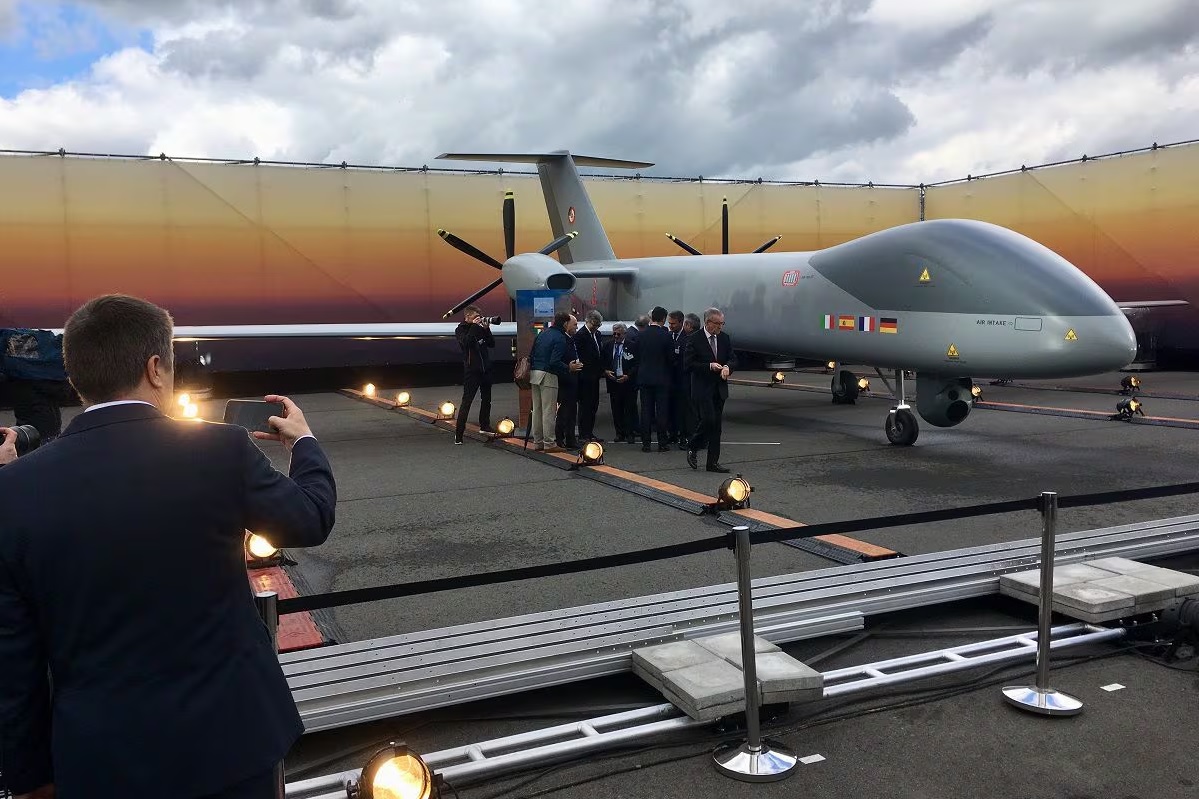
The Eurodrone programme is a joint European defence initiative involving France, Germany, Italy, and Spain, with Airbus as the prime contractor, alongside Dassault Aviation and Leonardo S.p.A..
The system is designed as a twin-engine Medium-Altitude Long-Endurance (MALE) unmanned aerial vehicle, intended to provide intelligence, surveillance, and reconnaissance capabilities while ensuring compliance with European civilian airspace regulations.
However, the programme has faced sustained challenges:
-
Diverging national requirements, particularly Germany’s preference for a heavier twin-engine configuration versus France’s earlier interest in a lighter, single-engine armed drone
-
Repeated development delays, pushing the expected entry into service to 2031 or later
-
Rising costs, with the total programme estimated at approximately €7.1 billion for around 60 systems
French defence planners assessed that the platform’s size, cost, and operational profile reduce its effectiveness in contested environments, particularly in light of lessons drawn from the conflict in Ukraine. Large MALE drones have demonstrated vulnerability to advanced air defence systems and electronic warfare.
Shift Toward Lower-Cost and Rapidly Deployable Systems
Under the revised LPM, France is redirecting investment toward a broader range of unmanned and counter-unmanned capabilities. The updated plan allocates an additional €2 billion to drone and robotic warfare, bringing the total drone-related funding envelope to €8.4 billion through 2030.
Key priorities include:
-
Procurement of loitering munitions and tactical drones
-
Development of drone swarms
-
Expansion of Counter-Unmanned Aerial Systems (C-UAS) capabilities
-
Acquisition of lower-cost sovereign MALE UAVs from domestic manufacturers
For 2026, the Ministry of the Armed Forces has ordered 10,000 combat drones, with an additional 5,000 units scheduled for delivery. The plan also targets a 400 percent increase in stocks of explosive drones by 2030.
France is also pursuing industrial cooperation with Ukraine to leverage its experience in rapid drone development and battlefield adaptation. New lower-cost MALE systems are expected to achieve operational availability between 2026 and 2027.
Budgetary Reallocation and Broader Defence Adjustments
Savings from the cancellation of the Eurodrone and Patroller programmes are being reallocated to address other defence priorities and capability gaps.
The updated LPM includes several major adjustments:
Air Defence: France will accelerate procurement of the SAMP/T NG long-range air defence system, with a target of 10 operational systems by 2030. An additional €4 billion is allocated for anti-drone defences.
Long-Range Strike Capabilities : An initial €1 billion has been allocated to begin development of a conventional ballistic long-range strike capability. The number of multiple launch rocket systems will increase from 16 to 30 by 2030.
Combat Aviation : France will independently finance a €3.5 billion upgrade to develop the Rafale F5 standard, following the withdrawal of the United Arab Emirates from a cost-sharing arrangement related to technology transfer.
Ground Combat Systems : The joint Franco-German Main Ground Combat System (MGCS) programme continues to face delays. France is evaluating an interim, highly connected combat vehicle to bridge the capability gap between the planned retirement of the Leclerc tank in 2038 and the expected arrival of MGCS in the 2040s.
Financial Outlook and Strategic Direction
The revised defence plan raises annual military spending to €57.1 billion in 2026, increasing to €76.3 billion by 2030, equivalent to approximately 2.5 percent of GDP. No increase in total armed forces personnel numbers is planned.
France began exploring withdrawal options from the Eurodrone programme in late 2025, with negotiations involving partner nations reported in February 2026. The French exit is expected to increase programme costs for the remaining participants—Germany, Italy, and Spain—by more than €700 million.
While France has ended its participation under the current budget framework, it retains the option to procure Eurodrone systems in the future if operational requirements change.
The programme will continue under the remaining partner nations, with its future timeline and cost structure subject to further review.
——— End of Article ———