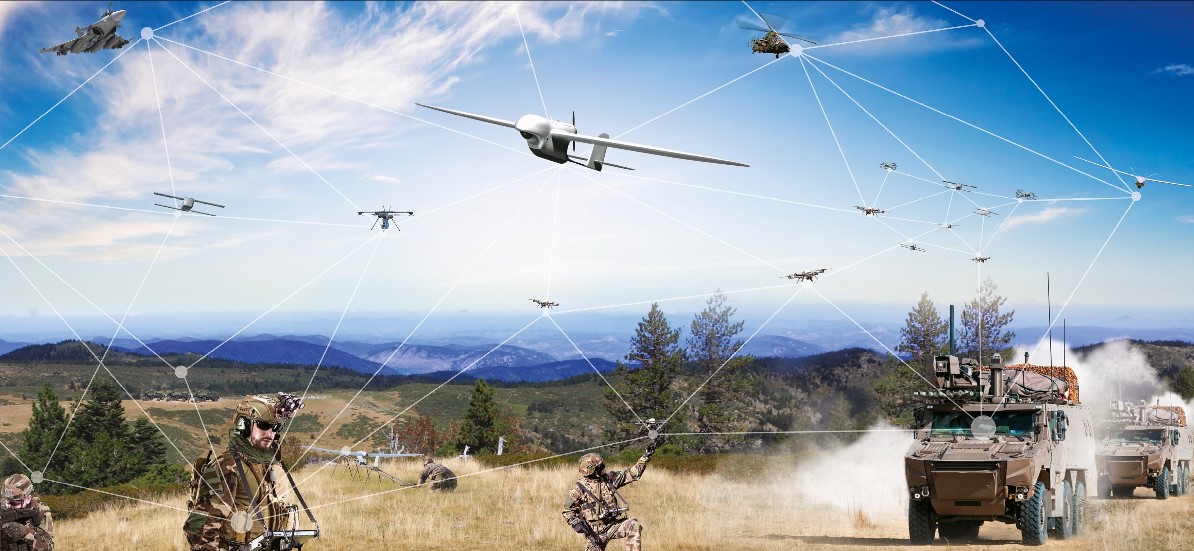
Defense News ,Europe:- The European Commission has initiated a groundbreaking €49 million ($53 million) project designed to enhance the swift operational coordination of European land combat systems. Termed the Land Tactical Collaborative Combat (LTCC) project, its primary goal is to ensure seamless coordination among various systems, interfacing not only within land domains but also with air, space, and cyber domains, as well as civil systems like 5G.
Aiming for Expedited Battlefield Decision-Making
The LTCC project is strategically aimed at expediting decision-making processes among allied forces, ensuring prompt responses and asserting battlefield superiority. Thales, the coordinator of the project, highlighted its focus on improving collaborative capabilities within armed forces, spanning from Brigade command posts down to combat vehicles, dismounted soldiers, and unmanned assets during high-intensity conflicts.
Enhancing Legacy Systems and Introducing New Technologies
Thales elaborated that the LTCC project, or LATACC, is designed to enhance legacy systems, develop new technologies, and seamlessly integrate them into a unified European framework. This collaborative effort involves 34 private firms and research institutes from 13 European countries, with Thales at the helm of project coordination.
Incorporating Diverse European Systems
The project aims to bring together various land combat systems from European countries, including France's Scorpion, Belgium's CAMO, Germany's DLBO, Spain's BMS-ET, Italy's FNEC, Sweden's Ledningsstodsystem Mark, and Norway's MIME. Over the course of three years, the project will analyze the requirements of European users and conduct studies to identify common operational scenarios.
Key Components of the Three-Year Project
Thales outlined that the project encompasses defining interoperable open architectures compatible with current and future standards. It will also involve developing essential technological components necessary for producing advanced technology demonstrators. Leveraging expertise in cloud technologies, communications, sensors, complex systems integration, robotics, AI, and system resilience in constrained environments, the partners aim to conduct trials under realistic operational conditions to confirm the tactical benefits of the LTCC project.
Anticipating a Potential Second Phase
While the initial three-year phase focuses on confirming tactical benefits, there is potential for a second phase that could involve the development of additional functionalities and the maturation of key capabilities established in the project's initial stage. The LTCC project signifies a significant step forward in advancing the collaborative capabilities and technological integration of European land combat systems.
——— End of Article ———