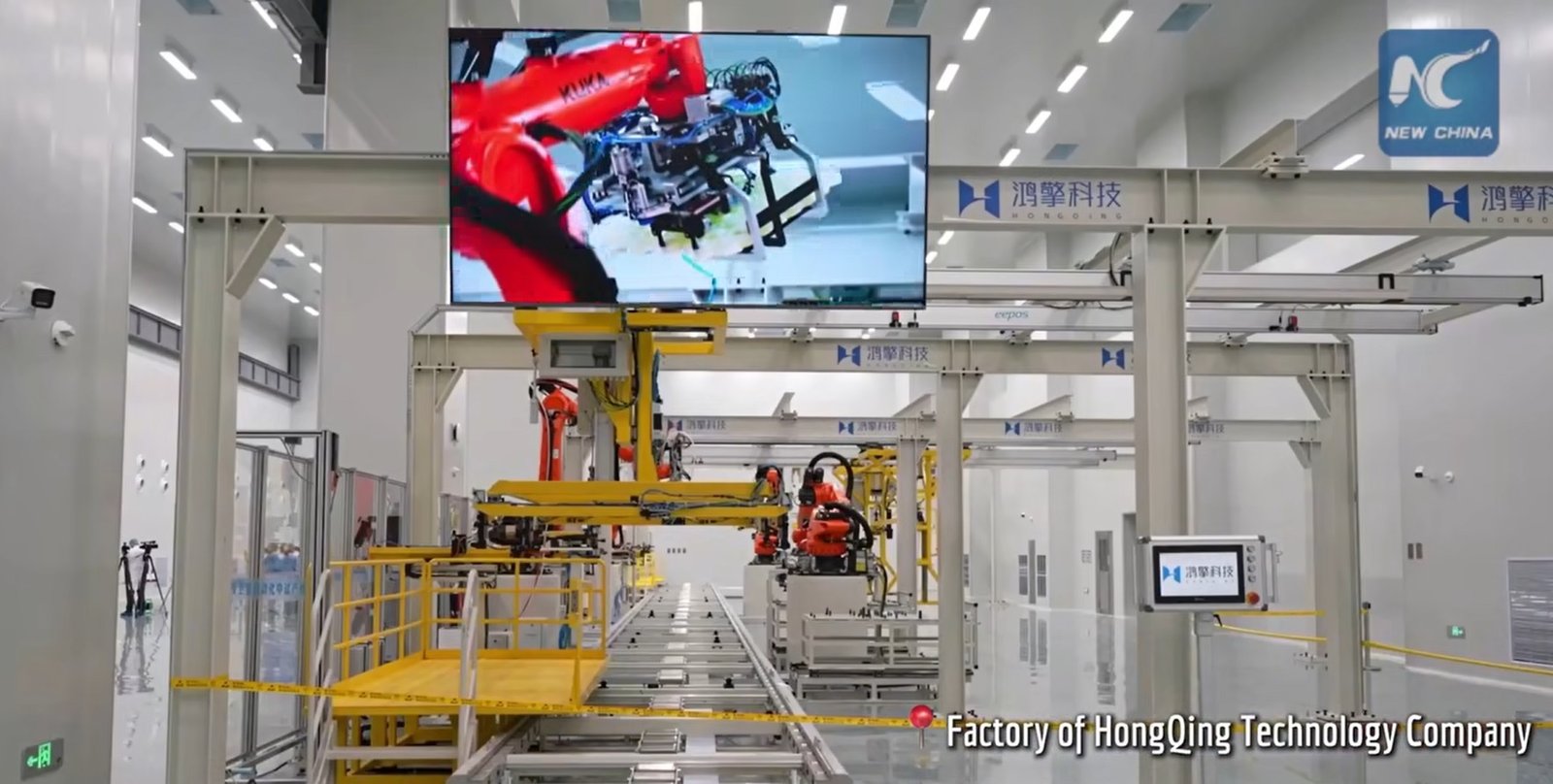
XIONGAN, CHINA, — China’s commercial space sector has begun operating what Chinese authorities describe as the country’s first assembly-line-style automated satellite mass-production facility in Xiongan New Area, Hebei Province. The production line, operated by Beijing LandSpace Hongqing Technology, is designed to move satellite manufacturing from largely individual production toward higher-volume manufacturing.
The facility uses robotic systems and automated stations for satellite assembly. More than 70 percent of its workstations are automated, according to Xiongan authorities. The company says the production cycle for a satellite has been reduced from about seven days using traditional methods to approximately 30 hours on the new line.
The production line is designed to support the manufacture of more than 100 flat-panel communications satellites annually. The approach is intended to improve manufacturing efficiency and support the production requirements of commercial satellite communications and constellation deployments.
— August 27, 2026
First Satellite Produced on the Line
The first satellite manufactured on the production line is Hongqing Technology’s Honghu-03, also known as Xiongan-1. The satellite was completed and rolled off the production line on October 22, 2025.
Xiongan-1 is a 541-kilogram flat-panel satellite measuring 3 meters in length, 2 meters in width and 0.4 meters in thickness. It was independently developed by Beijing LandSpace Hongqing Technology. The satellite incorporates the company’s self-developed propulsion, power and electronic systems.
The satellite includes an argon-propellant electric propulsion system and is being used to conduct in-orbit verification of several technologies. These include the electric propulsion system and commercial-grade gallium nitride power devices designed for space applications. Chinese authorities said the satellite is conducting verification of more than 10 technologies described as domestic firsts.
Xiongan-1 Reaches Orbit
Xiongan-1 was launched on August 19, 2026, aboard the Zhuque-3 Y2 reusable rocket from the Dongfeng commercial space innovation pilot zone in Jiuquan, Gansu Province.
The launch took place at 7:35 a.m. Beijing time. About 10 minutes later, the satellite separated from the rocket and entered its planned orbit. Its solar arrays deployed successfully, and telemetry data returned from the spacecraft was reported as normal.
The satellite is operating at an altitude of about 500 kilometers and is carrying out its planned in-orbit technology verification activities.
The launch also formed part of a major test for Zhuque-3. During the mission, the rocket’s first stage successfully completed a controlled landing and recovery on land, according to Chinese and international reports.
From Satellite Manufacturing to Mass Production
The automated production line applies an assembly-line manufacturing approach to satellite production. According to Hongqing Technology, the line can complete satellite assembly with substantially less manual intervention, while the overall production cycle has been reduced by about 80 percent.
The company says six to eight workers can support production capacity of more than 100 flat-panel communications satellites per year. The production line occupies about 500 square meters.
The facility is intended to support higher-volume manufacturing of satellites for applications including communications and satellite internet. The shift toward standardized and automated production is aimed at making it possible to manufacture satellites in larger numbers rather than treating each spacecraft primarily as an individual production project.
Xiongan’s Growing Space Industry
The satellite production facility is part of Xiongan New Area’s developing aerospace information and satellite internet industry. As of August 2026, the area had 69 companies connected to the aerospace information and satellite internet sector, along with nine innovation platforms.
China Satellite Network Group has established its headquarters in Xiongan, while companies involved in satellite research, manufacturing, components, testing and applications have also established operations in the area.
Xiongan is also developing shared satellite manufacturing and testing facilities. These facilities are intended to provide additional infrastructure for companies involved in commercial space activities and help create a production chain covering satellite development, manufacturing, testing and operation.
The launch of Xiongan-1 therefore marks both the first flight of a satellite manufactured on the automated production line and the beginning of in-orbit verification for its technologies. At the manufacturing level, the facility provides Xiongan with a production system designed specifically for higher-volume satellite manufacturing, with a stated capacity of more than 100 flat-panel satellites per year.
——— End of Article ———