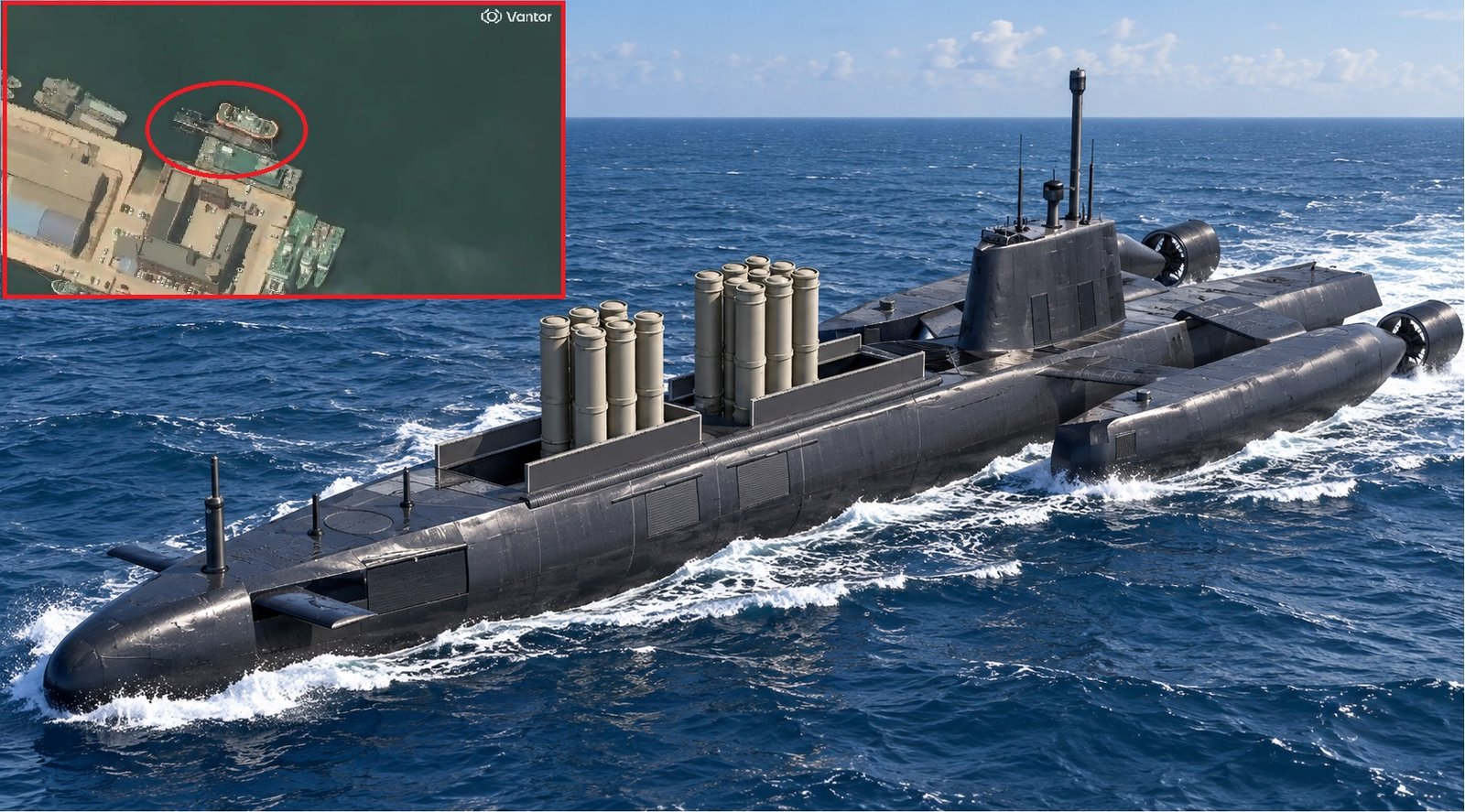
Huludao, China — China is testing a new type of semi-submersible arsenal ship featuring a distinctive trimaran design and multiple missile launch tubes. The vessel is believed to operate primarily underwater but must surface to deploy its weapons.
Originally constructed at the Huangpu shipyard in Guangzhou, southern China, the approximately 65-meter-long vessel was transported north through the port of Dalian earlier this year. Commercial satellite imagery captured on May 12, 2026, showed the vessel at Dalian, while subsequent observations indicate that it is undergoing trials in Huludao on the Bohai Sea.
The vessel has no officially announced Chinese designation or Western reporting name. Open-source analysis suggests it represents a separate development from China's known uncrewed surface vessel (USV) and extra-large uncrewed underwater vehicle (XLUUV) programs.
Trimaran Design and Propulsion
The vessel features a trimaran hull, consisting of a central body and two outriggers positioned toward the stern. The configuration is designed to provide stability when the ship surfaces, particularly during missile launch operations.
Despite its semi-submersible design, the vessel relies on diesel propulsion. A prominent snorkel mast allows it to operate its diesel engines while running just below the surface. The outriggers are fitted with ducted propellers, potentially pumpjets, while the central hull is expected to house the primary propulsion system.
Ship design specialist Dr. Rachel Pawling of K39 Consulting estimates the vessel's submerged displacement at approximately 900 tonnes.
According to Pawling, the internal volume is largely occupied by weapons bays, leaving limited space for a human crew. A small, open navigation bridge on top of the sail is believed to be used primarily by a human pilot during harbor entry and exit, suggesting the vessel is designed to operate without a crew during missions.
Missile Capacity and Potential Weapons
The central hull appears to contain two large horizontal weapons hangars holding missile tubes arranged in circular clusters. Satellite imagery and open-source analysis indicate at least eight tubes, with the total estimated at approximately 16 to 18 strike-length missile tubes if both hangars have similar configurations.
To launch its weapons, the vessel must surface, open the hangar doors, and raise the missile tubes into a vertical or near-vertical position.
The missiles are expected to be heavy anti-ship or land-attack weapons designed for surface launch rather than underwater firing.
One potential candidate is China's YJ-20 hypersonic missile, a weapon associated with the Type-055 cruisers and also reported to have been launched from Type-052D destroyers. The YJ-20 is estimated to have a range of approximately 1,000 to 1,500 km (620 to 930 miles) and is designed to engage sea and land targets.
However, the missile type intended for the new vessel has not been officially confirmed.
Operational Concept and Development
The vessel's operating concept has similarities to Cold War-era Soviet Juliett-class cruise missile submarines, which also had to surface to launch heavy anti-ship missiles.
The Chinese platform, however, is assessed to have a substantially larger missile capacity. Its long-range weapons would also require external targeting information to engage distant targets accurately.
As a result, analysts believe the vessel would operate as a forward-deployed missile transporter and launcher, relying on targeting data from China's wider network of sensors, aircraft, and satellites rather than operating independently.
The design combines characteristics of surface ships and submarines, providing a platform that can remain below the surface during transit but surface when required to launch its weapons.
China has not released official details about the project, including its intended missile types, operational status, or deployment timeline. Current assessments remain based on commercial satellite imagery and technical analysis.
Main Source : navalnews
——— End of Article ———