California-based Radiant has signed a landmark agreement to provide a mass-produced nuclear microreactor for a U.S. military installation under the Advanced Nuclear Power for Installations (ANPI) program.
The ANPI initiative, a joint effort by the Defense Innovation Unit and the U.S. Air Force, aims to deploy portable, resilient nuclear energy systems for both domestic and overseas bases. The project is part of the Pentagon’s broader strategy to adopt dual-use technologies that meet both military and civilian needs, with a focus on safety, scalability, and rapid deployment. Officials say such systems could give U.S. forces a decisive edge over near-peer adversaries by ensuring continuous, cyber-secure power even in contested environments.
Kaleidos: A Reactor in a Box
Under the agreement, Radiant plans to deliver its Kaleidos reactor to the ANPI program within three years, following its planned testing in 2026 at the Idaho National Laboratory’s Demonstration of Microreactor Experiments facility. This marks the first time in nearly 50 years that a new U.S. reactor design will be tested at the site.
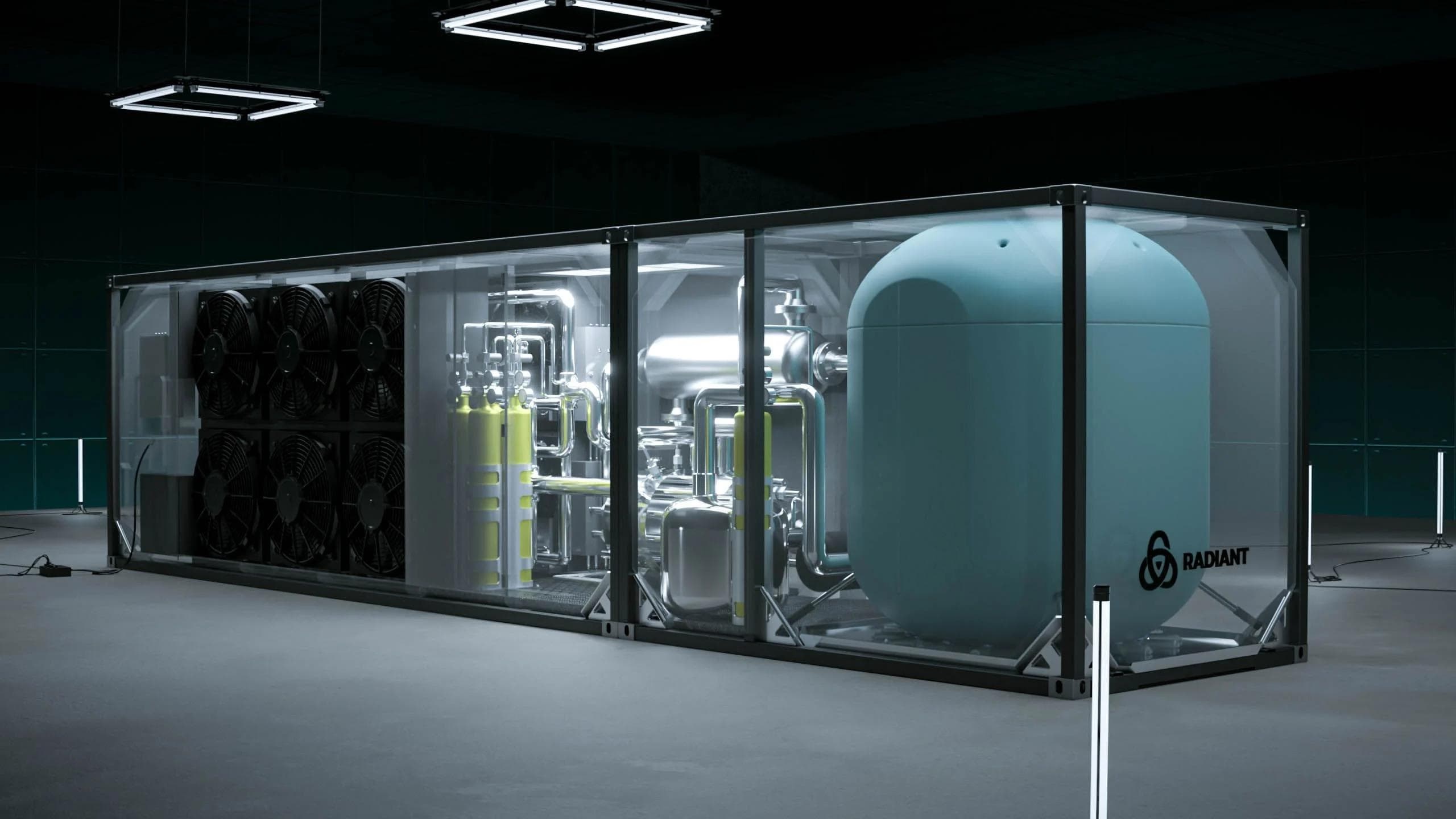
The Kaleidos is a high-temperature gas-cooled microreactor capable of generating 1 megawatt of electricity—enough to power a small military base—or about 3 megawatts of thermal energy for heating or industrial processes. Its most striking feature is mobility: the entire system fits into a standard shipping container, can be transported by truck, rail, or aircraft, and can be fully operational within 48 hours of arrival. Once running, it can provide years of uninterrupted energy without refueling.
How the Technology Works
The Kaleidos runs on TRISO fuel, which consists of ceramic-coated uranium particles engineered to be meltdown-proof. Cooling is provided by helium gas instead of water, eliminating the need for large cooling towers and reducing contamination risks. Inside the reactor, graphite blocks and a zinc-hydride moderator stabilize reactions, while a supercritical carbon dioxide Brayton cycle efficiently converts heat into electricity.
For safety, Kaleidos uses passive air-jacket cooling, meaning it can shed heat naturally without pumps or external power. In the event of an emergency, the reactor can shut down and cool itself in just 300 milliseconds. A single sealed unit runs for five years before being shipped back for refueling. Over its 20-year life, it can be refueled four times, leaving no permanent waste or infrastructure behind.
Strategic Impact and Future Deployment
Military analysts note that portable nuclear reactors could be a game-changer for U.S. forward bases, which often rely on vulnerable fuel supply chains. The ability to generate secure, stable power on-site reduces dependence on fuel convoys, which are high-risk in conflict zones.
Radiant envisions deploying hundreds of Kaleidos units worldwide, each monitored remotely around the clock from a centralized control center. In addition to military use, the company believes such reactors could support disaster relief operations, remote industrial sites, and isolated communities where traditional energy infrastructure is impractical.
The Pentagon is expected to use the ANPI program to evaluate Kaleidos and other microreactor designs for scalability, battlefield survivability, and rapid deployment capability, with the goal of building a resilient and adaptable military energy network for the decades ahead.
——— End of Article ———