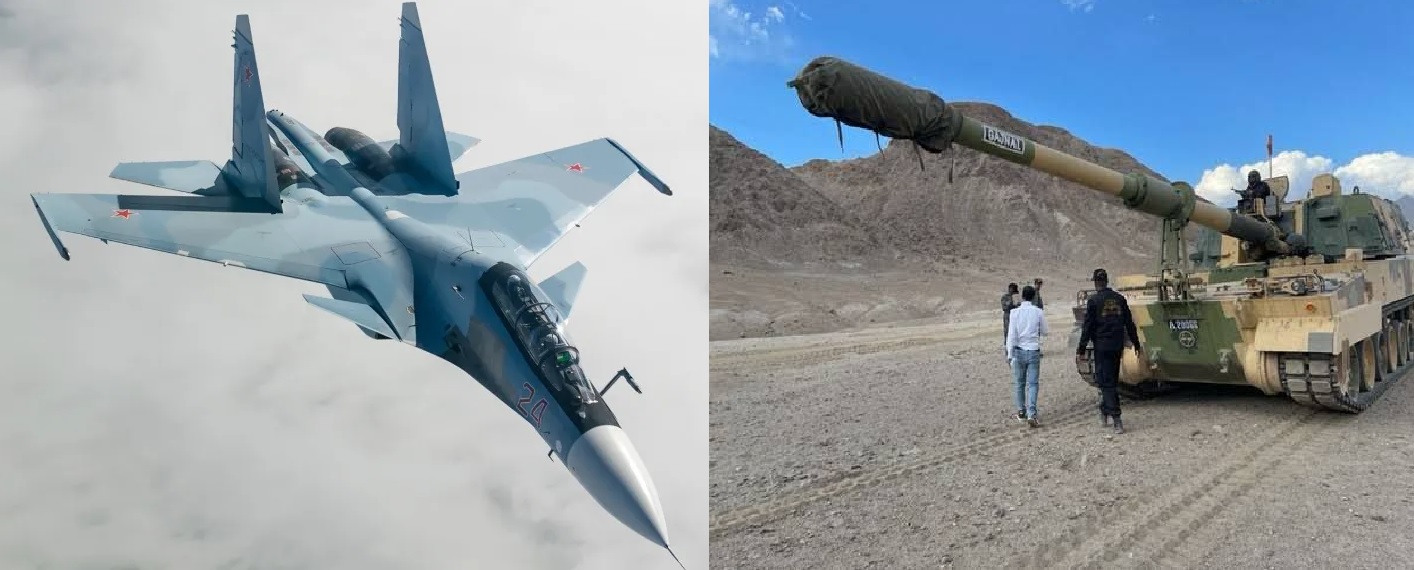
In a significant boost to India’s indigenous defense manufacturing, the Cabinet Committee on Security (CCS) has given the green light to two critical military projects valued at approximately ₹20,000 crore. These projects include the acquisition of 12 Su-30MKI fighter jets for the Indian Air Force (IAF) and an additional 100 K-9 Vajra self-propelled howitzers for the Indian Army, underscoring the government’s commitment to the Make in India initiative in the defense sector.
New Su-30MKIs to Bolster Air Power
The Su-30MKI jets, India’s frontline air superiority fighters, will be manufactured under license by Hindustan Aeronautics Limited (HAL) at its Nashik facility. The ₹13,000 crore contract aims to replace aircraft lost in service over the years, ensuring the IAF maintains its operational strength.
Known for their versatility, Su-30MKIs can carry a wide array of weapons, including air-to-air, air-to-ground, and anti-ship missiles. The jets are equipped with advanced avionics, a powerful AL-31FP turbofan engine with thrust vectoring, and a long operational range of over 3,000 kilometers, extendable through aerial refueling. Their ability to carry the supersonic BrahMos missile makes them a critical asset in India’s strategic defense arsenal.
This project is expected to stimulate HAL’s supply chain, providing a significant boost to small and medium enterprises (SMEs) that supply critical components for the Su-30MKI.
K-9 Vajra Howitzers: Expanding Artillery Firepower
The order for 100 K-9 Vajra howitzers, to be manufactured by Larsen & Toubro (L&T) at its Hazira plant in Gujarat, builds on the success of a previous batch of 100 howitzers already inducted into the Indian Army. The new contract reflects the Army’s satisfaction with the system’s performance in diverse terrains, from the deserts of Rajasthan to the challenging conditions along the Line of Actual Control (LAC) with China.
The K-9 Vajra, a self-propelled 155mm/52-caliber howitzer, boasts an impressive range of 38–40 kilometers and can fire multiple types of ammunition, including precision-guided shells. The system is mounted on a tracked chassis, offering high mobility in combat zones. L&T has significantly increased the indigenous content in these howitzers, a move that aligns with the government’s vision for defense self-reliance.
Strategic and Economic Impact
Both projects underscore the government’s commitment to strengthening the domestic defense industry. By involving public and private sector giants like HAL and L&T, the initiatives not only enhance India’s military capabilities but also generate employment and foster technological innovation.
Moreover, these deals will reinforce supply chains involving hundreds of SMEs, creating a ripple effect across the economy. The emphasis on local production also reduces dependency on foreign suppliers, aligning with the broader goal of Atmanirbhar Bharat (self-reliant India).
Reinforcing Defense Capabilities
The acquisition of these advanced platforms comes at a crucial time when India is addressing security challenges on multiple fronts. The Su-30MKIs will augment the IAF’s ability to project air power across vast distances, while the K-9 Vajras will provide the Army with superior firepower and mobility in diverse operational scenarios.
By approving these projects, the CCS has not only strengthened India’s defense posture but also provided a major impetus to the indigenous defense manufacturing ecosystem, reaffirming its role as a cornerstone of India’s strategic autonomy.
——— End of Article ———