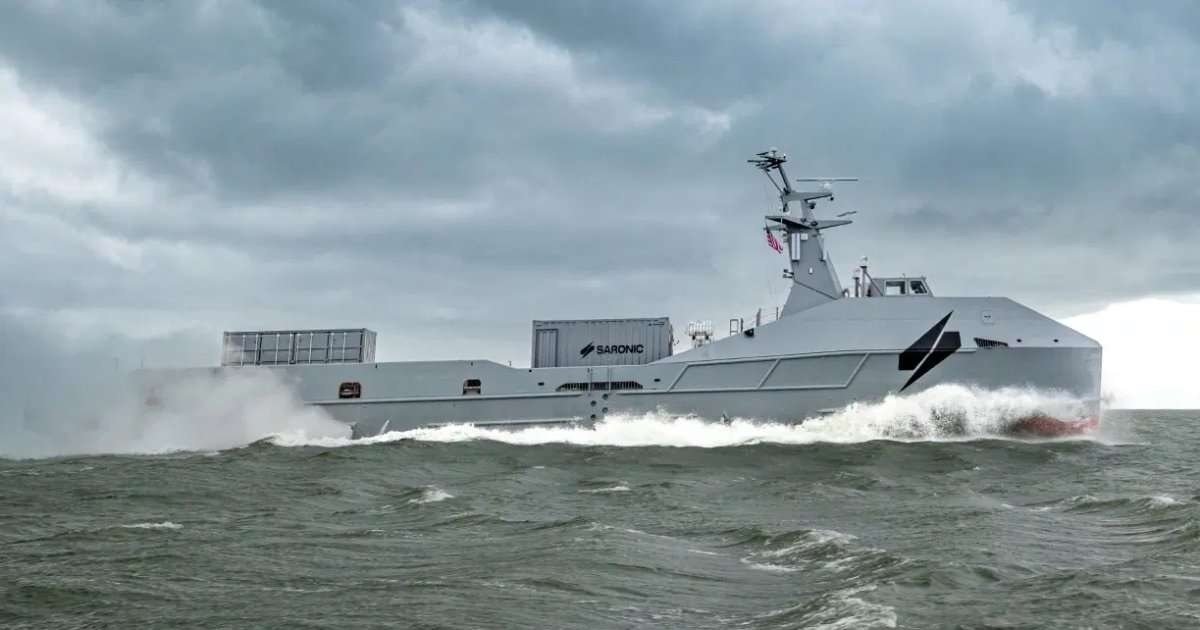
Menlo Park, California, — April 9, 2026 : Defense technology firm Bulwark Dynamics has announced the development of the Caravel 35, a 35-foot autonomous landing craft designed to support sea-to-shore resupply operations in contested littoral environments. The platform is intended for use by the United States military and allied forces, particularly in regions where conventional port infrastructure is unavailable, degraded, or at risk.
Platform Design and Operational Role
The Caravel 35 has been engineered for operations in shallow and austere coastal zones. A key feature of the vessel is its ultra-shallow draft of 6 inches when fully loaded, allowing it to access shorelines beyond the reach of conventional maritime platforms. This capability is intended to support distributed logistics operations across dispersed coastal environments.
The vessel is capable of carrying modular, containerized payloads, including a full 20-foot ISO container. In addition to standard cargo, the craft can transport vehicles and unmanned ground vehicles (UGVs), enabling flexibility in mission profiles that include both sustainment operations and littoral maneuver missions.
Autonomous Capabilities and Testing Background
The Caravel 35 builds on earlier testing conducted with a smaller 15-foot variant of the Caravel series. In late March 2026, the 15-foot platform completed an open-water demonstration that included a fully autonomous sea-to-shore delivery sequence. The trial involved unmanned beach landing and autonomous cargo offloading, carried out with zero human intervention.
The newly announced 35-foot model scales these demonstrated capabilities to a mission-relevant platform, while maintaining the same autonomous navigation, landing, and delivery functions. The system is designed to operate without onboard crew or reliance on shore-based support during final delivery stages.
Development Context and Strategic Focus
Bulwark Dynamics developed the Caravel series to address logistical challenges associated with last-mile maritime delivery in contested environments. These challenges are particularly relevant in regions such as the Indo-Pacific, including areas along the First Island Chain, where maintaining supply lines across dispersed maritime terrain presents operational constraints.
According to the company, the design of the Caravel 35 incorporates feedback from operators across the U.S. military and allied forces deployed in the Indo-Pacific. The platform is intended to reduce personnel exposure during the final segment of resupply missions by automating sea-to-shore transfer operations.
Manufacturing and Industry Partnerships
To transition the Caravel 35 from development to production, Bulwark Dynamics has established a partnership with a major shipbuilder. The collaboration focuses on ensuring reliability, manufacturability, and scalability for operational deployment.
In December 2025, the company signed a memorandum of understanding with a leading Japanese shipbuilder to explore co-production of autonomous maritime systems. This agreement is part of a broader effort to enable production at scale.
The company also opened a prototype production facility in Menlo Park in January 2026 to support ongoing development and testing of its autonomous vessels.
Program Background and Applications
Bulwark Dynamics, headquartered in San Francisco with operations in Menlo Park, was founded to develop autonomous beach-landing vessels for contested logistics and distributed military operations. The company completed a pre-seed funding round in September 2025 to support initial prototype development.
The Caravel platforms are designed to perform autonomous navigation, shoreline approach, physical beaching, and payload delivery without crew or shore infrastructure. While primarily intended for military logistics, the system has potential dual-use applications in sectors such as disaster relief, offshore energy, port operations, industrial logistics, coastal urban supply chains, and remote island support.
——— End of Article ———