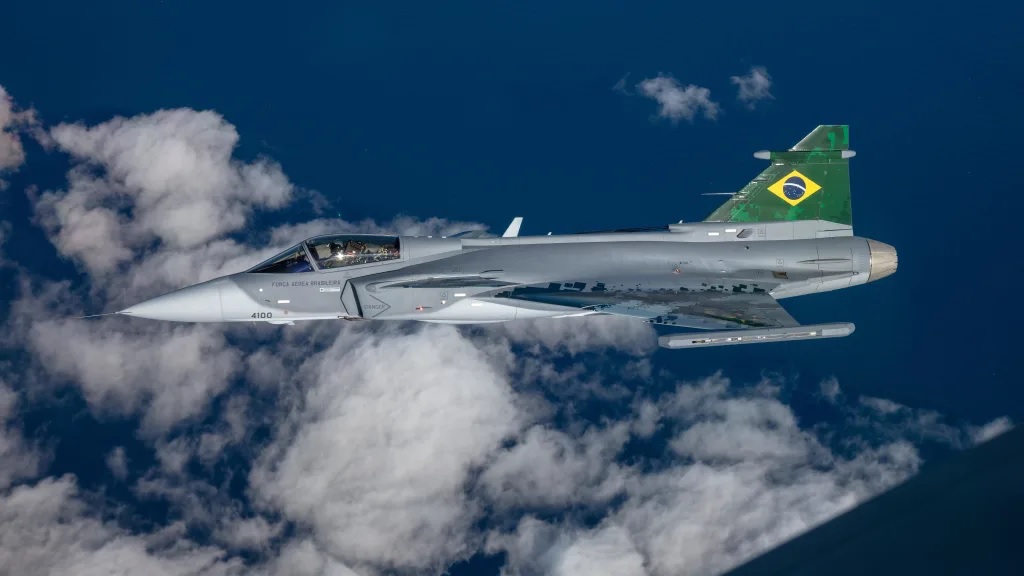
Defense News ,Brazil :-The Brazilian Gripen E aircraft, registered as FAB 4100 and dedicated to testing in Brazil, recently participated in a flight test campaign in Anápolis (GO) to evaluate its Infrared Search and Track (IRST) capabilities—a passive sensor designed for long-range target detection.
During the test, two Brazilian Gripen E fighters, accompanied by an F-5, engaged in a simulated aerial battle. The designated test aircraft, FAB 4100, was piloted by Saab test pilot Jonas Jakobsson, with the mission of utilizing the Infrared Search and Track (IRST) system to locate the other two aircraft.
Lieutenant Colonel Cristiano de Oliveira Perez, a test pilot from the Brazilian Air Force Research and Testing Institute (IPEV), piloted the second Gripen, while Colonel Bettega, also a test pilot from IPEV, commanded the F-5.
The test campaign consisted of three flights, each lasting between 1 and 1.5 hours. Brazilian professionals from Saab and Embraer, along with Swedish Saab engineers, actively participated in the entire testing process.
Martin Leijonhufvud, the head of the Gripen Flight Test Center (GFTC) in Brazil, highlighted the broader context of the tests, stating, “The goal of the tests was to ensure that the system can locate threats within the specified parameters and is part of the global test campaign for the Gripen E, involving all aircraft of this model, not just those of the Brazilian Air Force.”
Swedish pilot Jonas Jakobsson expressed satisfaction with the successful flight collaboration, emphasizing the importance of testing the IRST and verifying image resolution. He explained, "We had a successful flight, collaborating with the other fighters, to test the IRST and also verify the image resolution obtained, which is crucial for the pilot to understand if there is one or more targets and plan their actions."
The IRST, located at the front of the fighter, functions as a passive sensor that detects and identifies targets at long distances through their infrared signatures—specifically, the heat they emit. This system plays a critical role in identifying objects of interest in various environments, including aircraft in flight, vessels at sea, or vehicles on land.
——— End of Article ———