NEW DELHI — April 30, 2026 : Bharat Heavy Electricals Limited has signed a Licensing Agreement for Transfer of Technology (LAToT) with the Defence Research and Development Organisation’s Naval Science and Technological Laboratory to manufacture and deploy advanced infrared suppression systems for Indian naval platforms. The agreement, disclosed through a regulatory filing dated April 28, 2026, covers the Gas Turbine-Infrared Suppression System (GT-IRSS) designed for LM2500 gas turbine.
Under the terms of the agreement, BHEL will undertake end-to-end execution of the system, including fabrication of components based on DRDO-NSTL designs, installation within the exhaust architecture of naval vessels, and final commissioning involving testing and validation for operational readiness. The company confirmed that the arrangement is a domestic technology transfer with no involvement of related-party transactions or promoter group interests. Financial details remain undisclosed.
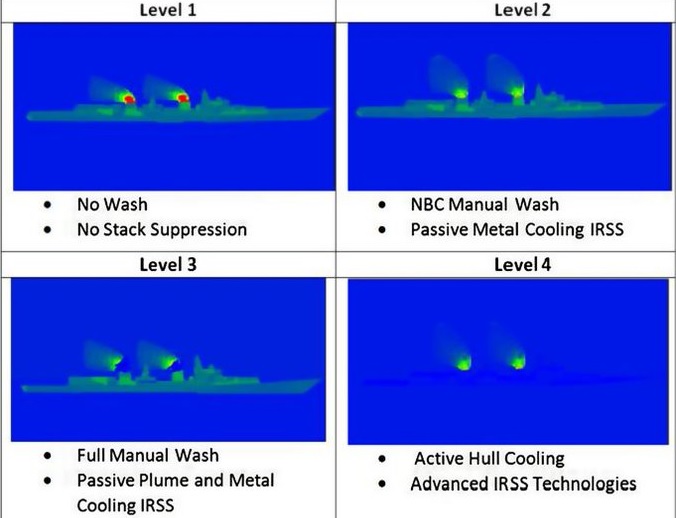
The GT-IRSS is an indigenously developed naval stealth technology engineered to reduce infrared (IR) signatures generated by gas turbine exhaust. The LM2500 gas turbine, widely used across Indian Navy warships including destroyers, frigates, and aircraft carriers, produces high-temperature exhaust gases that can be detected by infrared-guided anti-ship missiles. The suppression system addresses this vulnerability through a combination of thermal management techniques.
The system integrates ambient air intake mechanisms that draw cooler atmospheric air through engineered louvers and mix it with hot exhaust gases using an eductor-diffuser arrangement. This process reduces plume temperature before discharge. In addition, seawater mist injection is used to further cool the exhaust stream. The GT-IRSS also minimizes heat radiation from exposed exhaust structures by isolating and cooling metal surfaces, thereby lowering both plume and surface thermal signatures without significantly affecting turbine performance.
By reducing detectability from thermal imaging sensors and infrared-homing weapons, the system enhances survivability and operational effectiveness of naval platforms. The technology has already been incorporated into select Indian Navy vessels and is expected to see wider deployment through domestic production.
The agreement aligns with India’s ‘Make in India’ and ‘Aatmanirbhar Bharat’ initiatives by enabling indigenous manufacturing of critical stealth systems that were previously dependent on foreign suppliers. It is expected to strengthen supply chain independence, improve lifecycle support capabilities, and allow faster deployment across the Navy’s expanding fleet.
For BHEL, the development marks a continued expansion into defence manufacturing and naval systems integration. While traditionally focused on power generation equipment, the company has maintained a three-decade association with the Indian Navy, supplying systems such as Super Rapid Gun Mounts (SRGM) and Integrated Platform Management Systems (IPMS). The defence and aerospace segment currently contributes approximately 5–8% of BHEL’s revenue and recorded around 20% year-on-year growth in FY25.
With the addition of GT-IRSS to its portfolio, BHEL strengthens its position in naval systems integration and aligns alongside other major domestic defence manufacturers, including Larsen & Toubro, Mazagon Dock Shipbuilders Limited, and Cochin Shipyard Limited. No specific production timelines or delivery schedules were disclosed as part of the filing.
——— End of Article ———