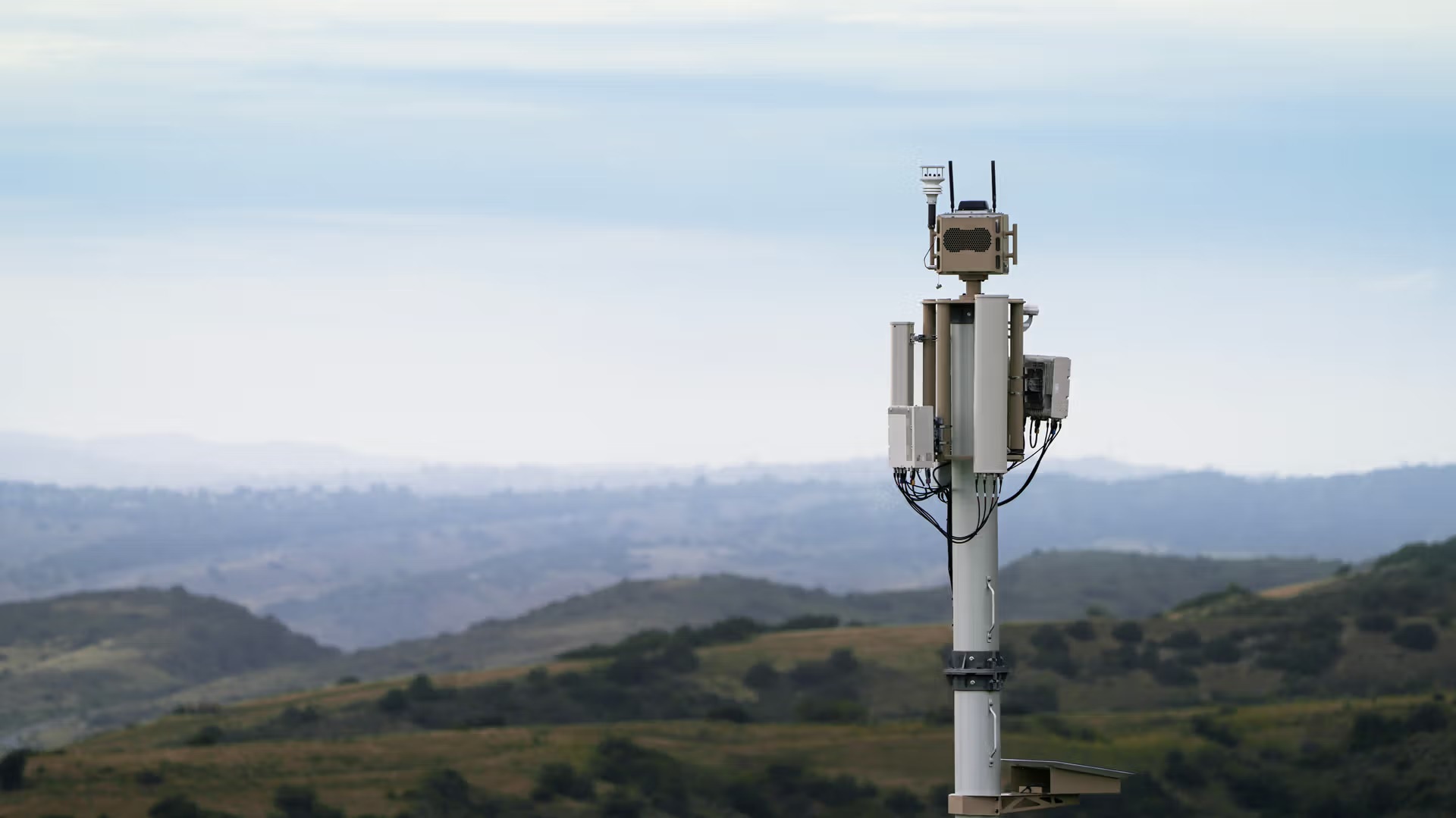
COSTA MESA, California — May 1, 2026 : Anduril Industries has introduced a new deployable communications system, the 5G Comms Sentry Tower (CST), designed to provide private, high-speed cellular connectivity in remote and infrastructure-constrained environments. The system expands the company’s Sentry family of autonomous surveillance and sensing platforms and is intended for military, government, and commercial operations where conventional communications options remain limited.
System Targets Gaps in Remote Connectivity
The 5G CST has been developed to address persistent communication challenges in austere environments such as forward operating bases, remote border regions, missile fields, test ranges, and energy infrastructure sites. In these locations, traditional 5G networks are typically unavailable due to reliance on fixed infrastructure, while tactical radios and satellite communications often face limitations in bandwidth, latency, or scalability.
By integrating a localized private 5G network into a deployable tower, the system enables real-time data exchange, coordination, and connectivity for personnel, sensors, and autonomous systems operating in isolated areas.
The platform was developed in collaboration with Nokia Federal Solutions, which contributed its private 5G technology optimized for secure and resilient government and defense applications.
Integrated Design and Deployment Capabilities
The 5G CST combines communications hardware, onboard compute, and an independent power system into a single deployable unit. It builds on Anduril’s existing Sentry Tower architecture, incorporating miniaturized private 5G infrastructure within the platform.
The system operates independently of existing telecommunications networks and electrical grids. It supports both solar power and shore power configurations, allowing deployment in environments without established infrastructure. According to the company, the tower can be fully assembled and operational in under three hours.
Each unit provides several kilometers of coverage, with a reported range of at least 3.5 kilometers in certain configurations. The system supports uplink speeds ranging from tens to hundreds of megabits per second and downlink speeds from hundreds to more than 1,000 megabits per second. For larger operational areas, multiple towers can be networked together to extend coverage.
Software Integration and Network Control
The 5G CST operates on Anduril’s Lattice software platform, which provides centralized control over network operations. Through a single interface, operators can manage user access, monitor system performance, and oversee network health in real time.
This architecture establishes a private and secure communications environment, reducing reliance on commercial or foreign networks and addressing associated security concerns. The system effectively creates a localized connectivity zone tailored to mission requirements.
Service-Based Model and Production Readiness
Anduril is offering the 5G CST under a service-based pricing model, where customers pay for network access rather than per-device data consumption. This approach differs from conventional telecommunications pricing structures and is intended to simplify deployment costs for operational users.
The company stated that the system was designed for high-rate production from the outset, utilizing established components, supply chains, and manufacturing processes derived from the existing Sentry Tower product line. This allows for scalable delivery aligned with operational demand.
Expansion of the Sentry Platform
The introduction of the 5G CST represents the latest development in Anduril’s Sentry family, which includes standard, extended-range, and maritime variants. Since the initial deployment of the Sentry Tower in 2017, more than 400 units have been deployed globally.
These systems are currently used for missions including border security and force protection. According to the company, Sentry Towers provide persistent situational awareness across more than 1,200 kilometers of the United States’ southern land border and operate in diverse environments ranging from arctic conditions to desert terrain.
Collaboration and Technical Approach
The partnership between Anduril and Nokia Federal Solutions focused on adapting commercial-grade 5G technology for deployment in austere environments. The system integrates scaled-down mobile network capabilities into a compact and transportable platform.
The companies indicated that the 5G CST is intended for scenarios where extending conventional telecom infrastructure is impractical due to cost, logistical complexity, or deployment timelines. By removing dependence on fixed infrastructure, the system enables rapid establishment of secure communications networks in remote locations.
Availability
Anduril stated that the 5G CST is production-ready and available for government and commercial customers. Additional technical specifications and details regarding initial customer contracts have not been disclosed at the time of the announcement.
——— End of Article ———