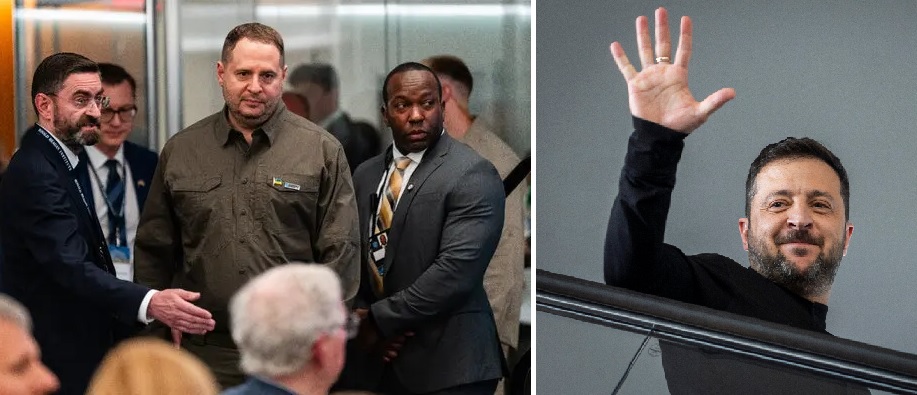
On 28 November 2025 — The political landscape in Ukraine was shaken today when Andriy Yermak, chief of staff to President Volodymyr Zelenskyy, announced his resignation hours after anti-corruption investigators raided his home and office. The high-profile departure comes amid a sweeping probe into a $100 million energy-sector kickback scheme, intensifying concerns over corruption even as Ukraine battles for its survival.
Raid, Resignation and the Official Line
Early on November 28, agents from the National Anti-Corruption Bureau of Ukraine (NABU) and the Specialized Anti-Corruption Prosecutor’s Office (SAPO) entered Yermak’s residence and carried out searches. By afternoon, Yermak — a powerful figure at the heart of Kyiv’s presidency, governance and peace negotiations — told the public he was fully cooperating. Within hours, President Zelenskyy accepted his resignation. In a televised address, Zelenskyy said the “Office of the President will be reorganised,” and he pledged to appoint a new head as soon as possible.
The sudden move comes as a major blow to Zelenskyy’s administration, especially at a time when the government needs unity and credibility while negotiating with Western partners and pursuing peace talks with Russia.
The Underlying Scandal: Energy-Sector Corruption and Military Procurement
The raid on Yermak occurs amid a broader investigation dubbed Operation Midas — a sweeping probe launched in 2024 by NABU and SAPO into alleged bribery and kickback schemes connected to Ukraine’s state energy sector. So far, multiple searches have been conducted, several millions of dollars seized, and around 1,000 hours of audio recordings obtained, implicating a network of high-level officials and business associates.
Western donors and partners, who have poured billions into Ukraine’s infrastructure and war-time defense needs, are watching closely. Many fear that this funding may have been partly siphoned off by corrupt officials — eroding both public trust and the war effort itself.
Analysts argue that wartime corruption in Ukraine has shifted from petty bribery to large-scale schemes involving procurement, energy, defense contracts, and supply of goods to the armed forces — areas where oversight is difficult and enormous sums of money are involved.
Corruption’s Deep Roots — A Long-Standing National Problem
Corruption in Ukraine is hardly new. For decades after the Soviet Union’s collapse, graft has pervaded politics, justice, business, public services, education, healthcare, and even elections. At one point, Ukraine ranked among the most corrupt nations in Europe — a reputation shaped by systemic bribery, opaque tenders, political influence over the judiciary, and nepotistic business-politics entanglements.
Bribes and kickbacks were common in delivering public services such as healthcare, education, vehicle inspection, and social security. Large corruption scandals involving state-owned enterprises, improper public procurement, and embezzlement were repeatedly exposed over the years.
More recently, corruption investigations by NABU and SAPO have expanded into powerful sectors, including military procurement and the judiciary. In 2023 alone, anti-graft agencies reported uncovering misdeeds involving senior officials, judges, state-owned enterprises, and even deputy-ministers — with millions of Ukrainian hryvnias recovered and top-level suspects under scrutiny.
Why Corruption Is Especially Dangerous During War
Observers warn that corruption during wartime — especially in defense procurement, energy, infrastructure rebuilding — poses an existential threat to Ukraine’s war effort. Resources diverted through graft mean fewer supplies and poor-quality equipment for soldiers, delayed reconstruction of damaged infrastructure, and loss of international support.
Political elites under war-time stress may be tempted to exploit procurement loopholes or emergency powers for personal gain. This not only weakens the state’s capacity to fight but also undermines morale, public trust, and Western support — particularly at a time when Kyiv seeks EU accession and foreign aid.
Who Are Viewed as the Most Corrupt — And Why the Public is Losing Patience
While it may be difficult to single out a single “most corrupt” individual or group in an institutional problem as deep as this, analysts and civil-society observers point to several sectors and patterns:
-
State-owned energy firms and power utilities, where large-scale kickback and procurement scams have flourished, including the scandal now under Operation Midas. The misuse of funds and collusion between business and politics in the energy sector is widely seen as emblematic of wartime corruption.
-
Defense procurement and military-supply chains, where urgent demands and large contracts during the war have yielded many recent graft allegations. Critics say loopholes were exploited to supply substandard weapons or inflate prices.
-
Senior political and judicial officials, including judges and prosecutors, whose positions of power have historically allowed them to influence outcomes, grant favorable sentences, or extract bribes — undermining rule of law and public confidence.
Public tolerance for such abuses seems to be eroding fast, especially given the stakes of the ongoing war — and many analysts argue that this is why recent high-profile probes and resignations have stirred strong reactions across Ukraine and among its international partners.
Aftermath — What Yermak’s Resignation Means for Zelensky and Ukraine’s Future
With Yermak’s departure, President Zelensky loses one of his closest and most influential advisers at a critical time. The change undermines continuity in Ukraine’s peace negotiation efforts, complicates management of foreign aid and reconstruction plans, and adds uncertainty at the highest levels of government.
But the scandal and Yermak’s exit also reflect a growing truth: even during war, Ukraine’s anti-corruption institutions — and public — are no longer willing to turn a blind eye. International partners, including the European Union and the United States, have repeatedly warned that sustained aid and Ukraine’s EU ambitions depend on genuine progress against graft.
In the words of experts, rooting out corruption in energy and defense, enforcing transparent procurement practices, and rebuilding judicial integrity are not just moral tasks — they are central to Ukraine’s ability to survive, rebuild, and ultimately win.
——— End of Article ———