Scientists recently fired up the world smallest particle accelerator for the first time. The tiny technological
triumph, could open the door to a wide range of applications, including using
the teensy particle accelerators inside human patients. This particle
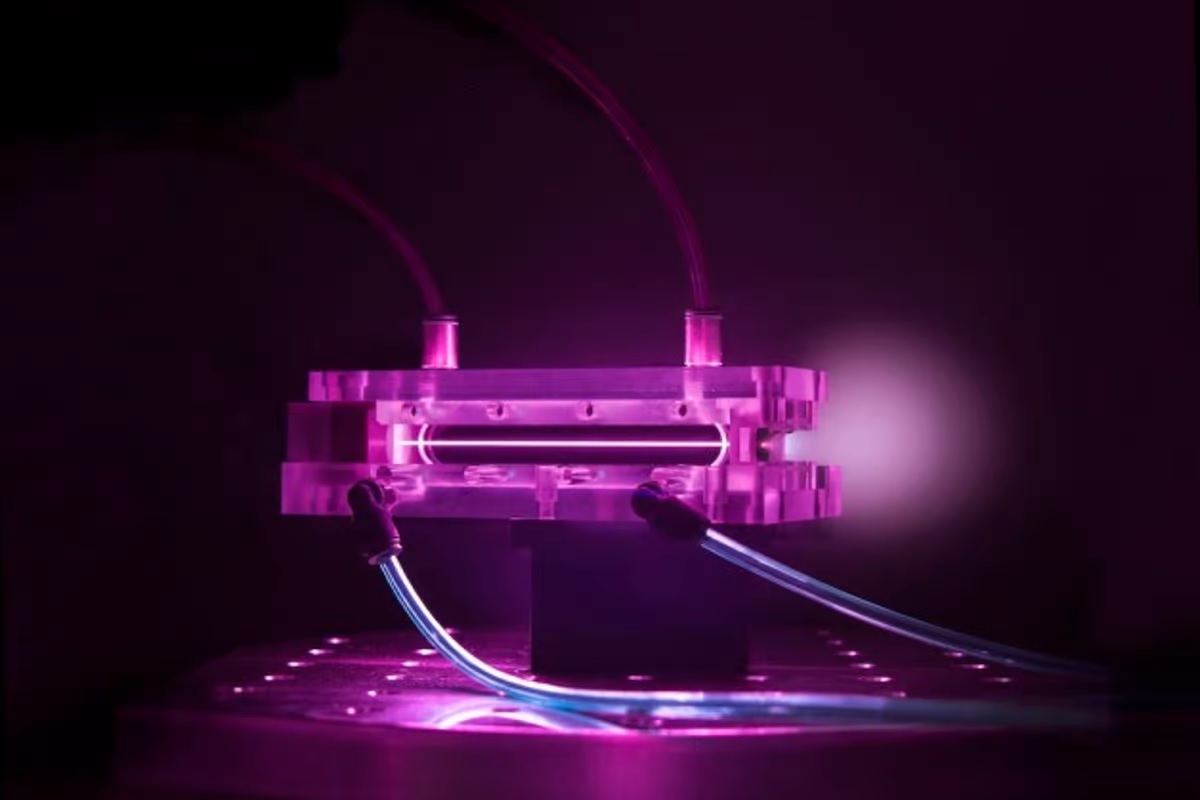
accelerator is known as a nanophotonic electron accelerator. Nanophotonic electron accelerator is the world smallest particle accelerator.
which is developed by researchers at the Friedrich-Alexander University of
Erlangen-Nuremberg (FAU) in Germany. It is so small that it can fit on a coin.
They can accelerate electrons to energies of up to 40.7 keV, which is enough to
penetrate thin materials.
It consists
of a small microchip that houses an even smaller vacuum tube made up of
thousands of individual "pillars." Researchers can accelerate
electrons by firing mini laser beams at these pillars. NEAs are much smaller and less expensive than traditional
particle accelerators, and they are also more efficient. According to the
National Nanotechnology Institute, the inside of the tiny tunnel is only
around 225 nanometers wide.
Nanophotonic electron accelerator tube is approximately 0.02 inch means (0.5
millimeter) long, which is 54 million times shorter than the 27 kilometers long
ring that makes up CERN Large Hadron Collider in Switzerland the world largest and most powerful
particle accelerator, which has discovered a range of new particles including
the Higgs boson or God particle, ghostly neutrinos, the charm meson and the
mysterious X particle.
The Large
Hadron Collider uses more than 9,000 magnets to create a magnetic field
that accelerates particles to around 99.9% of the speed of light. The Nanophotonic electron accelerator also
creates a magnetic field, but it works by firing light beams at the pillars in
the vacuum tube; this amplifies the energy in just the right way, but the
resulting energy field is much weaker.
The electrons accelerated by Nanophotonic electron accelerator
only have around a millionth of the energy that particles accelerated by the Large Hadron Collider have . Nanophotonic electron accelerator
are still in their early stages of
development, but they have the potential to revolutionize a wide range of
fields, including medicine, materials science, security, and electronics. The
researchers believe they can improve the NEA design by using alternative
materials or stacking multiple tubes next to one another, which could further
accelerate the particles. Still, they will never reach anywhere near the same
energy levels as the big colliders.
Here
are some potential applications of NEA:
- Medicine: NEA could be used to develop new cancer treatments
and medical imaging devices. For example, NEA could be used to
deliver targeted radiation therapy to tumors or to develop new types of
contrast agents for MRI scans
- Materials science: NEA could be used to study new materials
and develop new manufacturing processes. For example, NEA could
be used to study the properties of new materials or to develop new methods
for etching and depositing materials.
- Security: NEAs could be used to develop new security screening
and detection devices. For example, NEAs could be used to
develop new types of X-ray scanners or to detect explosives and other
hazardous materials.
- Electronics: NEAs could be used to develop new types of
electronic devices, such as faster and more energy-efficient
transistors.
NEAs
are a promising new technology with the potential to have a major impact on
society.
——— End of Article ———