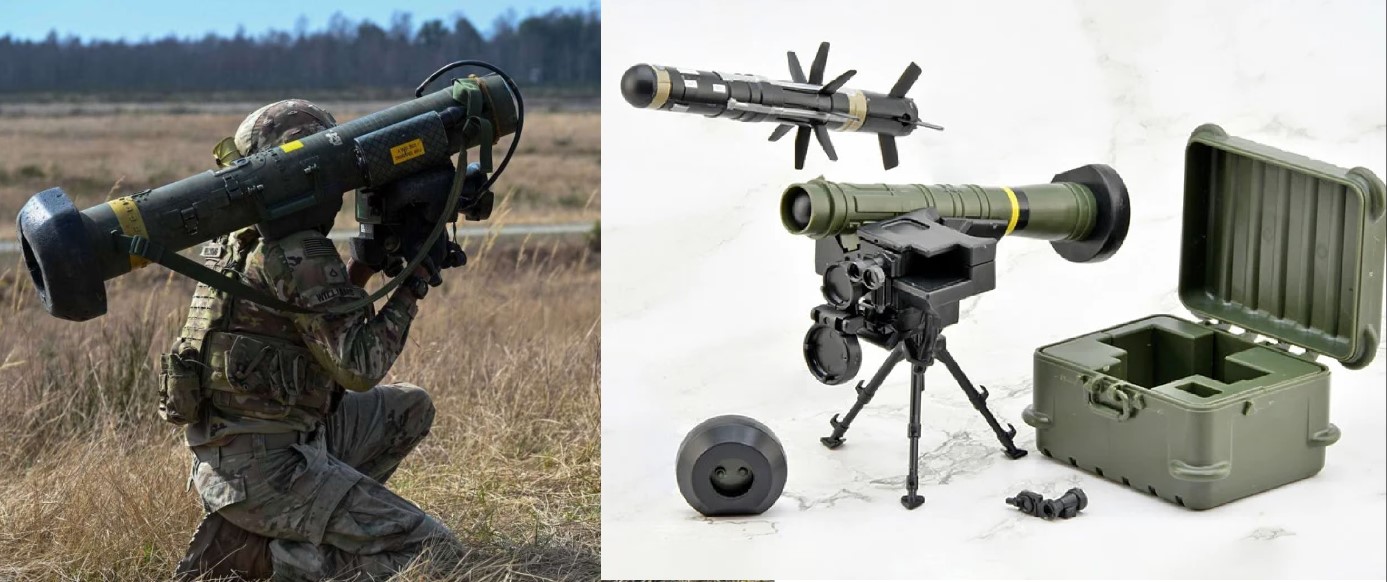
In a move that underscores the deepening strategic partnership between New Delhi and Washington, the U.S. State Department has approved a $45.7 million Foreign Military Sale of FGM-148 Javelin anti-tank missile systems to India. The decision, formally certified by the Defense Security Cooperation Agency (DSCA), was communicated to Congress as part of routine legislative notification.
The announcement comes at a time when India continues to strengthen its infantry firepower along sensitive borders, and the United States expands security ties with key Indo-Pacific partners.
A Package Designed for the Battlefield and Beyond
According to the DSCA notice, India has requested 100 Javelin missile rounds, a fly-to-buy missile, and 25 Lightweight Command Launch Units (LWCLU) — the updated launch system that enhances night-fighting capabilities and target acquisition.
But the sale extends far beyond missiles and launchers. The package includes simulation trainers, maintenance equipment, technical manuals, spare parts, coolant units, and full lifecycle support, ensuring India receives a complete operational ecosystem rather than isolated weapon components. U.S. officials emphasized that the support framework includes both government and contractor assistance, from logistics and engineering to ongoing program management.
For India, this means frontline units will receive not only the weapon but also the training modules, classroom systems, and command-launch interface familiarization needed for swift deployment.
What is fly-to-buy?
In defense procurement, fly-to-buy means:
-
The customer can test and evaluate the weapon in real conditions before committing to a full purchase.
-
It is like a trial purchase, used to check performance, reliability, and suitability.
-
If the missile meets expectations, the buyer can then place a larger order.
Inside the Javelin: What Makes It One of the World’s Most Feared Anti-Tank Weapons
The FGM-148 Javelin has become synonymous with modern anti-armor warfare. Compact enough to be carried by two soldiers yet powerful enough to strike through the upper armour of a main battle tank, its performance in multiple conflicts has made it one of the most respected systems in the world.
Engineers describe it as a fire-and-forget missile, powered by an infrared imaging seeker that tracks its target autonomously after launch. It uses a tandem high-explosive anti-tank warhead, designed to break through explosive reactive armor before penetrating the main hull.
The missile can strike targets at distances typically between 2.5 and 4 kilometres, depending on variant, and offers two distinct modes:
-
Top-attack, where it arcs upwards to hit the target where armour is weakest
-
Direct-attack, optimized for bunkers, fortifications, and light vehicles
Its Lightweight CLU gives operators high-resolution thermal imaging, allowing precise engagements during day, night, or adverse weather.
For Indian troops deployed in rugged mountain terrain, where mobility and survivability are critical, the Javelin’s portability and autonomous guidance offer a significant advantage over older wire-guided systems.
A Strategic Boost for India’s Infantry
The decision arrives at a time when India is placing increasing emphasis on modernizing its man-portable anti-tank capabilities. While indigenous systems are progressing, the Javelin provides an immediate, combat-proven solution for units operating in high-threat environments.
Defence analysts in New Delhi note that the missile’s precision and performance are particularly relevant to the Ladakh and Arunachal sectors, where armored deployments by regional adversaries remain a concern. The system’s ability to perform in extreme climates adds to its value for India’s high-altitude formations.
Washington’s Message: Strengthening Indo-Pacific Security
U.S. officials have framed the approval as part of a broader effort to reinforce the Indo-Pacific security architecture. The DSCA statement noted that the sale supports U.S. national security objectives by assisting “a major defence partner” and enabling India to better respond to “current and future threats.”
The agency also clarified that the sale would not alter the regional military balance, a standard assurance accompanying such approvals.
The Road Ahead
With the State Department’s approval delivered, Congress will now review the proposed sale. While this step is procedural, bipartisan support for deepening defence ties with India makes final clearance highly likely.
Once approved, production and delivery will proceed through the Javelin Joint Venture — a partnership between Raytheon and Lockheed Martin. Deliveries, along with phased training and support programs, are expected to begin within the next two to three years.
The $45.7 million Javelin missile package marks another significant milestone in the expanding U.S.–India defense partnership. Combining advanced weaponry, training systems, and long-term sustainment support, the deal strengthens India’s frontline infantry and provides a powerful deterrent against armored threats. At a geopolitical moment when Indo-Pacific security is in sharp focus, the agreement reflects a shared commitment to stability, capability, and preparedness.
——— End of Article ———