WASHINGTON — May 10, 2026 : The Defense Advanced Research Projects Agency (DARPA) is advancing plans for autonomous drone warfare networks through a new industry request focused on large-scale unmanned aircraft constellations and robotic containerized support systems designed for distributed military operations.
Through Request for Information (RFI) DARPA-SN-26-33, issued by the agency’s Tactical Technology Office, DARPA is seeking technical concepts for fully autonomous Group 1-3 unmanned aerial vehicle (UAV) systems and self-contained deployable drone hubs capable of operating with limited human involvement in contested environments.
The RFI was first published on SAM.gov on April 14, 2026, with updated notices issued as recently as May 8. Industry responses are required by May 15, 2026, at 4:00 p.m. Eastern Time.
Autonomous Drone Constellations
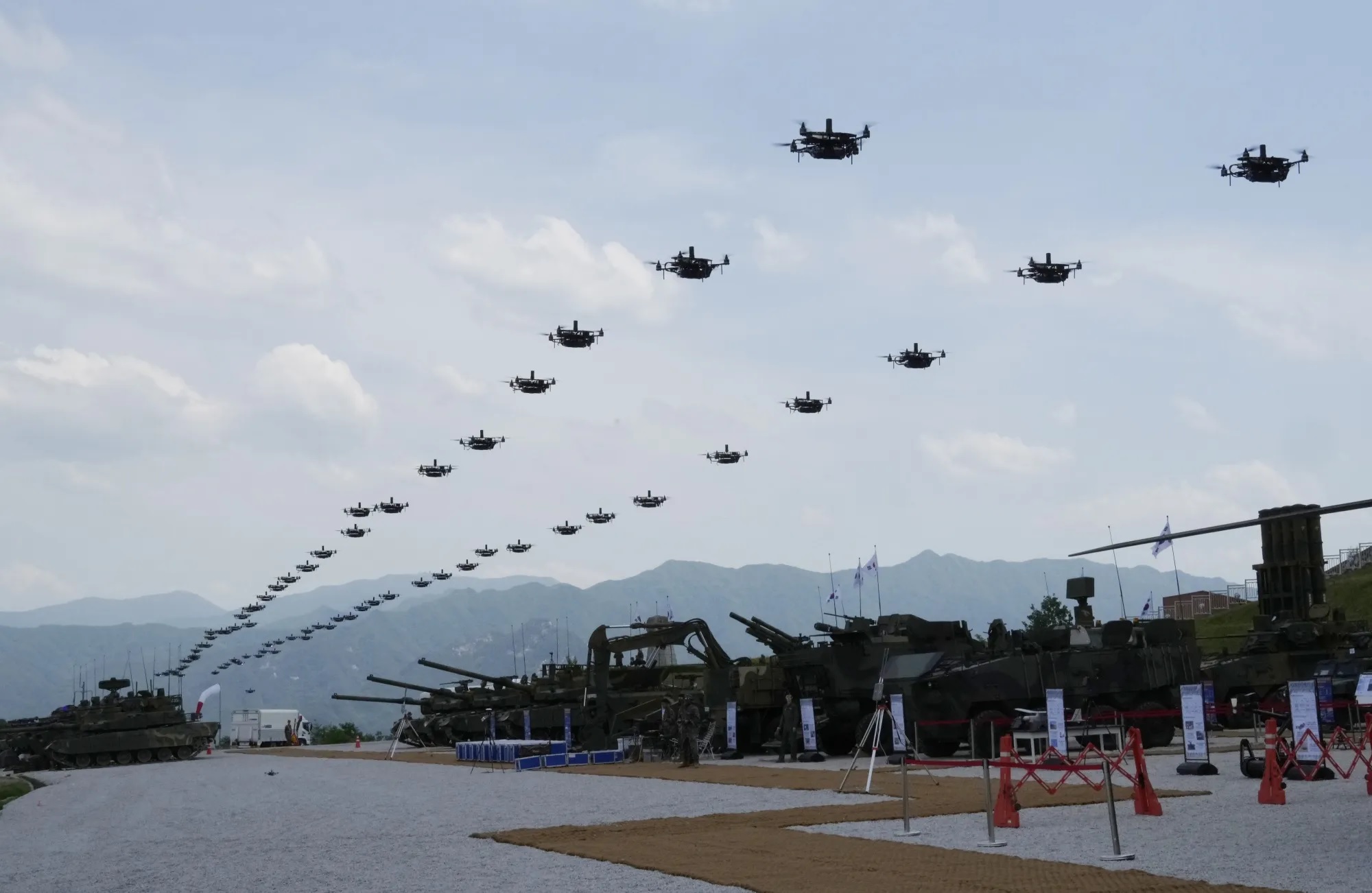
The effort centers on autonomous drone constellations consisting of up to 500 aircraft operating as coordinated networks capable of conducting reconnaissance, targeting, communications relay, electronic warfare, and strike missions.
DARPA stated that the systems must achieve Autonomy Level 4, where human operators are responsible primarily for mission definition while the drones independently manage launch, navigation, mission execution, formation control, collision avoidance, recovery, recharge or refuel cycles, and relaunch operations without continuous operator oversight.
According to the agency, current commercial Group 1-3 drone platforms remain limited by endurance, payload capacity, onboard power generation, and dependence on significant human infrastructure for deployment and recovery operations.
Under the RFI, DARPA is requesting systems capable of autonomous mission replanning, dynamic task allocation, formation reshaping, path optimization, edge-based computing, and collaborative multi-agent operations. The drones must also function in GPS-denied and contested electromagnetic environments using resilient navigation systems, spectrum-agile data links, low-probability-of-intercept communications, and onboard decision-making software designed to maintain operations during degraded connectivity.
The agency additionally requested engineering data related to size, weight, power, and cost (SWaP-C) metrics, including launch and recovery rates, recharge or refuel timelines, payload power generation, fuel handling requirements, and multi-day endurance capabilities.
Containerized Robotic Support Systems
A second component of the DARPA initiative focuses on robotic container systems designed to serve as autonomous drone operating hubs.
The containers are intended to manage aircraft storage, internal logistics, payload integration, pre-flight and post-flight diagnostics, launch and recovery operations, mission-data uploads, and recharge or refuel activities without large ground support crews.
DARPA specified that the systems should remain compatible with existing military transport infrastructure, including Conex containers, 463L pallets, Tricon modules, and ISU containers. The agency also stated that non-standard concepts, including compact box-based or suitcase-style systems compatible with military transport networks, would be considered.
Each deployable node is expected to incorporate onboard energy storage, environmental control systems, secure communications architecture, robotic handling systems, health monitoring capabilities, and fuel or battery management infrastructure.
Distributed Warfare Applications
The proposed architecture aligns with broader U.S. military concepts focused on distributed and survivable operations, including Joint All-Domain Command and Control (JADC2), Expeditionary Advanced Base Operations (EABO), distributed maritime operations, Mosaic Warfare, and attritable autonomous systems.
DARPA envisions the containerized hubs functioning as dispersed unmanned aviation detachments capable of generating persistent sortie rates from austere or contested locations without dependence on fixed air bases.
The concept is viewed as particularly applicable to Indo-Pacific operational environments, where anti-access and area-denial threats pose increasing risks to large centralized military installations.
Program Planning and Industry Input
DARPA stated that the RFI is intended for market research and future program planning purposes and does not constitute a formal solicitation for procurement.
Industry respondents are required to submit technical information using DARPA-specified templates limited to five pages per category. The agency indicated that U.S.-manufactured and assembled platforms are preferred.
DARPA has not assigned an official program name to the effort at this stage. Responses submitted under the RFI will remain with the agency and proprietary information must be clearly identified by participants.
——— End of Article ———