HYDERABAD, India — March 11, 2026 : Indian defense technology company Zen Technologies has detailed the architecture and operational capabilities of its Naval Anti-Drone System, a maritime counter-UAV solution designed for deployment on fast attack craft and patrol vessels operating in complex coastal and open-sea environments.
The system combines artificial intelligence-based detection, electronic warfare disruption, and kinetic interception capabilities into a compact defense architecture tailored for agile maritime platforms. According to the company, the system has been engineered specifically for vessels where space, weight, and stability constraints limit the integration of conventional large-scale air defense systems.
AI-Enabled Detection and Command Integration
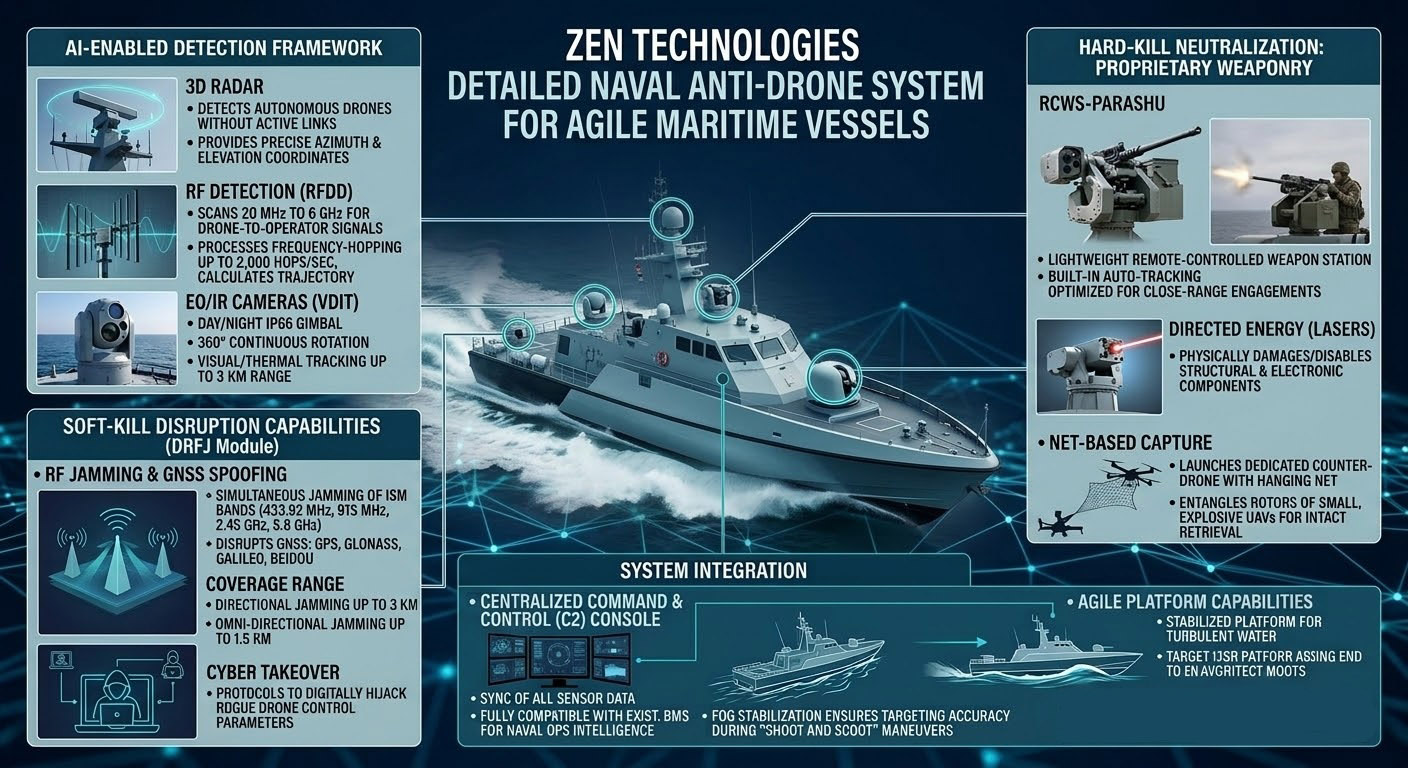
At the core of Zen Technologies Naval Anti-Drone System is an AI-enabled multi-sensor detection and tracking framework designed to identify and classify unmanned aerial vehicles (UAVs) in real time. Sensor data is processed and synchronized through a centralized Command and Control (C2) console, allowing operators to maintain continuous situational awareness of the surrounding airspace.
The command interface is compatible with existing naval battlefield management systems, enabling integration with wider maritime operational networks and intelligence feeds.
The detection architecture incorporates three primary subsystems:
3D Radar Surveillance : The radar component uses an X-band 2D/3D radar configuration capable of detecting and tracking small aerial objects, including autonomous drones operating without active communication signals. The radar system provides spatial positioning information including azimuth, range, and elevation, allowing early identification of incoming UAV threats.
Because it operates independently of radio-frequency communication links, the radar module is designed to detect drones that rely on pre-programmed flight paths or autonomous navigation.
Radio Frequency Detection and Direction Finding : The Radio Frequency Detection and Direction Finding (RFDD) module scans electromagnetic spectrum bands between 20 MHz and 6 GHz, identifying drone control links and telemetry signals transmitted between UAVs and their operators.
The system is designed to process complex frequency-hopping communication signals at speeds of up to 2,000 hops per second, enabling it to identify modern encrypted or adaptive drone control networks. By analyzing these signals, the RFDD module calculates the direction of arrival and predicts the trajectory of incoming UAV threats.
Electro-Optical and Infrared Tracking : Visual confirmation and target tracking are performed by a combined Electro-Optical/Infrared camera module known as VDIT. The camera system supports both daylight and thermal imaging and carries an IP66 environmental rating, allowing continuous operation in maritime weather conditions.
Mounted on a stabilized platform, the camera system provides 360-degree continuous rotation and maintains target tracking at distances of up to 3 kilometers, enabling operators to visually confirm radar and RF-detected targets.
Electronic Warfare and Soft-Kill Countermeasures
Once a drone threat is confirmed, Zen Technologies Naval Anti-Drone System can employ electronic disruption techniques to neutralize the UAV without physical destruction.
This capability is provided by the Drone RF Jammer (DRFJ) module, which performs targeted electromagnetic interference against drone control and navigation systems.
RF Jamming and GNSS Signal Disruption : The DRFJ module simultaneously disrupts the most commonly used drone communication frequencies, including the industrial, scientific, and medical (ISM) bands at 433.92 MHz, 915 MHz, 2.45 GHz, and 5.8 GHz.
In addition to communication jamming, the system interferes with satellite navigation signals from major Global Navigation Satellite Systems (GNSS), including:
- GPS (United States)
- GLONASS (Russia)
- GALILEO (European Union)
- BEIDOU (China)
By interfering with positioning signals and control links simultaneously, the system can cause hostile drones to lose navigation stability, alter course, or enter fail-safe landing modes.
Jamming Coverage : The electronic warfare module provides 360-degree azimuth coverage and 70-degree elevation coverage around the host vessel.
Directional jamming can be applied to targets at distances of up to 3 kilometers, while omnidirectional disruption covers a range of approximately 1.5 kilometers.
Cyber Takeover Capability : In addition to jamming, the system incorporates digital exploitation protocols designed to take control of a hostile drone’s command interface. Through this cyber takeover mechanism, operators can override external commands and assume control of the UAV’s flight parameters.
This capability allows forces to redirect or safely land captured drones, enabling intelligence analysis or forensic examination of recovered systems.
Hard-Kill Neutralization Systems
If electronic countermeasures are insufficient or if the drone carries explosive payloads requiring immediate neutralization, Zen Technologies Naval Anti-Drone System integrates multiple kinetic interception methods.
RCWS-Parashu Remote Weapon Station : One of the primary hard-kill options is the RCWS-Parashu, a lightweight remote-controlled weapon station developed by Zen Technologies.
The system supports 7.62 mm or 5.56 mm caliber smart ammunition and includes automated target tracking algorithms optimized for engaging small aerial targets at close ranges. Operators control the system remotely through the C2 console, reducing crew exposure during engagements.
Directed Energy Laser System : Zen Technologies Naval Anti-Drone System also integrates directed-energy laser weapons capable of damaging drone airframes or disabling onboard electronics. Laser engagement provides a precise interception method that does not rely on conventional ammunition.
Directed energy systems are particularly suited for countering small UAVs due to their rapid response time and low collateral risk.
Net-Based Capture Mechanism : For certain threat scenarios, Zen Technologies Naval Anti-Drone System deploys a dedicated counter-drone equipped with a suspended net system.
The interceptor UAV approaches the hostile drone and releases the net, which entangles the target’s propellers and causes it to lose lift. This method allows the drone to be captured intact, enabling intelligence recovery while neutralizing potential explosive payloads.
Stabilized Operations on High-Speed Maritime Platforms
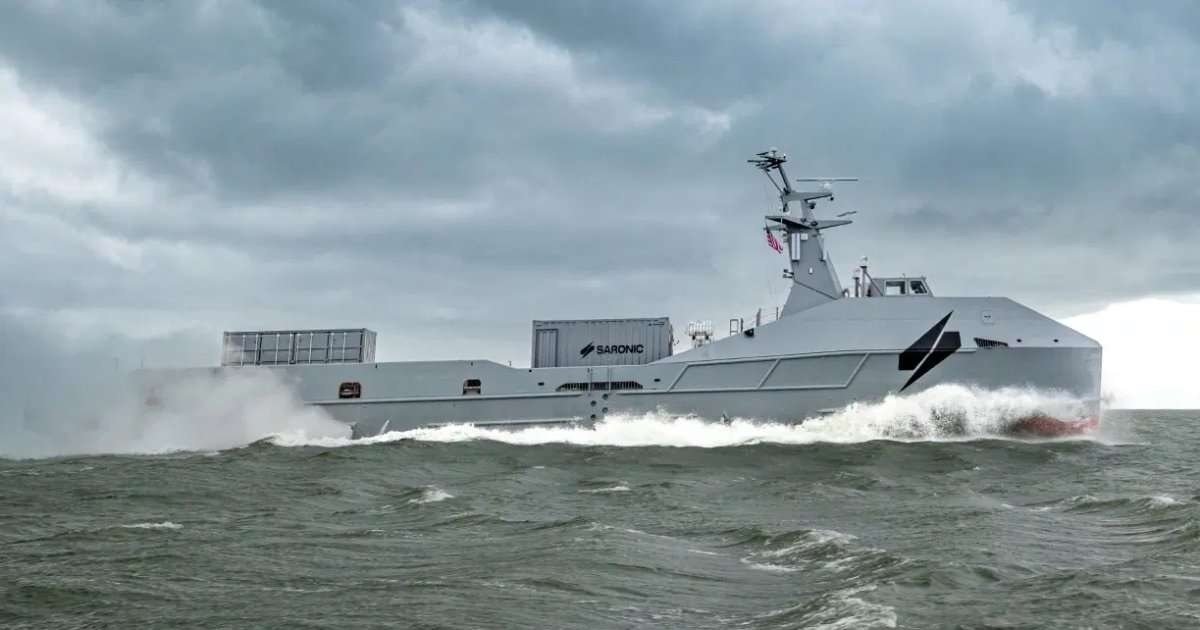
The system has been designed specifically for installation on fast attack craft, patrol boats, and other agile maritime vessels where space and weight limitations restrict the deployment of larger air defense systems.
Because small vessels experience significant motion in open water, Zen Technologies integrated Fiber Optic Gyro (FOG) stabilization across the system’s optical sensors and hard-kill weapon platforms.
FOG stabilization compensates for vessel pitch, roll, and yaw, ensuring that the radar, cameras, and weapon systems maintain targeting accuracy during high-speed maneuvers or rough sea conditions.
According to the company, the system’s detection, tracking, and interception capabilities remain operational whether the vessel is stationary or conducting rapid maneuvering operations.
System Role in Maritime Drone Defense
The increasing use of small unmanned aerial systems in maritime conflict environments has created new protection requirements for naval vessels, particularly smaller patrol and coastal security craft that traditionally operate without integrated air defense systems.
By combining sensor fusion, electronic warfare disruption, and multiple interception methods within a compact platform, Zen Technologies Naval Anti-Drone System is designed to provide layered protection against reconnaissance drones, loitering munitions, and small explosive-laden UAVs.
Zen Technologies stated that the architecture allows modular upgrades as drone technologies evolve, enabling additional sensors or countermeasure modules to be integrated into the system in the future.
——— End of Article ———