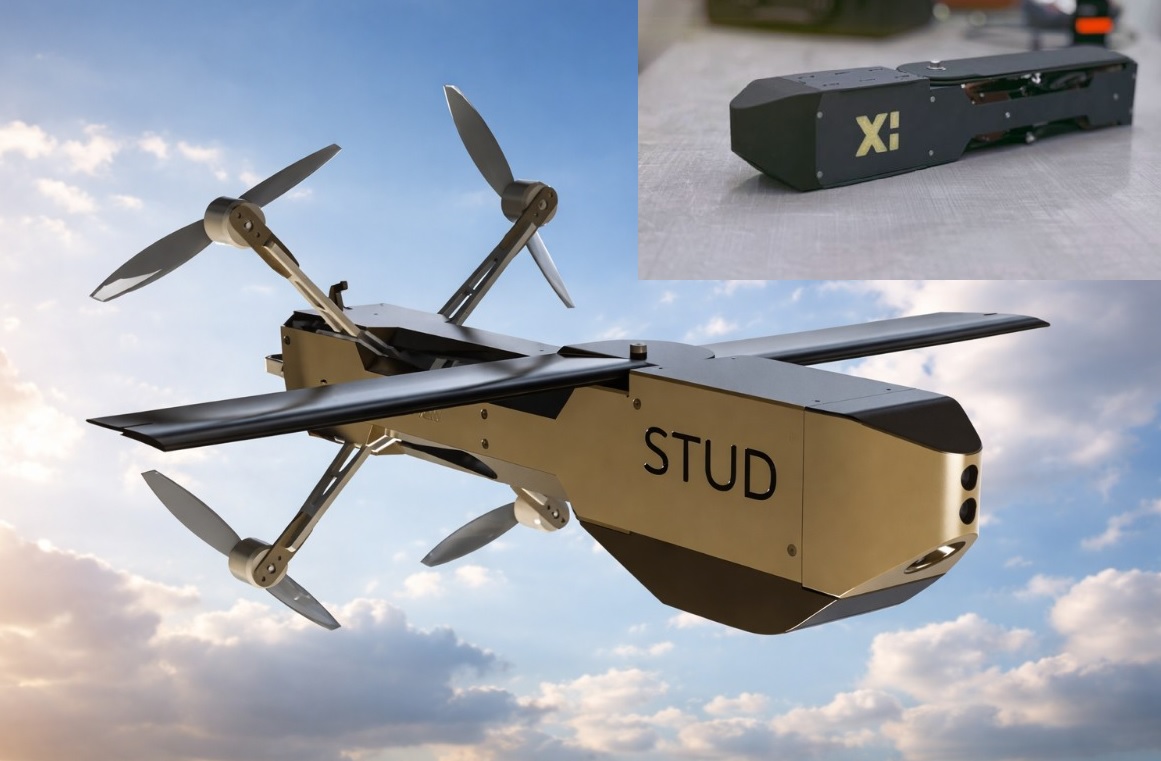
LOS ANGELES, — April 4, 2026 : U.S.-based defense startup XDOWN has formally unveiled the STUD (Small Tactical Unmanned Drone), a compact, rapidly deployable unmanned aerial system (UAS) designed for integration into frontline infantry units. The system is positioned as an attritable, multi-role platform intended to provide organic air support at the squad level without reliance on larger, centralized unmanned assets.
The announcement was made by XDOWN founder and chief executive Alexander Balan, alongside the release of prototype imagery and testing footage. The STUD builds on the company’s earlier PSK (P.S. Killer) concept introduced in early 2025, further refining the approach to portable, soldier-operated unmanned systems.
Rapid Deployment and Infantry Integration
A central feature of the STUD is its “throw-and-forget” launch mechanism, eliminating the need for dedicated launch equipment. According to the company, the system can transition from a stowed state to active flight in approximately two seconds. After being powered on, the drone is thrown into the air, where onboard rotors automatically engage to stabilize and initiate controlled flight.
XDOWN states that the system has been engineered for high-density portability. A single operator can carry between 8 and 12 units within a standard tactical backpack using a quick-release interceptor configuration. This approach reflects a broader shift toward distributing unmanned capabilities directly to small units, reducing dependence on traditional ammunition loads and centralized drone operators.
Technical Specifications and Performance
The STUD features a reinforced carbon fiber structure with a compact, aerodynamic design approximately the size of an American football. Despite its reduced form factor, the system incorporates performance characteristics typically associated with larger tactical drones.
-
Dimensions: 17.5 inches (length) × 3.1 inches (width) × 3.1 inches (depth)
-
Weight: 5.2 pounds total (1.7 pounds empty; payload capacity up to 1.7 pounds)
-
Top Speed: 165 knots (approximately 190 mph / 305 km/h)
-
Operational Range: 40 miles (approximately 64 kilometers)
-
Endurance: 17 minutes (standard configuration), extendable to 25 minutes
-
Radar Signature: Ultra-low radar cross-section (RCS)
The combination of speed, range, and reduced radar detectability is intended to support operations in contested environments where survivability and rapid response are critical.
Multi-Mission Capability and Modular Payloads
XDOWN has developed the STUD as a modular platform capable of supporting multiple mission profiles through interchangeable payload configurations. Company materials identify the following primary operational roles:
-
Intelligence, Surveillance, and Reconnaissance (ISR): Equipped with thermal imaging systems and advanced sensors for real-time battlefield awareness
-
Precision Strike: Configured as a loitering munition for engagement of armored vehicles and high-value targets (HVTs)
-
Counter-Unmanned Aerial Systems (C-UAS): Designed to intercept and neutralize hostile drones using kinetic impact or serial ramming techniques
-
Electronic Warfare (EW): Capable of disrupting communications and sensor networks
-
Anti-Personnel and Anti-Armor Operations: Adaptable payloads for engaging infantry, unmanned ground vehicles (CUGV), and unmanned surface vessels (CUSV)
The system’s dual-use architecture allows units to tailor payloads based on mission requirements without altering the core platform.
Manufacturing Plans and Program Status
XDOWN has outlined a production target of up to 6,000 units per month, indicating an emphasis on scalable manufacturing and cost reduction. The company describes the STUD as an attritable asset, meaning it is intended to be deployed in high-risk scenarios without the expectation of recovery, thereby reducing logistical constraints compared to reusable systems.
The platform is reported to be compliant with the U.S. National Defense Authorization Act (NDAA), aligning it with procurement standards for U.S. and allied military forces.
Prototype testing is ongoing, with the company indicating that additional details regarding payload configurations, pricing, and operational partnerships will be disclosed in the coming weeks. No information on unit cost or confirmed customers has been released at this stage.
Operational Context
The introduction of the STUD reflects a broader trend in modern military doctrine toward decentralizing unmanned capabilities and integrating them directly into small-unit operations. By combining rapid deployment, modular functionality, and scalable production, systems such as the STUD are intended to expand the tactical options available to infantry units operating in complex and contested environments.
——— End of Article ———