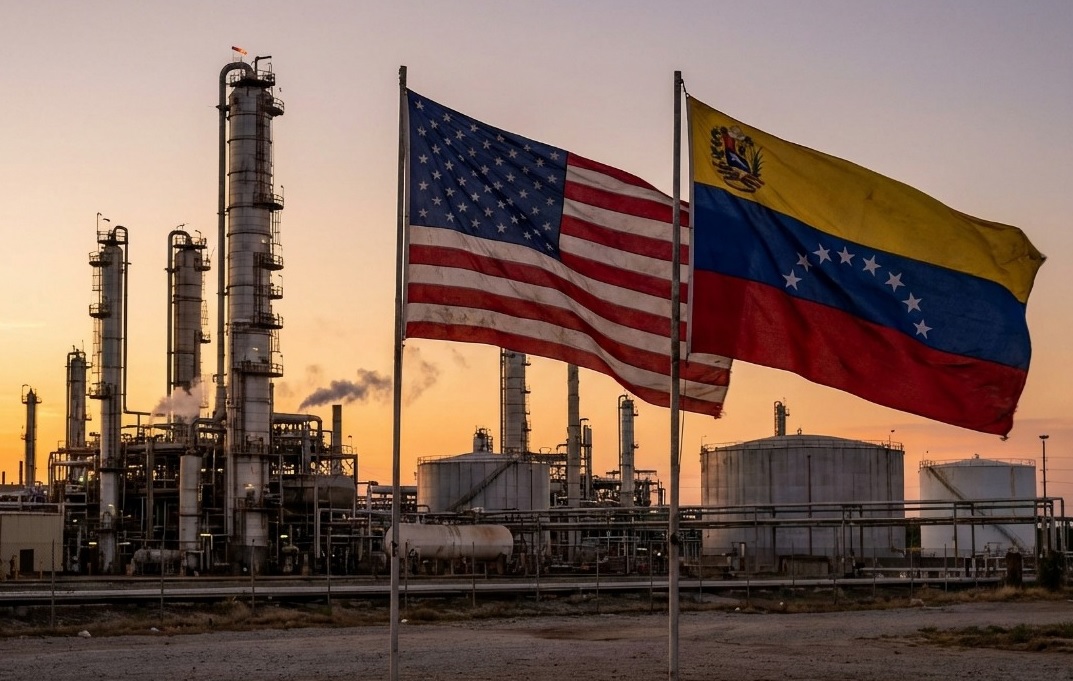
Washington / Caracas : The United States has completed the transfer of the full $500 million generated from the initial U.S.-authorized sale of Venezuelan oil, returning the final $200 million tranche to Venezuela this week, according to a U.S. official familiar with the matter. The transfer concludes the first major financial transaction under a new energy and financial framework established between Washington and Caracas following the January 3 U.S. military operation that resulted in the capture of Venezuelan President Nicolás Maduro.
The official, speaking on condition of anonymity, confirmed that Venezuela has now officially received all $500 million from the first oil sale. An earlier $300 million was released in late January, with the remaining $200 million transferred this week, completing the disbursement.
Purpose of the Transfer
U.S. officials said the primary reason for returning the funds was to prevent the collapse of the Venezuelan state and ensure continuity of basic government functions during a volatile transition period. While the revenue was generated from Venezuelan oil, it was managed under U.S. oversight to ensure its use for public benefit purposes.
During recent testimony before Congress, U.S. Secretary of State Marco Rubio said the arrangement was intended as a short-term stabilization measure, not a long-term economic solution.
Rubio told lawmakers that allowing Venezuela to access revenue from its own oil was necessary to pay public sector salaries, including teachers, firefighters, and police officers, and to keep core government services operating. He said failing to do so risked systemic collapse, which could have led to economic disintegration, mass migration, and regional instability.
Oversight and Use of Funds
U.S. officials emphasized that the funds were not released without conditions. According to the official, the $500 million is to be disbursed “for the benefit of the Venezuelan people” and remains subject to U.S. discretion over how and when it is spent.
Under the arrangement, Venezuelan authorities must submit detailed spending plans, with disbursements tied to specific public, governmental, or diplomatic obligations. The stated objective is to ensure the funds support essential services and administrative functions.
Temporary Holding in Qatar
Before being transferred, the oil revenues were held in a temporary account in Qatar. U.S. officials described the account as a short-term mechanism designed to ensure Venezuela had access to operational funds while the post-Maduro administrative framework was being organized.
The official said the arrangement also protected the money from legal claims, international creditors, and competing claims during the transition period.
Long-Term Financial Framework
U.S. officials said the Qatar-based arrangement is not permanent. The long-term plan is to move proceeds from future Venezuelan oil sales into a dedicated fund located in the United States.
Under this framework, expenditures would be authorized only for approved obligations or expenses of the Venezuelan government and its agencies, in line with agreed procedures. U.S. authorities would retain approval authority to ensure spending aligns with stabilization and reconstruction priorities.
Rubio has indicated that additional oil sales could generate several billion dollars in the coming months if production and exports continue under the new framework.
Context of the Deal
The oil sale followed a deal reached last month between Washington and Caracas, shortly after the January 3 military operation. It marked the first U.S.-authorized Venezuelan oil sale in years and reflected a shift from broad sanctions enforcement toward a managed, conditional engagement aimed at maintaining state functionality.
U.S. officials have described the arrangement as transitional and limited, stressing that it does not represent full normalization of relations, but rather a temporary stabilization effort during a period of political and economic uncertainty.
With the full $500 million now transferred, attention is focused on how the funds will be used and whether the U.S.-managed framework for future oil revenues will be formally established in the United States as planned.
——— End of Article ———