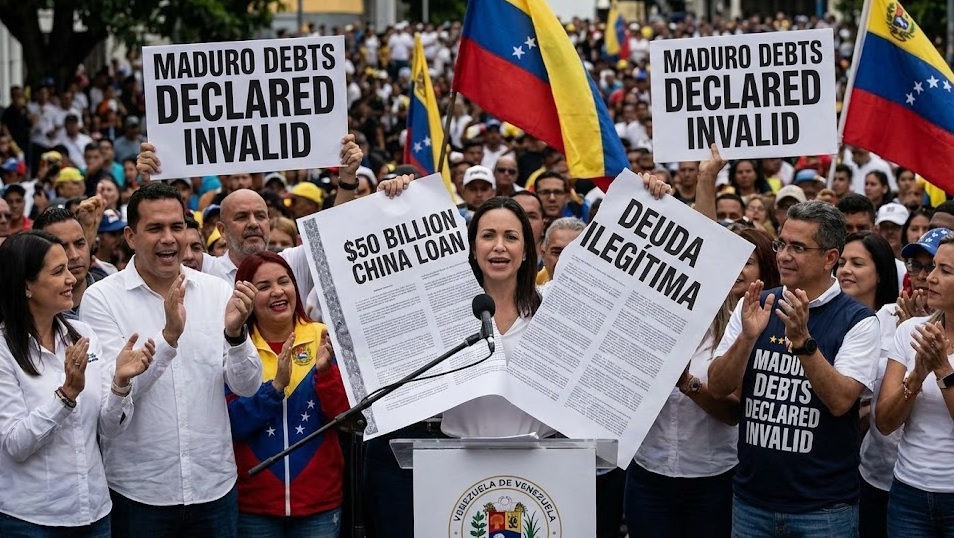
CARACAS : Venezuela’s new government on Tuesday formally repudiated billions of dollars in sovereign debt owed to China and Russia, declaring the obligations “odious” and legally void in one of the most dramatic economic and geopolitical reversals in the country’s modern history.
In a nationally televised address from the Miraflores Palace, President María Corina Machado announced that her administration would no longer recognize loans contracted under former president Nicolás Maduro, whose rule she described as an “illegitimate criminal regime.” The decision immediately halts oil shipments used to service those debts and signals a fundamental realignment of Venezuela’s foreign and economic policy away from Beijing and Moscow.
“The Venezuelan people will not be forced to repay the chains that bound them,” Machado said, standing alongside her newly appointed economic cabinet. “These loans were signed in secrecy, used to entrench repression, and never served the nation. They are null and void.”
A Doctrine of “Odious Debt”
At the core of the decree is the legal concept of “odious debt,” a doctrine in international law holding that obligations incurred by a dictatorship, without the consent of the people and used against their interests, should not be enforceable against a successor government.
Machado’s administration argues that the bulk of Venezuela’s borrowing from China and Russia meets that standard. Officials said the contracts were never approved by the National Assembly, violated constitutional oversight requirements, and were structured to prop up the Maduro government rather than invest in public welfare or productive development.
A senior finance ministry official, speaking on condition of anonymity, said the decree would be defended in international courts if challenged. “We are prepared for a long legal fight,” the official said. “But legitimacy is on our side.”
China’s Oil-Backed Loans in Limbo
China is the largest single creditor affected by the decision. Beginning in 2007, Beijing extended vast oil-backed loans to Caracas through the China Development Bank and other state lenders, tying repayment to long-term shipments of Venezuelan crude.
Over nearly two decades, China committed an estimated $60 billion under these arrangements. While much of the debt was repaid through oil deliveries during periods of high global prices, analysts estimate that between $15 billion and $19 billion remains outstanding.
Under the new decree, all oil-for-debt shipments to China are suspended with immediate effect. Venezuelan officials said every barrel of crude exported from now on would be sold for cash on international markets, with revenues directed toward stabilizing public finances and funding domestic recovery.
“These contracts drained the country while hiding the true cost from the public,” Machado said. “From today, Venezuelan oil will be sold transparently and for the benefit of Venezuelans.”
China’s Foreign Ministry responded swiftly, condemning the move as a “serious breach of international trust” and warning of “grave commercial consequences.” While no specific retaliatory steps were announced, Chinese state media framed the decision as a threat to the credibility of sovereign lending.
Russia’s Military-Focused Claims Rejected
The decree also targets Russia, which emerged as Caracas’s lender of last resort as Venezuela became increasingly isolated from Western financial markets. Russian financing, estimated at roughly $17 billion, was channeled through a mix of state-to-state loans, military contracts, and energy deals involving state oil giant Rosneft.
Machado singled out the military component of that debt, which includes purchases of Sukhoi fighter jets, S-300 air defense systems, and armored vehicles. “We will not repay the cost of weapons used to terrorize our own citizens,” she said.
The new government also announced plans to reclaim oil assets and joint-venture shares transferred to Russian entities as collateral during the Maduro years. Officials described those transfers as “fraudulent privatizations conducted under duress.”
The Kremlin has not issued a formal response, but Russian analysts quoted by state media warned that asset seizures could trigger international arbitration and further strain bilateral relations.
Immediate Economic Impact
Economically, the decision is designed to deliver immediate relief to a country battered by hyperinflation, collapsing infrastructure, and mass emigration.
According to government estimates, debt service to China and Russia consumed nearly 40 percent of Venezuela’s oil exports, equivalent to roughly 400,000 barrels per day. By ending those obligations, the government expects to free up billions of dollars annually in hard-currency revenue.
Machado emphasized that the repudiation does not extend to all creditors. Debts held by Western bondholders, multilateral institutions, and U.S. companies operating in Venezuela will be honored, she said, with a promise of “good-faith restructuring” and renewed legal protections.
That distinction effectively divides Venezuela’s creditors into two camps: those considered legitimate partners and those accused of underwriting authoritarian rule.
Global Repercussions
The move is being closely watched in global capitals, particularly in Beijing, where it raises uncomfortable questions about China’s Belt and Road Initiative and its practice of lending to resource-rich autocracies.
If Venezuela’s repudiation holds, it could encourage future governments emerging from regime change to challenge similar loans, potentially exposing Chinese banks to heightened political and legal risk. Several analysts described the Venezuelan case as a test precedent for how far the odious debt doctrine can be pushed in the modern global financial system.
For now, the billions invested by China and Russia in the Maduro-era Venezuelan state appear increasingly unlikely to be recovered. As one Latin America analyst put it, “This is what geopolitical lending looks like when the regime you backed collapses.”
For Venezuela, the gamble is clear. Machado is betting that breaking with illegitimate obligations will unlock economic recovery, restore international credibility, and accelerate reintegration into global markets. Whether investors, courts, and foreign governments ultimately agree may determine the success of her most consequential decision to date.
——— End of Article ———