Caracas / Washington : Venezuelan soldiers and security personnel loyal to President Nicolás Maduro have described a harrowing encounter with what they believe was a U.S. directed-energy or sonic weapon during a covert special operations raid, an incident that allegedly left troops bleeding internally, vomiting blood and physically unable to move.
The claims, first reported by the New York Post, center on a secret operation in which a small, technologically advanced U.S. unit reportedly attempted to capture the Venezuelan leader. Although the United States has neither confirmed nor denied the operation, the vivid and technically consistent testimonies have triggered renewed scrutiny of classified acoustic and directed-energy weapons.
Radar Blackout, Drone Swarms and a Small Assault Force
According to a Venezuelan security guard interviewed about the operation, the attack began without warning. Radar systems and electronic surveillance reportedly shut down simultaneously, leaving defenders blind.
“We didn’t hear anything coming,” the guard said. “We were on alert, but suddenly all our radar systems shut down without any explanation.”
Moments later, a large number of drones appeared over Venezuelan positions, followed by approximately eight helicopters. From those aircraft, the guard estimated around twenty soldiers deployed — a remarkably small force compared with the hundreds of Venezuelan troops present at the site.
Despite their numerical disadvantage, the attackers were described as “technologically very advanced,” moving and firing with extraordinary speed and accuracy. The guard claimed each operator appeared capable of firing up to 300 rounds per minute, overwhelming defenders before they could mount an effective response.
“It Felt Like My Head Was Exploding From the Inside”
The most disturbing accounts emerged when soldiers described the moment a previously unseen weapon was activated.
“At one point, they launched something; I don’t know how to describe it,” the guard said. “It was like a very intense sound wave. Suddenly I felt like my head was exploding from the inside.”
Multiple soldiers reported immediate and severe physical reactions. Nosebleeds began almost instantly. Several said they started vomiting blood. Others collapsed to the ground, unable to stand, walk or even maintain balance.
“We all started bleeding from the nose,” another soldier recalled. “Some were vomiting blood. We fell to the ground, unable to move. We couldn’t even stand up after that sonic weapon, or whatever it was.”
The soldiers insisted the assault team suffered no casualties, while Venezuelan forces sustained hundreds of deaths, an outcome they attributed not only to gunfire but to the incapacitating effects of the unknown weapon.
Analysis: Infrasonic Pulse and Resonance Effects
Weapons specialists examining the accounts say the symptoms align closely with exposure to a high-powered infrasonic or shockwave-based directed-energy system.
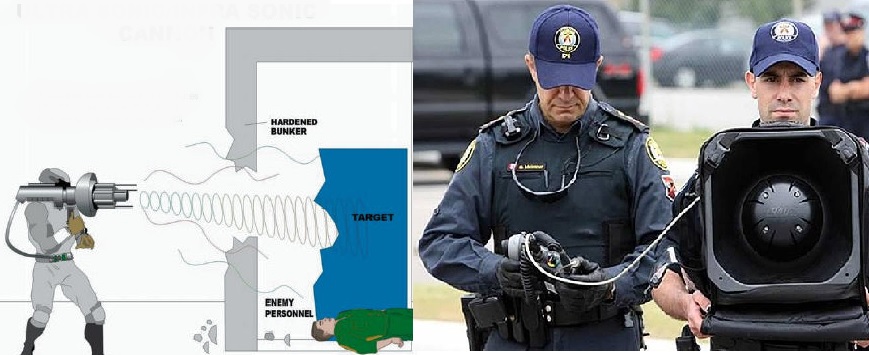
Infrasound consists of low-frequency sound waves below 20 hertz, far beneath the range of human hearing. Unlike conventional sound, infrasound does not primarily affect the eardrum. Instead, it vibrates the gases and liquids inside the human body, passing through walls, armor and tissue with minimal energy loss.
Medical research shows that every human organ has a natural resonant frequency. The human skull and brain resonate between 70 and 80 hertz, while the eyes resonate around 18 hertz. Lower frequencies in the 4–8 hertz range can align with the resonant frequencies of the lungs and stomach.
If a weapon projects extremely high-decibel waves — estimated at 170 decibels or higher — at or near these frequencies, organs can be forced into violent oscillation. This resonance can produce the sensation of internal pressure or expansion, explaining soldiers’ descriptions of their heads “exploding” from the inside.
Why Soldiers Were Bleeding and Vomiting Blood
The reported nosebleeds, known medically as epistaxis, indicate barotrauma — injury caused by sudden pressure changes. High-intensity acoustic waves generate rapid pressure fluctuations similar to a blast wave, rupturing delicate capillaries in the nasal cavity and sinuses almost instantly.
More alarming are reports of vomiting blood, which suggest internal hemorrhaging. Low-frequency acoustic energy can cause lung tissue to slam repeatedly against the rib cage, leading to pulmonary contusions or micro-tears. Similar forces acting on the stomach lining can result in gastrointestinal bleeding.
Soldiers also described being unable to stand or move, a classic symptom of severe vestibular disruption. The inner ear’s fluid-filled balance system is highly sensitive to pressure and vibration. Intense acoustic exposure can induce extreme vertigo, rendering victims temporarily or permanently incapacitated without visible external injuries.
Analysis of Potential Technologies Behind Alleged Acoustic Attacks
While the accounts from Venezuelan security personnel remain unverified, defense analysts note that the described effects correlate with specific technologies currently present in U.S. and allied military research programs. The alleged weapon likely draws upon principles found in three distinct categories of existing systems.
1. Long Range Acoustic Device (LRAD)
The LRAD is an established system currently deployed by the U.S. Navy and domestic law enforcement.
-
Capabilities: It projects a highly focused beam of sound, capable of delivering intense, piercing noise over significant distances.
-
Limitations: Standard models are designed for communication, crowd control, and pain compliance. They are not engineered to cause internal organ damage or hemorrhaging.
-
Assessment: Analysts suggest that if an LRAD-based system was used, it would represent a highly militarized, lethal evolution of the technology that far exceeds publicly acknowledged capabilities.
2. "Thunder Generator" Shockwave Systems
The technology most closely aligned with the reported physical injuries is the experimental "Thunder Generator," developed in U.S. and Israeli defense programs.
-
Mechanism: Unlike traditional acoustic weapons, these devices generate rapid, repetitive shockwaves that create the sensation of being struck by a physical wall of compressed air.
-
Physical Effects: The sustained air-pressure impacts can cause barotrauma (pressure injuries), internal bleeding, and loss of balance without the use of explosives.
-
Assessment: This mechanism closely matches the specific reports of nosebleeds, internal hemorrhaging, and sudden incapacitation described by the soldiers.
Based on the combination of symptoms—auditory distress, cranial pressure, and internal trauma—specialists suggest the alleged weapon is likely not a single known system. Instead, it appears to be a hybrid or advanced form of shockwave-based directed-energy technology. This hypothetical system would combine acoustic pressure, resonance effects, and air-compression forces to achieve the reported lethality.
Regional Impact and Strategic Warning
Beyond the immediate allegations, the incident has reportedly sent shockwaves across Latin America, prompting renewed discussion among regional governments and security analysts about the evolving nature of U.S. military capabilities and emerging forms of warfare.
Venezuelan security personnel involved in the incident said the operation has altered perceptions of modern conflict, particularly the role of advanced technologies that can incapacitate forces without prolonged engagements or conventional large-scale troop deployments.
Officials in Venezuela have not released a detailed public assessment of the alleged operation, and Washington has remained silent on the claims. Nonetheless, the accounts have intensified debate over the quiet militarization of directed-energy technologies and the increasingly blurred line between so-called non-lethal systems and weapons capable of causing severe or potentially fatal injuries.
If accurate, the alleged raid would represent one of the clearest reported battlefield uses of such technology to date, underscoring a broader shift in modern warfare — away from visible firepower and toward invisible forces that act directly on the human body, often leaving little immediate physical evidence.
——— End of Article ———