MANILA, Philippines, June 23, 2026 — The Philippine Navy has officially inducted four Ocean Aero Triton Autonomous Underwater and Surface Vehicles (AUSVs) through a United States-funded security assistance program aimed at enhancing maritime domain awareness and surveillance capabilities.
The transfer, valued at approximately US$13 million (PHP 754 million), was formalized during a handover ceremony held on June 22 at Naval Operating Base Subic Bay in Zambales. The systems will be operated by the Philippine Navy’s Unmanned Surface Vessel Unit One to support maritime monitoring and territorial defense missions.
The turnover ceremony was attended by U.S. Embassy Chargé d’Affaires ad interim Bridgette Walker and Senior Defense Official and Defense Attaché Col. Daniel Oh, representing the United States. The systems were received by Philippine Fleet Commander Rear Adm. Joe Anthony Cabahug-Orbe and Unmanned Surface Vessel Unit Acting Commander Lt. Cmdr. Aldwin Pasicolan.
Ocean Aero Triton Capabilities
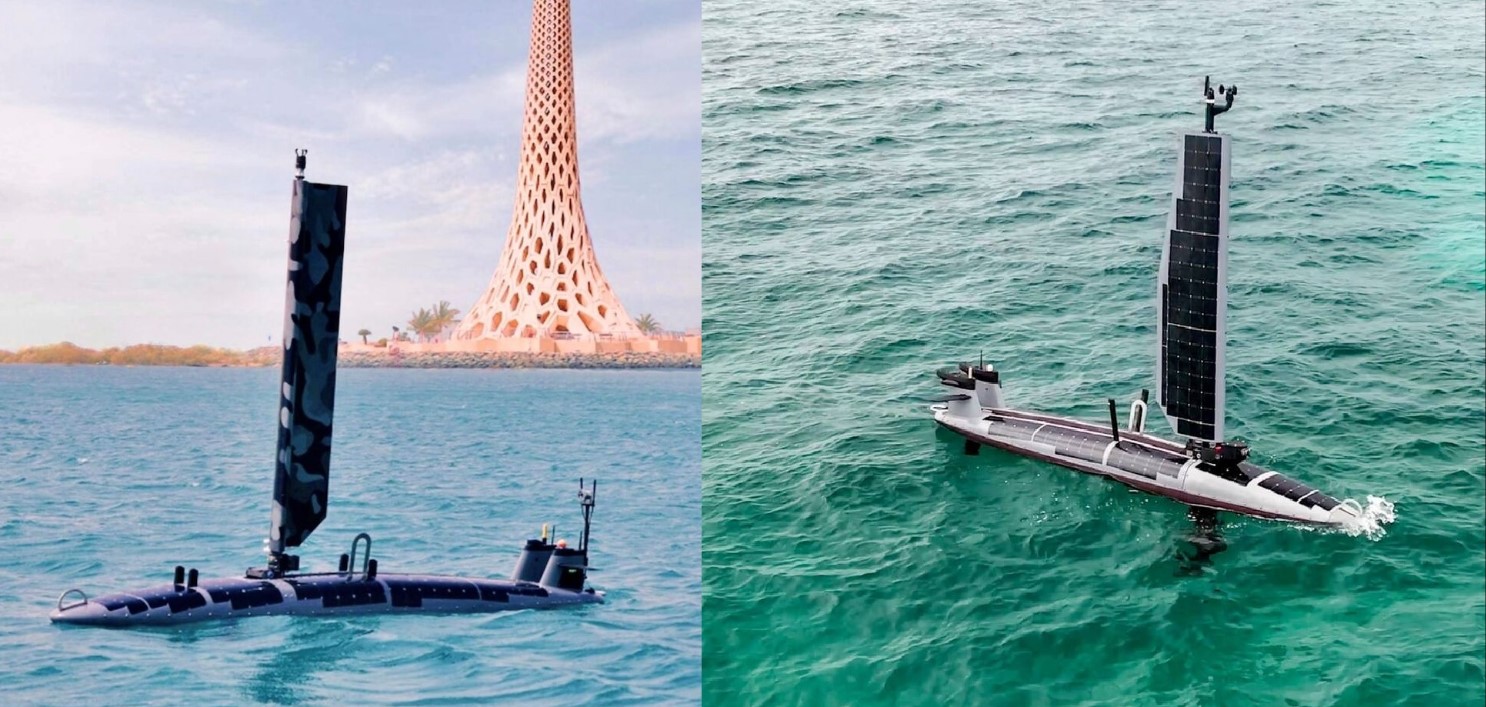
The Ocean Aero Triton is a dual-modality Autonomous Underwater and Surface Vehicle capable of operating both on the surface and underwater. Powered by wind and solar energy, the platform is designed for long-endurance maritime surveillance operations while maintaining a low logistical footprint.
Key specifications include:
- Surface endurance of more than 30 days using wind propulsion and 740-watt solar panels
- Subsurface endurance of over 5 days powered by 13.2 kWh onboard batteries
- Length of 14.5 feet (4.4 meters) and weight of approximately 775 pounds (350 kilograms)
- Maximum speed of 5 knots on the surface and 2 knots underwater
- Payload capacity of up to 50 pounds (22.7 kilograms) for modular sensors and mission equipment
The vehicles can carry side-scan sonar, passive acoustic sensors, intelligence-gathering equipment, and other surveillance payloads. They are capable of supporting intelligence, surveillance and reconnaissance (ISR), maritime domain awareness, anti-submarine warfare support, and mine countermeasure operations.
The Tritons can be deployed from forward operating bases, remote islands such as the Batanes Island Group, standard boat ramps, or small vessels. Their low radar and visual signature, combined with underwater operating capability, enables discreet monitoring of maritime areas, surface vessels, and underwater infrastructure. The systems are equipped with 360-degree cameras, side-scan sonar, radio mesh networking, and satellite communications for data transmission to command centers.
Strengthening Maritime Surveillance
The acquisition supports the Armed Forces of the Philippines (AFP) efforts to improve surveillance coverage across its archipelagic waters, Exclusive Economic Zone (EEZ), and strategically important areas including the Spratly Islands and Scarborough Shoal.
According to the U.S. Embassy, the Tritons will assist in monitoring illegal fishing activities, threats to freedom of navigation, and gray-zone maritime activities. Their long-endurance autonomous operation allows continuous collection and transmission of intelligence without exposing personnel to operational risks.
Expanding the Philippine Navy's Unmanned Fleet
The Ocean Aero Tritons join other unmanned maritime systems already operated by the Philippine Navy's Unmanned Surface Vessel Unit One. The unit currently operates four MARTAC Mantis T-12 unmanned surface vessels and at least one Devil Ray T-38, which were also provided through U.S. security assistance programs.
The addition of the Triton systems expands the Philippine Navy's layered maritime surveillance architecture, enhancing its ability to monitor territorial waters, critical sea lanes, and maritime activities across a broad operational area.
The transfer forms part of ongoing U.S.-Philippines defense cooperation and supports the modernization of the Philippine Navy's unmanned maritime capabilities.
——— End of Article ———