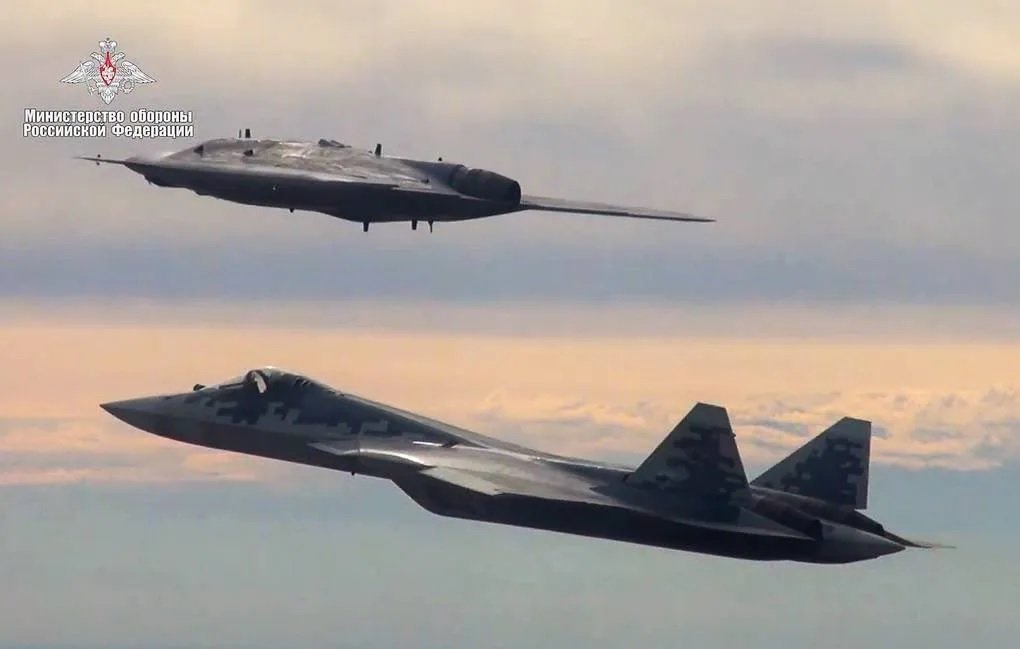
MOSCOW, Russia — Russia plans to use its new two-seat Su-57D as a testbed for technologies being developed for future sixth-generation fighter aircraft, including unmanned-aircraft control and combat artificial intelligence.
Mikhail Strelets, chief designer at Sukhoi, said the second cockpit will allow an operator to control unmanned aerial vehicles, particularly the S-70 Okhotnik. The additional crew member could manage unmanned systems while the pilot focuses on flying and combat tasks. Russian officials have also described the two-seat aircraft as having combat, training and tactical-control roles.
Russian two-seat Su-57D to serve as a testbed for sixth-generation fighter technologies
— H. Memarian (@HEMemarian) August 14, 2026
Its second cockpit will allow one pilot to control UAV such as the S-70 Okhotnik. Su-57D will also be used to test combat artificial intelligence according to chief designer Sergey Strelets. pic.twitter.com/9DdnpKwqDN
The Su-57D is based on an early T-50-4 flight prototype, aircraft 054. It began taxi tests on May 16, 2026, and completed its first flight on May 19, lasting about 40 minutes. Sukhoi test pilot Sergey Bogdan conducted the flight.
The aircraft is also being used to test combat artificial intelligence developed by Sukhoi specialists. The work is intended to examine how AI and autonomous decision-making systems can be integrated into the aircraft and the unmanned systems operating under its control.
The Su-57D builds on earlier Russian tests involving the Su-57 and S-70 Okhotnik. The two-seat configuration provides a dedicated crew station for managing unmanned aircraft and processing mission information.
Strelets has not disclosed details of Russia's planned sixth-generation fighter. He has previously described future combat aviation as a system involving manned, optionally manned and unmanned platforms connected through advanced information and control systems.
Su-57 upgrades continue
Russia is continuing to improve the existing Su-57 while developing these future technologies. In February 2026, UAC announced delivery of another batch of Su-57s equipped with modernized onboard systems and an updated weapons suite. Specific details of those upgrades were not released.
Russia is also testing new engines. In December 2025, the T-50-2 prototype, aircraft 052, flew with the new Product 177 engine. The engine is being developed for the Su-57, Su-30 and Su-35 and has a declared afterburning thrust of 16,000 kgf, along with claimed reductions in fuel consumption and an increase in service life.
Development of the Su-57's second-stage Product 30 engine is also continuing.
The same T-50-2 prototype was observed in December 2024 testing a flat engine nozzle. The purpose of those tests has not been fully disclosed. Russia had previously considered a flat nozzle for the S-70 Okhotnik, although test aircraft were seen with conventional round nozzles.
Alongside the Su-57, Russia is developing the Su-75 Checkmate as a lighter fighter intended to complement its heavier aircraft. In June 2026, UAC CEO Vadim Badekha said construction of the first flight prototype was underway.
The Su-57D therefore provides Russia with an existing aircraft platform for testing technologies involving manned-unmanned teaming, AI-assisted combat operations and control of unmanned aircraft, while development of future fighter programmes continues. Detailed specifications of a Russian sixth-generation fighter have not yet been publicly disclosed.
——— End of Article ———