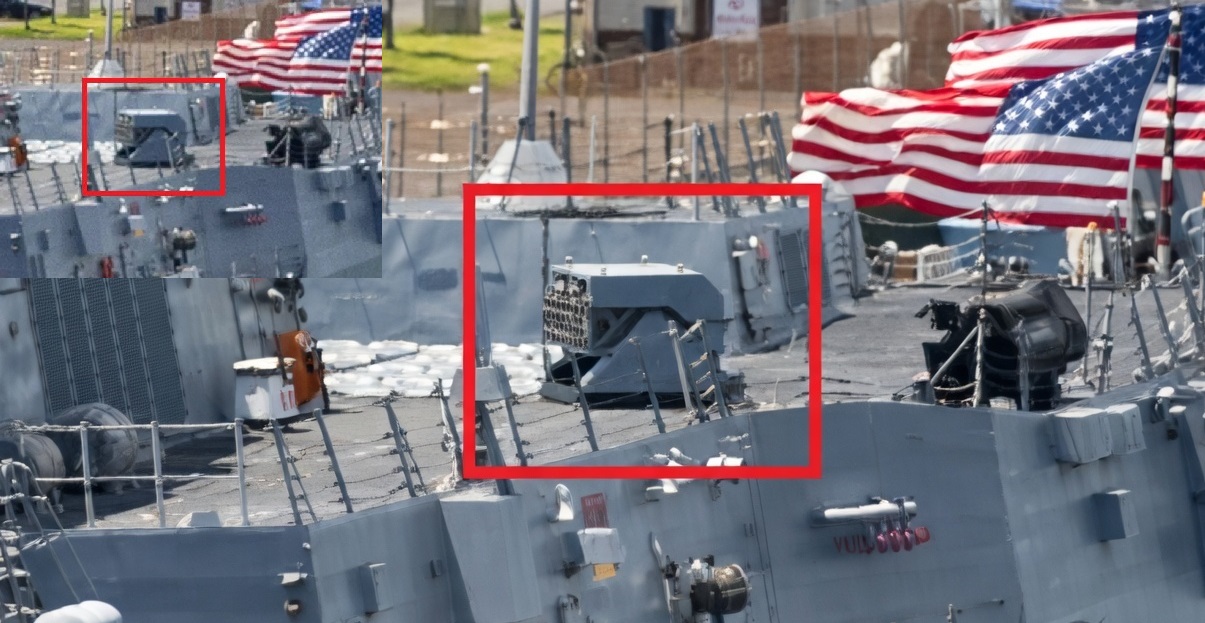
PEARL HARBOR, Hawaii, — April 12, 2026 : A previously unrecognized launcher system has been installed on the U.S. Navy USS Carl M. Levin (DDG-120), an Arleigh Burke-class guided-missile destroyer, according to open-source imagery and defense analysis. The system was first observed in a U.S. Marine Corps photograph taken on March 29, 2026, while the ship was at its homeport in Pearl Harbor, Hawaii. The image was publicly released on April 8, 2026.
System Location and Physical Characteristics
The launcher is mounted on the aft upper deck of the vessel, positioned between the port-side torpedo tubes and the rear Mk 41 Vertical Launch System (VLS) array, near the stern section of the superstructure. Visual assessment indicates a multi-cell configuration mounted on a circular base, suggesting the system may have a traversing or rotating capability.
While it is not definitively confirmed whether the launcher is fixed or fully trainable, its structure appears designed to elevate for firing. The system was not visible in photographs of the ship taken as recently as December 2025, indicating a relatively recent installation.
The external design does not fully correspond with any launcher currently documented in widespread operational use aboard Arleigh Burke-class destroyers.
Possible System Identification and Roles
Defense analysts have proposed several possible identifications based on visual similarities and prior Navy integration concepts.
One possibility is that the launcher is related to the White Spike counter-drone interceptor developed by Zone 5 Technologies. The White Spike system is a modular, multi-domain interceptor designed primarily for counter-unmanned aerial system (C-UAS) missions. Publicly available configurations show a four-cell launcher with a trapezoidal front profile. Although the unit observed aboard USS Carl M. Levin differs in some details, it shares notable structural similarities that could indicate a modified or navalized variant.
Another potential configuration involves the AGM-179 Joint Air-to-Ground Missile (JAGM), developed by Lockheed Martin. Lockheed Martin has previously proposed multi-cell JAGM launch modules for installation on Arleigh Burke-class destroyers in similar aft-deck positions. The JAGM, derived from the AGM-114 Hellfire family, incorporates dual-mode guidance combining millimeter-wave radar and infrared or semi-active laser targeting. Originally designed for engaging surface targets, it has also been evaluated for counter-drone and counter–fast attack craft roles, offering multi-domain engagement capability.
A third possibility is that the launcher supports deployment of non-kinetic or auxiliary payloads, including decoys, electronic warfare systems, or small unmanned platforms. The U.S. Navy has been exploring containerized launch solutions capable of deploying off-board countermeasures to confuse or divert incoming threats such as anti-ship missiles.
Broader Operational Context
The installation aligns with ongoing U.S. Navy efforts to enhance close-in defensive capabilities against emerging threats, particularly unmanned aerial systems and drone swarms. Current naval air defense often relies on high-cost interceptors, creating an unfavorable cost-exchange ratio when engaging low-cost drones.
In 2025, similar aft-deck launcher installations were observed on other Arleigh Burke-class destroyers, including the USS Bainbridge (DDG-96) and the USS Winston S. Churchill (DDG-81). Those ships were fitted with launchers for Coyote counter-drone interceptors, reflecting a broader push to integrate lower-cost, scalable defensive systems across the fleet.
The addition of a compact launcher on USS Carl M. Levin suggests continued evaluation of diverse solutions to address capability gaps in layered maritime defense.
Platform Background and Capabilities
USS Carl M. Levin is a Flight IIA Technology Insertion variant of the Arleigh Burke class. The destroyer is equipped with a 96-cell Mk 41 Vertical Launch System, two triple torpedo tubes, a 5-inch naval gun, and a range of advanced sensors and combat systems.
The newly observed launcher adds a supplementary capability layer within the ship’s close-in defense zone without replacing or displacing existing systems. Such modular additions allow for rapid experimentation and integration of emerging technologies.
Open-Source Reporting and Official Status
The launcher was first highlighted by open-source analysts, including the Japanese-language blog OSINFO, based on the March 29 imagery. Additional reporting by defense publication The War Zone also noted the system’s presence.
As of April 12, 2026, the U.S. Navy has not issued any official statement confirming the launcher’s identity, operational role, or technical specifications. The system’s exact purpose and the type of munitions it is designed to deploy remain unconfirmed.
The development is consistent with ongoing Navy initiatives to incorporate cost-effective counter-unmanned systems and adaptable payload launchers to address evolving threats in contested maritime environments.
——— End of Article ———